
Certifications do not get you hired. They remove reasons to reject you. That is the honest way to think about them. A localization employer is trying to answer one question: can this person be trusted with a deliverable that reaches a client? A certification can support that answer, but it can never replace it. This guide maps the certifications that exist, what each one actually certifies, which ones carry weight with which kind of employer, and how to decide whether the cost is worth it for the work you want.
We will be precise about one distinction that most lists blur: some certifications are awarded to people, and some are awarded to organisations. Confusing the two is the single most common mistake candidates make when they talk about their credentials in an interview.
In This Article
- 1. The Four Families of Certification
- 2. Standards and Process Certifications (Organisations)
- 3. Professional Body Certifications (Individuals)
- 4. Academic Qualifications
- 5. Tool and AI Certifications
- 6. Who Each Certification Is For
- 7. What Employers Actually Value
- 8. Our Titles, and the Certificates That Earn Their Reputation
- 9. How to Choose the Right One
- 10. Cost and Return, Without the Sales Pitch
- 11. A Shortlist by Goal
- 12. The Limits of Any Certification
- Frequently Asked Questions
1. The Four Families of Certification
Almost everything sold as a "localization certification" falls into one of four groups. They are not interchangeable, they are not bought from the same places, and they are not read the same way by an employer.
| Family | Awarded to | What it proves | Typical examples |
|---|---|---|---|
| Standards and process | The organisation | That a company runs a defined translation process with qualified people and revision | ISO 17100, ISO 18587, ISO 9001, ISO 27001 |
| Professional bodies | The individual | That a translator or interpreter has passed a competence assessment or met a membership standard | ATA certification, CIOL qualifications, ITI membership grades |
| Academic | The individual | That a person completed a structured programme in translation or a related field | MA or MSc in Translation, postgraduate diplomas, PhD |
| Tool and AI | The individual, usually | That a person can operate a specific platform, or has completed training in a specific method | CAT tool badges, vendor academies, AI quality programmes |
If you are a freelance translator, three of these four families are relevant to you directly. If you run a language service provider, two of them are, and the standards family becomes the one that wins contracts.
2. Standards and Process Certifications (Organisations)
These are the certifications most often misunderstood, because a translator will say "I am ISO 17100 certified" when in fact the standard is not awarded to a person at all.
2.1. ISO 17100
The core international standard for translation services. It sets out what a translation service provider must do to deliver a professional result: use translators with the right competences, have the work revised by a second competent person, manage the project and the workflow, handle terminology and quality assurance, and keep records of the whole chain. ISO 17100 applies to the service provider, not to an individual translator, which is why "ISO 17100 certified" is a statement about a company, not a CV line.
It is the successor to the earlier European standard EN 15038, so you will still see the old name in tender documents and older contracts. When an end client asks a vendor to be "ISO 17100 certified", what they are really buying is a documented process and a guarantee of revision.
2.2. ISO 18587
The companion standard for full machine translation post-editing. It specifies requirements for the post-editing process and the competences of the post-editors, which makes it the standards-family answer to the AI question. If you work with machine output and you are asked which framework governs it, this is the standard to name.
2.3. The wider family
ISO 9001 (general quality management) and ISO 27001 (information security) are not translation standards, but language service providers often hold them because enterprise buyers, legal clients and healthcare clients require them. They say something about how the company runs, not about linguistic quality.
The practical point for a candidate: process certifications become relevant when you are selling to an organisation, or applying to work inside one that is certified. They matter far less when you are applying for a freelance seat on a vendor panel, where the reviewer is looking at your sample and your tooling.
3. Professional Body Certifications (Individuals)
This is the family that actually lands on a CV. These are awarded to individuals, usually after an assessment, and they are the closest thing the profession has to a recognised competence mark.
3.1. ATA certification
The American Translators Association certifies individual translators through an examination in a specific language pair and direction. This is the detail that matters: ATA certification is pair-specific. Being certified English into Spanish says nothing about your Japanese, and the certification has to be maintained over time through continuing education. For the US market, and for translators working into or out of English with US clients, it is the most recognisable individual mark.
3.2. CIOL qualifications and Chartered Linguist status
The Chartered Institute of Linguists (CIOL) is a UK professional body. It offers its own qualifications, among them the Diploma in Translation, widely known as DipTrans, and the Certificate in Translation, alongside a range of language and interpreting qualifications. CIOL also confers Chartered Linguist status, which is a professional standing rather than a single exam. For the UK market, and for anyone working with British institutions, these are the names that carry weight.
3.3. ITI membership and assessment
The Institute of Translation and Interpreting (ITI) is the other main UK body. It works through membership grades rather than a single certification, with levels such as Associate, Member and Fellow, and it runs an assessment route for experienced translators who want to qualify for the higher grades without a formal translation degree. Membership is also a directory listing, which matters because some clients search directories rather than job boards.
3.4. National and other bodies
Most countries have an equivalent body, and in many markets the local association is more recognised than an international one. The rule is the same everywhere: check whether the body you are considering is the one your target clients actually know, and check whether membership or certification is what they ask for, because they are different things.
4. Academic Qualifications
Strictly speaking these are qualifications, not certifications, but they belong in the same conversation because employers treat them as one bucket during screening. An MA or MSc in Translation or Translation Studies, a postgraduate diploma, or a doctorate is evidence of structured, supervised training in theory, terminology, research and often a specialism. For in-house roles, for public sector work and for markets where a degree is a legal requirement for certain titles, they can be the deciding factor.
What an academic qualification does not do is prove production speed, tool fluency or commercial judgement. Many graduates discover this in their first test task. The degree opens the door; the sample decides whether you walk through it. If you already hold a translation degree, your effort is better spent on a domain and a tool stack than on a second certificate that repeats the first signal.
5. Tool and AI Certifications
The newest and fastest-moving family. These certify that you can operate a specific platform, or that you have completed training in a specific method. They are cheap, they are quick, and they are read literally by the employers who use the same tools.
5.1. CAT and TMS badges
Tool vendors and their ecosystems run certification and badged-training programmes. The names you will meet in postings include Trados Studio from RWS, memoQ, Phrase, Crowdin, XTM and others. A badge proves familiarity with that environment, which is genuinely useful when the employer has standardised on it. The honest limit: a badge in a tool you will never be given says nothing about your linguistic quality, and a strong translator can learn a new TMS quickly.
5.2. AI and quality certifications
The market has moved fast here, and the certifications that matter most are the ones tied to a defensible method rather than a single tool: how to evaluate machine output, how to run quality measurement, how to decide what a model should never touch. This is the gap that our own AI Quality Specialist certification addresses, taking a post-editor from editing machine output to owning the quality of an AI-assisted pipeline, and it sits beside the deeper quality track in AI-Powered Localization Quality.
Treat the AI family with a filter. A certificate from a named vendor about that vendor's own product is a tool badge. A certificate about a method is closer to a professional qualification, and it keeps its value even when the model underneath it is replaced.
6. Who Each Certification Is For
The families above answer what a certification is. The next question is who should hold it, because the same credential can be essential for one kind of buyer and irrelevant for another. Read the table by the row that describes you, not by the credential you happen to have heard about.
| Credential | Best for | Less useful for | What it unlocks |
|---|---|---|---|
| ISO 17100 (organisation) | LSPs, in-house localization departments, vendor managers | Freelancers applying for a single seat | Tenders, enterprise contracts, a documented process with revision |
| ISO 18587 (organisation) | Teams that deliver full machine translation post-editing | Sellers of human-only translation | A formal framework for MT post-editing and post-editor competence |
| ISO 9001 and ISO 27001 | Companies selling to enterprise, legal, healthcare and public buyers | Individual practitioners | Procurement and security clearance, not linguistic quality |
| ATA certification | Individual translators working into or out of English with US clients | Anyone outside the certified language pair | A recognised, pair-specific individual competence mark |
| CIOL and ITI | Individual translators and interpreters working with UK clients and institutions | Non-UK markets | Professional standing, directory listings, assessment routes |
| MA, MSc or PhD | Individuals targeting in-house, public sector or research roles | Freelancers with a strong portfolio already | Shortlisting where a degree is a requirement |
| CAT and TMS badges | Individuals and teams standardised on one environment | Buyers who do not use that tool | Fast proof of tool fluency |
| Method certifications (MQM, AI quality) | Individuals moving into LQA, AI quality and quality leadership | Anyone staying in pure translation delivery | A repeatable method, not a tool licence |
Seen by buyer, the logic is simple. Companies and LSPs buy the standards family, because those are the credentials that appear in tenders and procurement. Individual professionals buy the professional body and method credentials, because those are the ones a reviewer reads on a CV or a profile. Teams need the tool badges and the method certifications, so that everyone applies the same model in the same environment. And freelancers should pay only for a credential that appears in the postings and panels they actually target.
7. What Employers Actually Value
Across the certifications above, the same five things decide whether you are read as a professional. A certification helps only when it is evidence for one of them.
- Domain evidence. A certificate in a method plus no domain is weaker than a domain plus a portfolio. Employers want to know which sectors you can defend: medical, legal, gaming, software, finance.
- Process ownership. Can you describe running work from brief to delivery, including terminology setup and quality check? A process standard like ISO 17100 gives you the vocabulary for this, even though it certifies a company.
- Tool fluency. Postings keep naming CAT tools and TMS. A badge is the cheapest way to prove you have used the environment the employer runs.
- Quality reasoning. The ability to talk about error categories and severity rather than personal taste. This is what turns "it reads well" into a professional answer, and it is the ground the Evaluating Translation Through MQM course covers.
- Communication. The most requested skill in language job postings, and the one no certificate can grant.
Where a certification genuinely changes an outcome, it is usually one of three situations: a tender that names a standard, a directory that requires a professional body membership, or a screening filter that lists a tool the client uses. In every other case, the sample does the work.
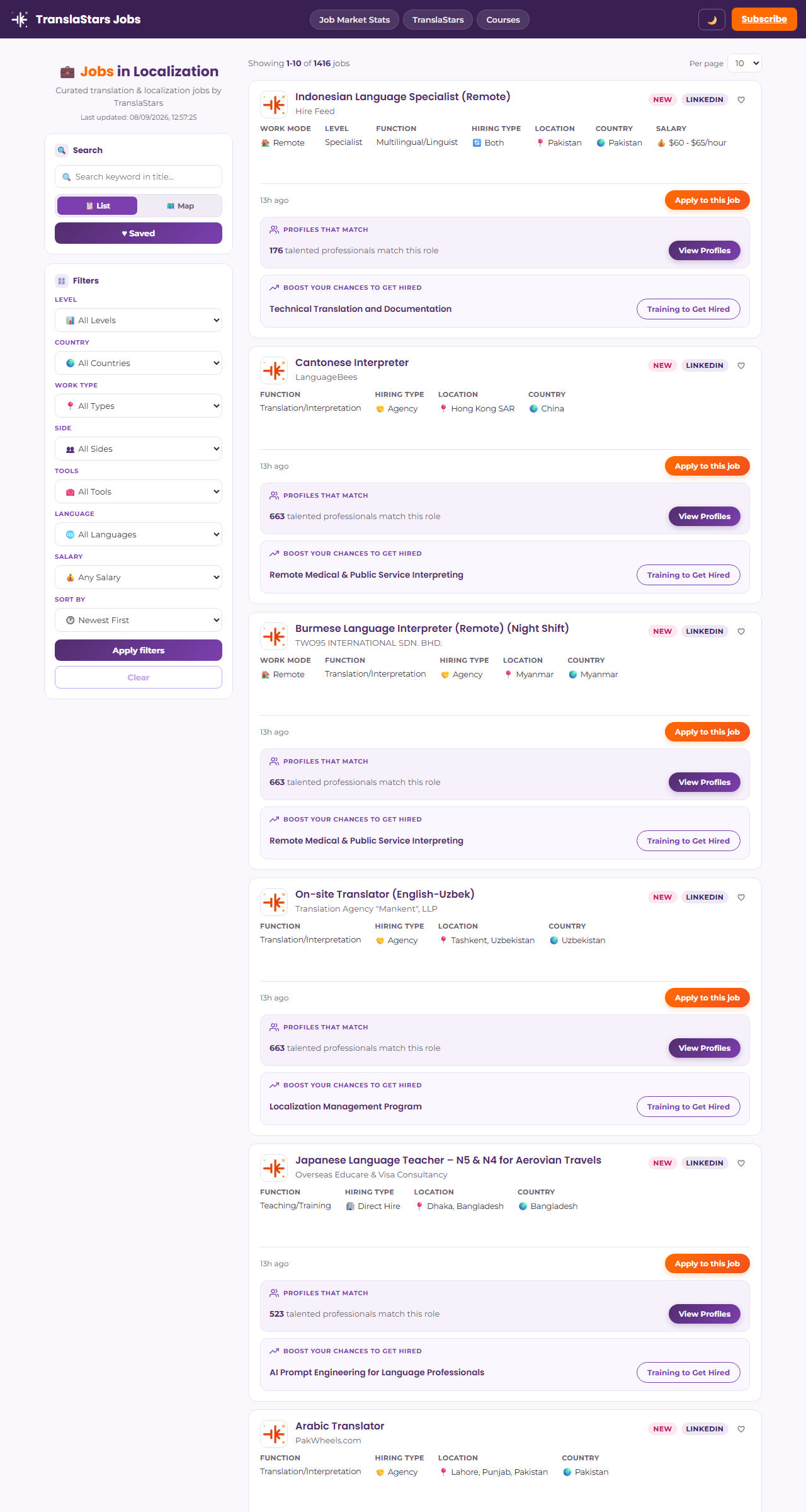
Read the postings, not the marketing. Before you spend on any certification, take twenty live openings in your language pair and highlight every credential they name. The patterns tell you exactly which family, if any, is worth your money. You can browse live openings on the TranslaStars Jobs Board, and see how the market reads credentials in our guide to getting hired in localization.
If you would rather read the market than the marketing, the TranslaStars Jobs Board is the fastest check. It lists live localization openings you can filter by language pair, seniority, country and work mode, so you can see how often a given certificate is actually named in the roles you want.
8. Our Titles, and the Certificates That Earn Their Reputation
Not every credential worth holding is an official title. In this industry a large part of what an employer trusts comes from who designed the programme and who teaches it. A certificate backed by a practitioner with a proven method can outrank a generic badge, because it encodes a way of working that the market can see in practice.
8.1. Titles and certificates from TranslaStars
TranslaStars builds its own certificates around exactly that principle: the method first, the certificate as proof. The AI and quality track is the clearest example.
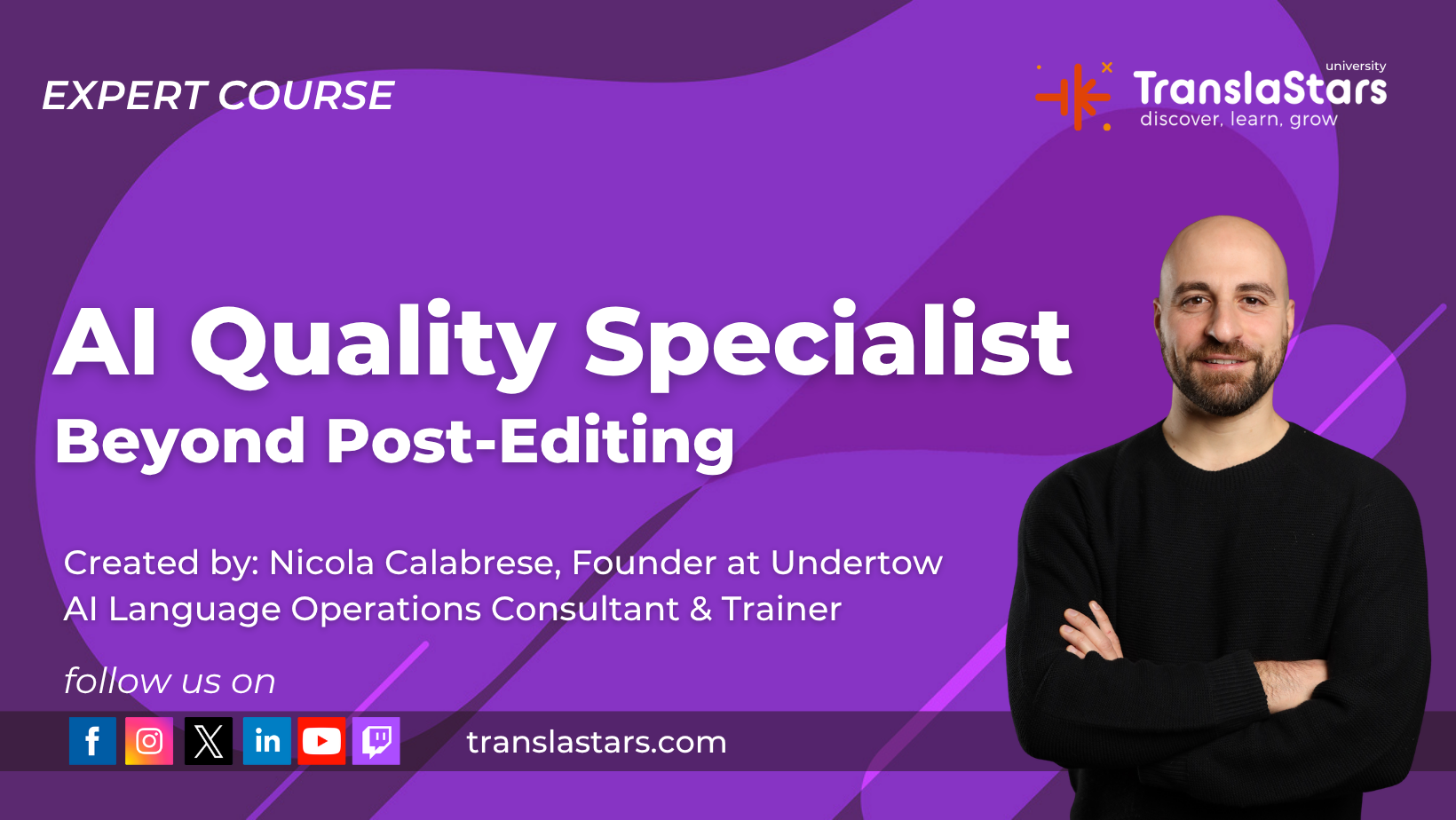
- From Post-Editor to AI Quality Specialist. A method-based certification taught by Nicola Calabrese, founder of Undertow and an AI language quality consultant who builds structured quality programmes for B2B SaaS companies. Participants who complete the three sessions earn the Undertow AI Quality Specialist Certificate, covering an AI error taxonomy, machine-readable glossaries and style guides, and structured quality reporting. This is the certificate to name when the role is about owning the quality of an AI-assisted pipeline, not only editing its output. See From Post-Editor to AI Quality Specialist.
- Certificate in AI for Translators and Interpreters. A 10-hour, five-day programme that moves a linguist from writing better prompts to orchestrating AI tools and agents across transcription, video, QA and copywriting workflows. It is aimed at professionals who want to lead AI-assisted work rather than react to it. See Certificate in AI for Translators and Interpreters.
- AI-Powered Localization Quality: From Human Review to Intelligent Language QA. A practical session with Marco Baglioni, CEO of LanguageCheck.ai, on how AI fits into real localization workflows, what it can detect reliably, and how to adopt it without disrupting existing processes. See AI-Powered Localization Quality.
- Evaluating Translation Through MQM. The error and severity model behind modern LQA, taught as a working method rather than a theory module. See Evaluating Translation Through MQM.
- Localization Management Program. The process side, including terminology management and quality and metrics sessions, for professionals who run programmes rather than single projects. See the Localization Management Program.
The full programme behind these titles, from translation and localization to audiovisual courses, is gathered on the TranslaStars courses page.
8.2. Other certificates that carry weight without being official
The same logic applies outside TranslaStars. Three groups of non-official credentials are widely respected, and in each case the reason is the know-how behind them rather than a government register.
- Vendor academies. The structured training and certification programmes run by CAT and TMS makers, among them memoQ, Trados Studio from RWS, Phrase and Crowdin, are read literally by the employers who standardised on those tools. They are not official titles, but they are the fastest proof that you can operate the environment a client already runs.
- Method and research-based training. Programmes built around MQM, the TAUS DQF typology or a comparable quality model, taught by the people who research and apply them, carry more weight than a tool badge because they survive a change of model and a change of vendor.
- Practitioner-run programmes. Certificates designed and delivered by working specialists, the way TranslaStars structures its own track, are valued for the same reason: the instructor has done the job, and the certificate is evidence that the learner has been assessed against a real workflow rather than a slide deck.
The instructor is the credential. When you compare two non-official certificates, ask who teaches them, what method they encode, and whether the people hiring in your market know that name. A certificate from a recognised practitioner is worth more than an official-sounding title nobody in the room has heard of.
9. How to Choose the Right One
Choosing is a filtering exercise, not a wish list. Work through these questions in order, and stop at the first one that gives you a clear answer.
| Question | If yes | If no |
|---|---|---|
| Do my target postings or tenders name a specific credential? | Get that one, in that form | Move to the next question |
| Is there a legal or procurement requirement in my market? | Meet it before anything else | Move on |
| Does the employer use a tool I have not certified in? | A tool badge is a fast, cheap win | Skip the badge |
| Is my gap domain knowledge rather than credentials? | Spend on a domain course, not a certificate | Move on |
| Am I changing track, for example into LQA or AI quality? | A method certification signals the move | Strengthen the portfolio instead |
One more filter, and it is the important one: a certification is worth it when it changes what you can do, not only what you can say. A programme that leaves you with a repeatable method, a stronger portfolio piece and a network is worth more than an exam you pass and forget.
10. Cost and Return, Without the Sales Pitch
We are not going to quote fees, because they differ by country, by body and by year, and a number copied from a blog is worse than no number. Instead, here is the structure of the decision, so you can price it correctly yourself.
10.1. The cost side
- Assessment or exam fee. A one-off, per language pair for the certifications that work that way.
- Preparation and materials. Courses, mock assessments, books, sometimes a sample-review service.
- Membership dues. Where the credential is tied to a body, expect a recurring annual or periodic fee.
- Renewal and continuing education. Several bodies require you to keep earning points or re-qualify, which is a long-term time cost.
- Opportunity cost. The hours spent preparing are hours not spent earning. This is usually the largest real cost and the one candidates forget to count.
10.2. The return side
- Access. Directory listings, tender eligibility and vendor-panel filters that only open when the credential is present.
- Rate and domain premium. A recognised credential helps you hold a higher rate in a specialised domain, but only once you can evidence the domain.
- Employment eligibility. Some in-house and public sector roles require a specific qualification to shortlist.
- Network and confidence. The training cohort and the assessment itself often teach more than the certificate states.
To decide, compare the total cost against the contracts or roles the credential unlocks over its validity period. If the credential does not appear in the postings and tenders you are targeting, the honest answer is that the return is marketing, and marketing is optional when the sample is strong.
11. A Shortlist by Goal
| Your goal | Most useful credential family | Why |
|---|---|---|
| Freelance, US clients | ATA certification | Recognised individual mark, pair-specific |
| Freelance, UK clients | CIOL or ITI | Local recognition, directory listings, assessment routes |
| In-house employee | Academic qualification plus a domain | Shortlisting often starts with the degree |
| Vendor or LSP owner | ISO 17100 (organisation) | Wins tenders and enterprise contracts |
| CAT or TMS work | Tool badges | Fast proof you can operate the employer's stack |
| LQA or AI quality track | Method certification (MQM, AI quality) | Signals a capability, not a tool licence |
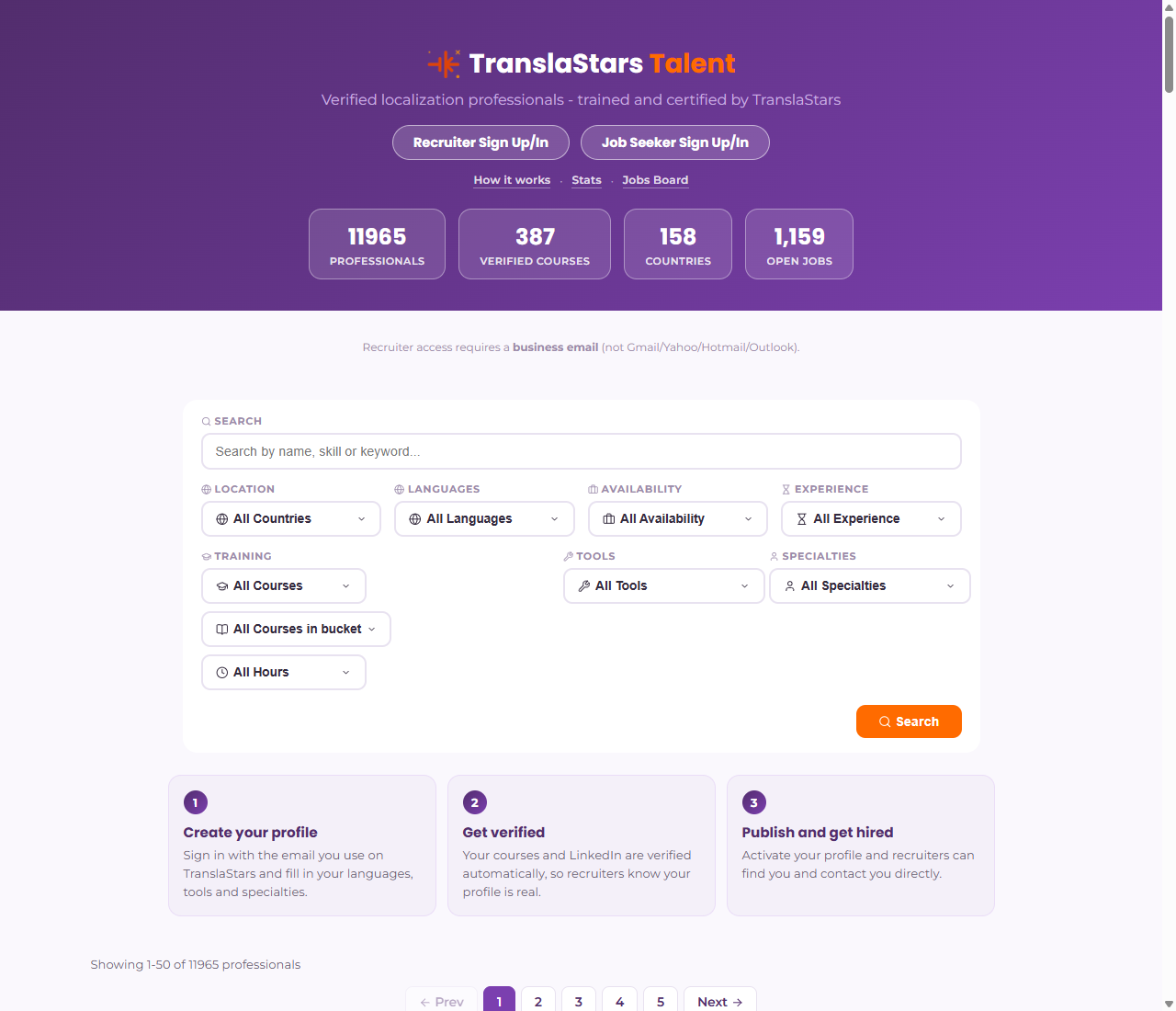
Whichever family you choose, being findable matters as much as being certified. The TranslaStars Talent Pool is where language professionals publish a profile that recruiters and LSPs search by language pair, tools and specialism, so your next certification has somewhere to land.
12. The Limits of Any Certification
Three limits worth stating plainly, because they save candidates from disappointment.
A weak certificate never beats a strong sample. No credential survives a test task that shows the reviewer you cannot follow a style guide. The certificate gets you read; the sample gets you paid.
Organisation certifications are not personal credentials. Saying "I am ISO 17100 certified" when the standard was awarded to your employer is the kind of detail an experienced interviewer will catch, and it costs you credibility on every other claim you made.
Certification ages. A tool badge from three versions ago, or an AI certificate from before the current generation of models, signals that you stopped learning rather than that you learned. The method-based credentials survive model changes. The tool-specific ones need refreshing.
None of this makes certifications useless. It makes them what they are: a signal that supports a story you can already tell. Build the story first, then choose the certificate that makes it easier to be believed.
Frequently Asked Questions
12.1. Is ISO 17100 a certification for translators?
No. ISO 17100 is a standard for translation service providers. It certifies the organisation and its process, including translator competence and revision. Individual translators do not hold ISO 17100; they hold professional body credentials such as ATA certification or a CIOL qualification.
12.2. Which is better, a professional body certification or a university degree?
They answer different questions. A degree proves structured training; a body certification proves an assessed competence standard, often in a specific language pair. For in-house roles the degree helps at shortlisting; for freelance credibility the body certification is usually the more portable signal.
12.3. Do I need a certification to be an AI quality specialist?
No single credential is mandatory, because the role is new. What employers look for is a defensible method for evaluating machine output, measured against an error and severity model, plus the judgement to know what a model should never be trusted with. That is what a method-based certification such as From Post-Editor to AI Quality Specialist is designed to evidence.
12.4. Are tool certifications worth anything?
Yes, but narrowly. They prove you can operate a specific environment, which matters when the employer has standardised on it. They say nothing about linguistic quality and they need refreshing as tools change, so treat them as a fast, cheap win rather than a career credential.
How do I know if a certification is recognised in my market?
Read the postings and tenders you are actually targeting, and ask two or three working professionals in your pair and domain whether they hold it or whether they have ever been asked for it. Recognition is local and specific; it is not a property of the certificate in the abstract.
Does a certification replace a portfolio?
No. It supports it. The portfolio or test task is the evidence that you can do the work; the certification is the evidence that someone else assessed you against a standard. Employers in this market consistently weight the first more heavily than the second.
More on the market side of this question: the localization skills employers want in 2026 and the questions they ask in the interview.
Build the method, not just the line on the CV. The certifications worth holding are the ones that leave you with a repeatable way of working. TranslaStars programmes for the AI and quality track are collected at TranslaStars courses, and each opening on the jobs board links to the courses that strengthen your profile for it.