
How do you make money with AI in localization and translation? The honest answer is that AI has not killed the money in this industry. It has moved it. The work that used to pay for producing sentences a machine can now produce is shrinking, and at the same time the market has started paying for something else: people who can direct the machine, check what it produces, and build the systems it runs inside.
That shift is uncomfortable if your income still depends on volume translation. It is an opportunity if you are willing to move up a ladder. The ladder has six rungs, and each one pays more than the last because each one is harder to replace: get trained on what the market actually pays for, sell AI services you can deliver now, specialise where AI cannot reach, build your own tools, build your own product, and then teach others. This guide walks all six, with real market data and with working AI prompts whose output you can see.
Why this question, and why now? Our own search data says it is the biggest unanswered question on the site. Over the 90 days to 21 September 2026, "how to make money with ai in localization and translation industry" produced 5,881 impressions and zero clicks, at an average position of 5.0. Two honest caveats: search impressions include repeated crawls, so treat the figure as a demand signal rather than 5,881 different people, and what Google currently shows for the query is a general AI tips article that does not answer the money question at all. In the same period English accounted for 10,365 queries on the site against 760 in every other language combined, which is why this guide is written in English. There was no page that answered the question properly. This is that page.
A note on the numbers. Every figure about demand below comes from the public TranslaStars job board, read live on 21 September 2026: 1,204 open offers at that moment. The board is a sample of the market, not the whole of it, and the count moves day by day. Tags overlap (one offer can carry several), so they describe intensity, not a sum. Nothing here is an estimate dressed up as a fact.
In This Article
- The Money Did Not Disappear, It Moved
- Step 1: Get Trained on What the Market Pays For
- Step 2: Sell AI Services You Can Deliver This Month
- Step 3: Specialise Where AI Cannot Reach
- Step 4: Build Your Own Tools
- Step 5: Build Your Own Product on a Localization Core
- Step 6: Teach and Multiply
- The Whole Ladder in One Paragraph
- Frequently Asked Questions
1. The Money Did Not Disappear, It Moved
Look at what employers are asking for rather than at what the industry says about itself. On the board we read today, the tag "ai" alone appears in 268 of the 1,204 open offers, which is about 22 percent. That is the single most repeated technical requirement, ahead of automation (71), artificial intelligence (71), machine translation (50) and prompt (40). Meanwhile the classic tool tags sit far below: memoQ 48, Trados 41, Phrase 31.
That is not a story about translation dying. It is a story about a different job description. The offers that remain are increasingly written by people who assume an AI engine does the first pass, and who need a human to own what happens before and after it. The money did not leave the industry. It moved from "produce the sentence" to "own the system that produces the sentence".
The single number to remember: 268 of 1,204 open offers carry the AI tag on 21 September 2026. AI is not a niche specialism any more. It is the default technical expectation, and it is appearing more often than the tools the industry spent twenty years learning.
2. Step 1: Get Trained on What the Market Pays For
The first rung is the cheapest and the fastest, and it is also the one most people skip. If you want to be paid for AI work, you have to be able to do more than open a chatbot. The board tells you exactly which capabilities are being paid for.
The AI and technical tags are the clearest signal: ai 268, automation 71, artificial intelligence 71, machine translation 50, prompt 40, llm 36, post-editing 29. Two of those deserve attention on their own. Machine translation plus post-editing is a full workflow, not a buzzword, and it is the workflow most agencies now run. Prompt and llm are the vocabulary of the second wave.
The second signal is terminology. "terminology" is the most repeated tag in the entire Tools category with 274 mentions, ahead of glossaries (93), cat tools (88) and tms (53). Terminology is not glamorous, and that is exactly why it pays: it is the asset that decides whether an AI engine produces your client's voice or a generic one. If you learn one thing that AI cannot generate by itself, learn terminology management.
The third signal is the shape of the market, and it is uncomfortable. Employers are not opening doors for beginners. Of the 1,204 offers, only 23 are classified as Entry / Junior, about 1.9 percent, against 678 at General level, 244 Specialist and 125 Manager or Lead. If you are starting out, the entry rung of the ladder is not "junior translator". It is "someone who already understands the workflow". Training is how you buy that understanding.
So the practical move is to learn the two things the board repeats most, in a structured way rather than by trial and error: how AI translation actually works end to end, and how to build terminology assets a machine can follow.
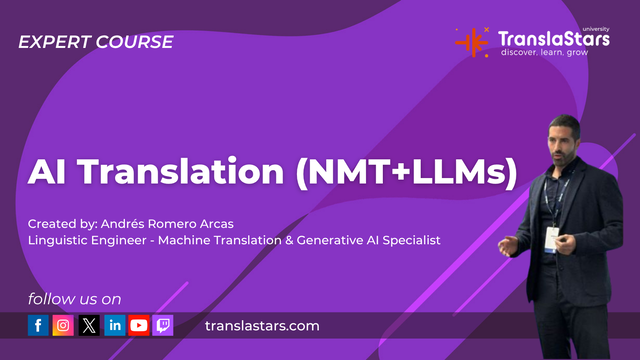
AI Translation: NMT, LLMs, MTQE and APE
How the engines work, how quality estimation works, and how to run automated post-editing in a real workflow. The structured version of the tags employers ask for most.
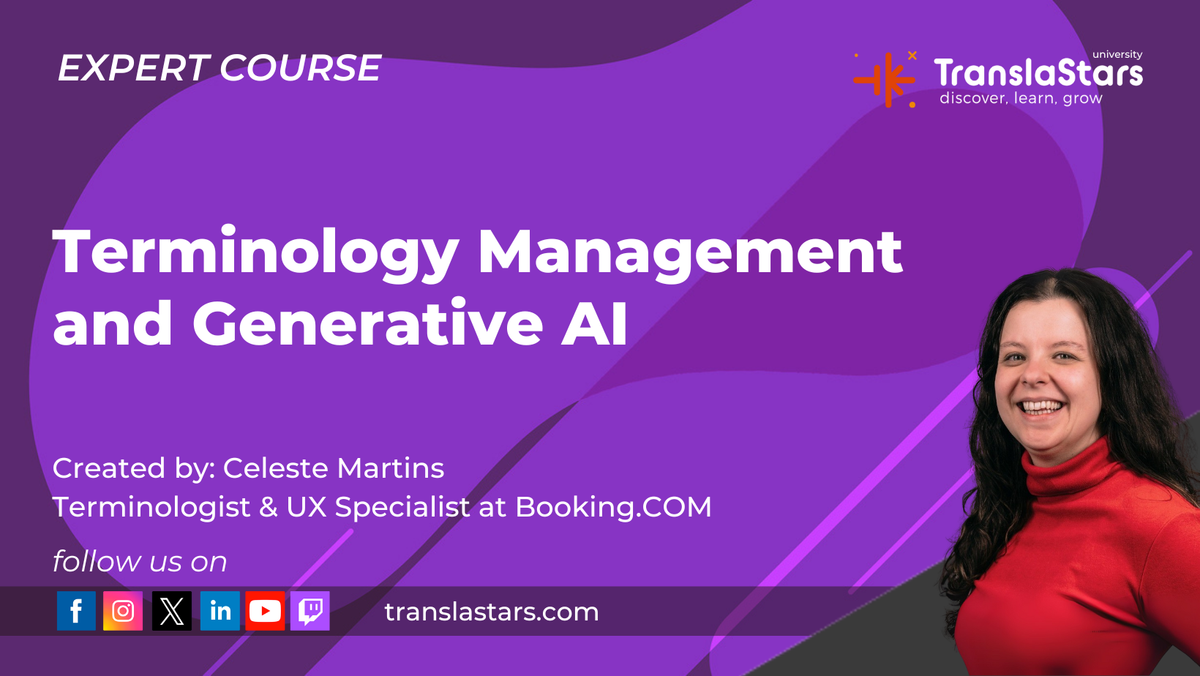
Terminology Management with AI
Build glossaries and termbases that an AI engine can follow, and turn terminology into a service clients will pay for. Maps directly to 274 mentions on the board.
If you want the broader credential rather than two focused courses, the Certificate in AI for Translators and Interpreters covers the same ground as a single programme.
3. Step 2: Sell AI Services You Can Deliver This Month
Training only converts into money when you package it. The good news is that most of these services need nothing more than the skills on the first rung and a clear way of explaining them. Here is what you can sell, what it is worth, and how to say it to a client.
| Service | What the client buys | How it is priced |
|---|---|---|
| Post-editing | A publishable text from a machine first pass, with the errors that change meaning corrected | Per word, below translation rates, but at higher volume and speed |
| AI quality review | An independent check on AI output before it goes live, with an error log the client can act on | Per hour or per project |
| Glossaries and terminology | A termbase and style rules that make every future AI output consistent with the brand | Per project, then a retainer to keep it alive |
| Task automation | Scripts and small tools that remove manual file handling and repetitive checks | Per project, with a maintenance element |
| Localising AI-generated content | Content a client produced with AI, made correct and natural in another market | Per word or per hour, with a clear brief on register |
On price, be honest with yourself about the shape of the market before you quote. Of the offers on the board that publish a salary, 30 publish an hourly figure, and the median of those is $26 per hour, ranging from $10 to $100. Post-editing sits below straight translation per word, which is why the professionals who earn well from it sell it as a volume workflow with a quality guarantee, not as cheap translation. The per-role figures are higher where the work is more specialised, which is what the next rung is about.
3.1. Two prompts you can run today
The reason this section is not just a list is that these services have a concrete, testable core. Below are two prompts that do real work, with the real output the model produced. Both were run on DeepSeek (deepseek-chat) on 21 September 2026 and pasted here exactly as they came back.
Prompt 1: terminology consistency check
I localize software documentation from English into Spanish. Here is my project glossary and a target text produced by a machine translation engine.
GLOSSARY (Spanish target terms that must be used exactly):
- deployment = despliegue
- release = version
- onboarding = incorporacion
- cloud = nube
- dashboard = panel
TARGET TEXT TO CHECK:
"El despliegue de la nueva release en la nube ya esta listo. El lanzamiento incluye una guia de onboarding para clientes, y los datos se ven en el dashboard."
List every terminology deviation in a markdown table with exactly these columns: Term, Expected, Found, Verdict. Verdict is OK, DEVIATION or MISSING. Then give the corrected sentence in one line.
What it produced (verbatim):
| Term | Expected | Found | Verdict |
|---|---|---|---|
| deployment | despliegue | despliegue | OK |
| release | version | release | DEVIATION |
| cloud | nube | nube | OK |
| onboarding | incorporacion | onboarding | DEVIATION |
| dashboard | panel | dashboard | DEVIATION |
El despliegue de la nueva version en la nube ya esta listo. El lanzamiento incluye una guia de incorporacion para clientes, y los datos se ven en el panel.
Three of five terms failed the glossary, and the model caught all three: the machine had left release, onboarding and dashboard in English inside Spanish text. That is exactly the kind of error a client does not see until a customer complains, and it is exactly the kind of check you can run as a paid service.
Prompt 2: light post-editing with an issue log
SOURCE (EN): "Charge the headphones for two hours before first use. The battery lasts up to 30 hours, and a 10-minute quick charge gives you 5 hours of playback."
MACHINE TRANSLATION (ES): "Cargue los auriculares durante dos horas antes del primer uso. La bateria dura hasta 30 horas, y una carga rapida de 10 minutos le da 5 horas de reproduccion."
Perform light post-editing. Then produce, in this order: (1) an issue log as a markdown table with columns Category (Terminology, Grammar, Register, Omission, Formatting), Issue, Correction; (2) the final light post-edited Spanish text in one block.
What it produced (verbatim):
| Category | Issue | Correction |
|---|---|---|
| Formatting | Missing accents on "bateria", "rapida", "reproduccion" | "batería", "rápida", "reproducción" |
| Register | "le da" is less natural for product instructions; "ofrece" reads better | "ofrece" |
| Grammar | Comma before "y" in a simple series is unnecessary in Spanish | Remove comma |
Cargue los auriculares durante dos horas antes del primer uso. La batería dura hasta 30 horas, y una carga rápida de 10 minutos ofrece 5 horas de reproducción.
Notice what the model did and did not do. It flagged the missing accents, which are the errors that make a Spanish speaker distrust a page immediately, and it questioned a register choice. It did not rewrite the text; that is the difference between light and full post-editing, and it is why the two are priced differently. A service built on this prompt is not "AI translation". It is the check that stops AI translation from embarrassing your client, and it is billable on its own.
If you want to go deeper than a prompt, this is the workflow the AI Machine Translation and Post-Editing course is built around, and the practical post-editing guide on this blog covers the rates and the quality standards in detail.
4. Step 3: Specialise Where AI Cannot Reach
The third rung is the one that protects you from the first two being commoditised. If AI can do a first pass on a text, it can do a first pass on your text. What it cannot do is stand in a hospital corridor and interpret a consultation in real time, in person, under legal and ethical accountability. That is why medical and legal interpreting remain the most defensible money in this industry.
The board reflects it. Interpreter is the largest single role family, with 269 of the 1,204 offers, ahead of Translator (200) and Linguist (190). Twelve of those interpreter offers publish a salary, and the annualised range runs from $20,800 to $74,880, with a median of $49,920. The actual postings show what that looks like in practice. Medical Interpreter at St. Jude Children's Research Hospital is advertised at $24.00 to $42.00 per hour. A Spoken Language Interpreter (Spanish) at Oregon Health and Science University is posted at $32.18 per hour. Medical Interpreter I at Seattle Children's is posted at $32.07 to $48.11 per hour. Medical Interpreter (Sign Language) at Atrium Health is posted at $35.50 per hour.
Legal is a smaller and quieter market, with 20 offers on the board and only two publishing salary, ranging from $39,520 to $52,000. The pattern is the same: fewer roles, less competition from AI, more accountability.
What turns this into a career rather than a job is certification. CCHI offers national certification for healthcare interpreters of any language: the CoreCHI exam, the CoreCHI-Performance credential and the CHI certification, with each credential valid for four years. NBCMI awards the Hub-CMI credential and the CMI certifications, and its exams are explicit about what is being tested: the written exam is 61 percent medical knowledge, 15 percent code of ethics, and 24 percent on the role of the interpreter, cultural awareness, and legislation. The oral exam is 35 percent medical terminology in two languages, 30 percent linguistic mastery, 25 percent consecutive interpreting and sight translation, and 10 percent cultural awareness. Exams run year round and can be taken online with remote proctoring.
Why this rung holds. A machine can draft a discharge summary. It cannot accept professional and legal responsibility for what was said in the room. Certification is the market's way of charging for that responsibility, which is why interpreter postings here publish firm hourly figures while generic translation postings often publish nothing at all.
This is a specialist path, so it is worth building it deliberately. The Remote Medical and Public Service Interpreting course covers the medical and public service setting, Introduction to Legal Translation opens the legal side, and Note-Taking for Consecutive Interpreting drills the single skill that decides whether you survive the oral exam.
5. Step 4: Build Your Own Tools
From here the ladder changes character. Up to now you were selling something a client asked for. From this rung you start selling something a client did not know they needed, because you built it. This is where AI stops being a threat and becomes leverage: the model writes the code, you decide what it should do.
The market signal is small but sharp. Only 10 offers on the board are for a Localization Engineer, and that scarcity is the point: few people can do it, so few roles exist, and each one is worth more than a generic one. Look at what those ten openings ask for: python 9, tms 6, automation 6, workflow 6, json 5, xml 4, javascript 4. In ten postings, the employer expects Python more often than any tool. Translation memories are not on that list. Code is.
You do not need to become a software engineer to enter this rung. You need to be able to describe a task precisely enough that a model can write a small tool for it, and then to check the result. Here is a third prompt, and this time the model did not just write text: the script it produced was saved and executed.
Prompt 3: build a glossary compliance checker
You are a localization engineer who writes small, working Python utilities. Reply with a single complete Python script in one fenced code block, then a short usage note. Use only the Python standard library (csv, sys, re, pathlib). The script must read a glossary CSV with the header term,target and a translated text file, then print, for each glossary target term: the count of exact matches, the count of near-miss variants (case-insensitive or accent-insensitive), and a compliance percentage. Keep it under 60 lines.
What it produced (verbatim):
import csv
import sys
import re
import unicodedata
from pathlib import Path


def strip_accents(s):
    return "".join(
        c for c in unicodedata.normalize("NFD", s)
        if unicodedata.category(c) != "Mn"
    )


def main():
    if len(sys.argv) != 3:
        print("Usage: python glossary_check.py <glossary.csv> <translated.txt>")
        sys.exit(1)

    glossary_path = Path(sys.argv[1])
    text_path = Path(sys.argv[2])

    with glossary_path.open(encoding="utf-8", newline="") as f:
        reader = csv.DictReader(f)
        terms = [row["target"].strip() for row in reader if row.get("target", "").strip()]

    text = text_path.read_text(encoding="utf-8")
    text_lower = text.lower()
    text_folded = strip_accents(text_lower)

    print(f"{'term':<30}{'exact':>8}{'near':>8}{'compliance':>12}")
    print("-" * 58)

    for term in terms:
        exact = len(re.findall(re.escape(term), text))
        term_lower = term.lower()
        term_folded = strip_accents(term_lower)

        near_lower = len(re.findall(re.escape(term_lower), text_lower))
        near_folded = len(re.findall(re.escape(term_folded), text_folded))
        near = max(near_lower, near_folded) - exact

        total = exact + near
        compliance = (exact / total * 100) if total else 0.0

        print(f"{term:<30}{exact:>8}{near:>8}{compliance:>11.1f}%")


if __name__ == "__main__":
    main()
Written is not the same as working, so the script was saved as a file and run against a small glossary and the same Spanish text used above. This is the real terminal output, not a description of it:
term                             exact    near  compliance
----------------------------------------------------------
despliegue                           3       0      100.0%
version                              1       0      100.0%
incorporacion                        1       0      100.0%
nube                                 2       0      100.0%
panel                                0       0        0.0%
It runs. Four terms are fully compliant, and panel scores 0 percent because the text says dashboard, which is exactly the deviation Prompt 1 identified. Two different prompts, two different tools, one consistent answer. That consistency is the product.
Now the uncomfortable part, said plainly: a script like this is a starting point, not a finished product. It counts occurrences, it does not understand context, and it will flag a correct term as a near miss if the client legitimately uses both. Anyone selling it must test it against real files first. But that gap is the opportunity. The person who can take an AI-written script, test it, break it, fix it and hand it to a client is doing something the client cannot do alone, and that is a billable service with no ceiling set by per-word rates.
Two resources on this blog are written for exactly this rung: Vibe Coding in Localization explains how to build tooling by describing intent, and How to Build an AI Localization Pipeline covers the workflow the tools have to fit into. On the training side, Creating AI Localization Pipelines and AI-Driven Localization Pipelines take the same skills further.
One more resource belongs on this rung, and it is ours: the OpenClaw Professional Course. OpenClaw is a private AI assistant that runs on your own infrastructure and connects to the tools you already use, which is this rung taken one level up. The course is the complete walkthrough, from a clean install to a configured multi-agent setup.
6. Step 5: Build Your Own Product on a Localization Core
This is the rung most people never see, and it is the one that changes the economics completely. Selling services means your income stops when you stop. Building a product means you can sell the same asset to many people, and if that product is built on a localization core, you are selling the one thing you already understand better than a generic developer.
The clearest example is our own. TranslaStars Audio is an audio platform built around a simple idea: people can learn from audio summaries of books and courses, in their own language, on a commute. Localization is not a feature bolted on at the end. It is the product. The same title exists as a summary in several languages, so a learner in Berlin and a learner in Lisbon get the same content in a form they can actually use.
How a release is actually made is less mysterious than it sounds, and the pipeline is the point:
| Stage | What happens |
|---|---|
| 1. Source | Take a book or a course and produce the audio (for a book, this means its audiobook; for a course, its lessons). |
| 2. Transcription | Transcribe the audio so the content becomes searchable, checkable text rather than sound. |
| 3. Summary per language | Write a structured summary of the content, not a translation of it, separately for each target language, so each version reads as if written for that market. |
| 4. Audio per language | Produce the summary audio in each language, usually 17 to 29 minutes for a book summary. |
| 5. PDF per language | Generate a companion PDF with localised labels and structure, so the reader can follow or revise. |
The most recent release, a summary of Malcolm Gladwell's Outliers, went through that pipeline in six languages: English, Spanish, French, German, Italian and Portuguese. Six audios, six transcripts, six summaries that were written rather than translated, and six PDFs, each with its own localised headings. Nothing in that pipeline is exotic. It is transcription, summarisation, localisation and a PDF generator, assembled in a fixed order.
What a reader can copy from this. The product idea matters less than the shape of the pipeline. Pick one thing you already know well (a book you understand, a course you teach, a niche you specialise in). Pick one source asset. Then run the same five stages end to end for one language first, and only add languages once the first one is clean. The reason this works for a language professional and not for a generic builder is that you can judge whether the summarised and localised output is actually good, and that judgement is the hard part.
You can see the result rather than take our word for it: listen to the free audios, where the same titles are available across several languages, and read the full description in TranslaStars Audio: learn 15 minutes a day. If you want to build the audiovisual side properly, the Master in AI, Project Management and Translation for AVT is the structured version of that pipeline.
7. Step 6: Teach and Multiply
The top rung of the ladder is not more production. It is other people's production. Once you can do the five rungs above, you can be paid to teach them, and the market asks for it: Teaching / Training appears 20 times on the board, and the board's functional breakdown lists 20 offers under Teaching/Training. It is a small number on purpose. It is a rung you reach, not one you start on.
Teaching shows up in three forms, and they are priced differently. Teaching, as courses and classroom hours, is the most visible and the most competitive. Consulting, where a company pays for your judgement on its AI workflow rather than for hours of delivery, is the most profitable per hour. Internal training, where you train a client's in-house team so they stop outsourcing the work, is the most stable, because it usually becomes a retainer.
The move that makes this rung work is counter-intuitive: teaching what you are good at does not create competitors, it creates demand for you as the person who frames the problem. Every team you train will come back with the questions only you can answer. That is why the instructors on this platform teach the same material they use, and why the Localization Management Academy and the Master in AI and Innovation for Localization sit at the top of the same path this article has just walked.
8. The Whole Ladder in One Paragraph
Making money with AI in localization and translation is not one decision, it is six, and each one is a step up: train on the skills the market is already paying for (AI workflows and terminology, the two most repeated tags on the board), sell AI services you can deliver now (post-editing, quality review, glossaries, automation, localising AI content), specialise where AI cannot reach (medical and legal interpreting, where certification and responsibility set the price), build your own tools (the rung where Python is asked for more often than any translation tool), build your own product on a localization core (the rung where income stops depending on your hours), and teach (the rung where other people's work starts paying you). AI did not remove the money from this industry. It moved it upward, and the ladder is how you follow it.
Your first concrete step, by profile.
If you are a student or just starting: learn how AI translation and terminology actually work before you look for work. Those are the two skills the board repeats most, and the entry level is too small to rely on chance.
If you are a working translator: pick one of the five services above, run the terminology prompt on a real project this week, and add it to your offer with a clear price.
If you are an interpreter: start the certification path (CCHI or NBCMI) rather than competing on availability. It is the part of the market that still publishes firm rates.
If you already write scripts or build tools: stop doing it for free inside translation projects and sell it as a service, then as a product.
If you have a product idea: run the five-stage audio pipeline on one title in one language before you build anything else.
9. Frequently Asked Questions
9.1. How do I actually make money with AI in localization and translation?
By selling what AI cannot do alone: directing it, checking it, and building the systems it runs inside. In practice that means post-editing and AI quality review, terminology and glossary work, automation, localising AI-generated content, and eventually your own tools and products. The board data in this article shows the demand shifting in exactly that direction: 268 of 1,204 open offers carry the AI tag on 21 September 2026.
9.2. Do I need to learn to code?
No, but the market says it helps. Only 10 of the 1,204 offers are for a Localization Engineer, and across those ten, Python appears 9 times. Coding is not required for the service rungs of the ladder. It is what separates the top rungs, where you build tools and products instead of selling hours.
9.3. Is post-editing worth it if the rates are lower than translation?
Yes, if you sell it correctly. Post-editing pays less per word than translation, which is why the money is in volume, speed and a quality guarantee rather than in competing on price. The prompts in this article are the quality guarantee: a terminology check and an issue log turn an invisible process into a deliverable a client can measure.
9.4. Which specialisms are most protected from AI?
Certified medical and legal interpreting, and any specialism that carries professional or legal responsibility. Interpretation is already the largest role family on the board with 269 of 1,204 offers, and the interpreter postings are the ones that publish firm hourly figures, from $24.00 to $42.00 per hour in the examples quoted here.
9.5. Can one person really build a product like TranslaStars Audio?
The pipeline, yes, and the article above lists its five stages. Transcription, summarisation, localisation and PDF generation are all tools that exist today. What is not trivial is the judgement: knowing whether the summarised and localised output is good enough to publish, which is precisely the skill a language professional brings and a generic builder does not.
9.6. How current is the data in this article?
All job board figures were read live on 21 September 2026, when the board showed 1,204 open offers. The board changes daily, so treat the absolute numbers as a snapshot of that date and the ratios as the durable signal.
Move up the ladder: start with AI Translation: NMT, LLMs, MTQE and APE and Terminology Management with AI, find the roles on the TranslaStars job board, check your tool stack with the free CAT and TMS comparison tool, and listen to the free audios. The Localization Management Academy and the Master in AI and Innovation for Localization are where the path leads.