Machine translation is now part of every translator's workflow. The market has moved from asking whether to use MT to asking how to use it well - and that is exactly where post-editors come in.
Post-editing (MTPE) is the fastest-growing specialization in the language industry, and it is not going away. This guide explains how professional post-editing works, what clients expect, and how you can build a career in it in 2026.
1. What Post-Editing Is
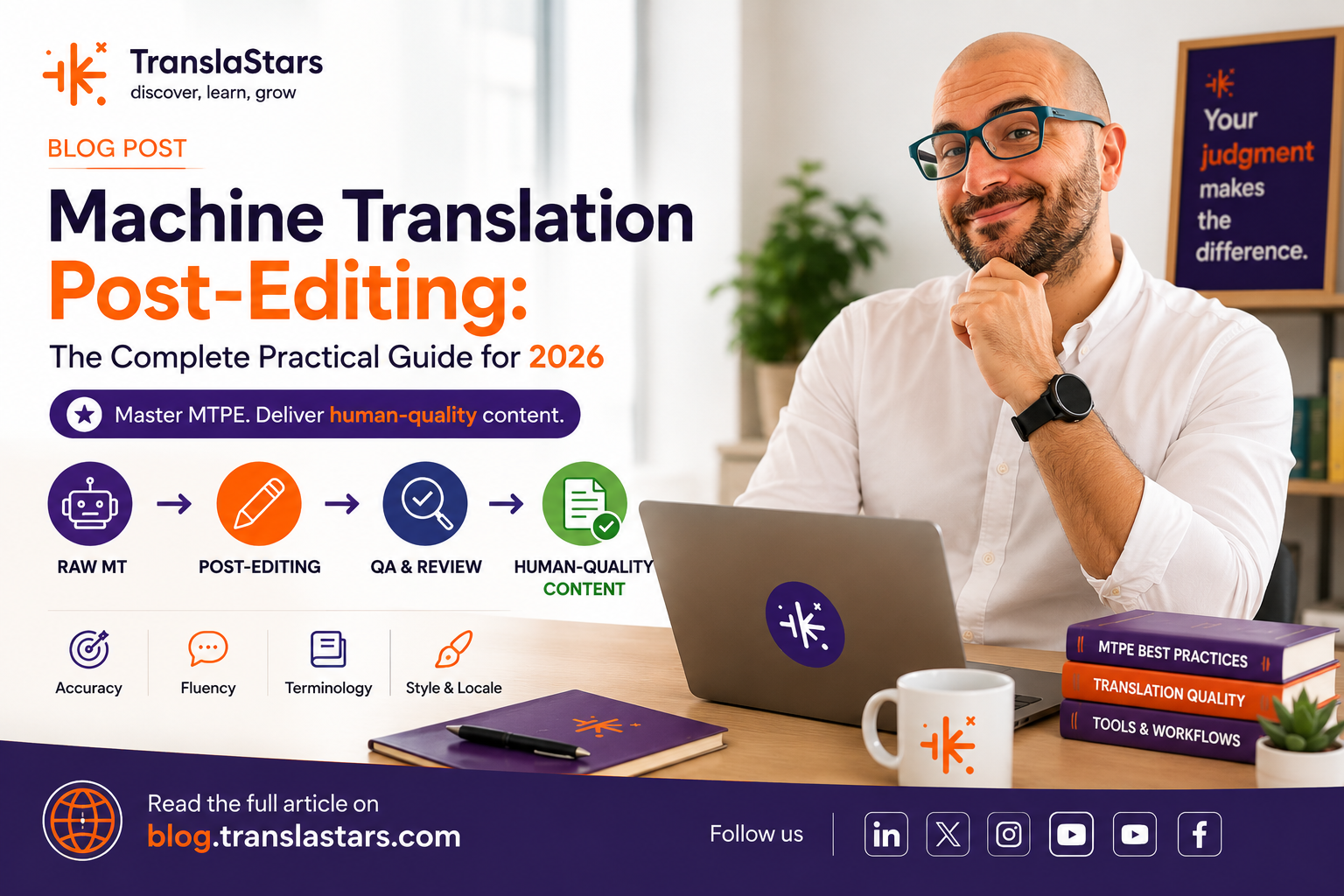
Post-editing means reviewing and correcting machine translation output so it meets the quality level a client needs. In practice, a linguist reviews machine translation and AI-produced target texts so they make sense and meet the desired quality standards. It is not translating from scratch and it is not a light proofread - it sits in between.
Understanding where that machine output comes from helps you edit it. Machine translation has a longer history than most people assume: Warren Weaver circulated a memorandum proposing cross-lingual translation by computer back in 1949, and the first public demonstration was the Georgetown-IBM experiment of 1954, which translated a set of Russian sentences into English. The field then moved through rule-based systems like Systran and statistical MT to the turning point that made MT mainstream - Google Translate's launch in 2006 - and on to neural MT (NMT) after 2013. Around the same time, large language models quietly inherited translation as a side effect of next-token prediction, which is why today's output can read fluently while still being wrong.
This is why the skill is not "trust the engine" but know when the output is good enough. In the industry that question - when can raw MT be used without any post-editing - is considered one of the trickiest problems right now, and it is exactly the judgment a post-editor brings.
The industry defines two standard levels (ISO 18587 and the TAUS guidelines): light post-editing, which makes the text understandable with minimal effort, and full post-editing, which brings it to human-translation quality. Knowing which one a client wants is the first professional skill.
The single most important rule when you start is simple: never post-edit to a higher level than the client paid for, and never deliver light post-editing where the client expects full. Confirm the level in writing before starting.
2. Light vs Full Post-Editing
| Aspect | Light Post-Editing | Full Post-Editing |
|---|---|---|
| Goal | Comprehensible, accurate, no MT errors that change meaning | Publishable quality, indistinguishable from human translation |
| Style | Keep MT style; only fix what is wrong | Improve style, flow, register, terminology consistency |
| Effort | Minimal, fast (aim: under 50% of translation time) | Close to or equal to human translation effort |
| Typical use | Gist translation, internal content, large volumes | Customer-facing content, marketing, legal, published text |
| Rate | Lower per word, but higher volume | Higher per word, closer to translation rates |
In light post-editing the focus is on errors: correct mistakes that hurt comprehension, rewrite sentences with no clear meaning, remove extra text the engine added, and verify the whole text has been translated. In full post-editing the focus is wider: you fix critical mistakes and make the text sound fluent and natural, so you correct style and preferential issues too.
Those categories are not theoretical. In a live translation test, a simple idiom shows how differently engines behave: asked to render "kick the bucket" into Italian, DeepL produced the natural idiom "tirare le cuoia" while Google Translate produced the literal "calciare il secchio". Neither is a random failure - it is a pattern. Engines also carry systematic bias: in gendered languages, roles like nurse and doctor tend to be assigned a gender even when the source is neutral, and an NMT system can produce a sentence that is perfectly fluent and completely wrong. Knowing these patterns is what lets you skip straight to the problem instead of hunting for it.
AI and Machine Translation Post-Editing
Learn AI and machine translation post-editing. Boost your skills, improve quality, and stay competitive in the modern language industry. The practical starting point for anyone moving into MTPE.
3. The 10 Practices That Separate Serious Post-Editors
There is real craft behind good post-editing. These 10 practices come from working linguists who post-edit daily, and they are the habits that separate professionals from people who simply "read the machine output."
1. Study the machine
You must know your tool before you use it. The dominant approach is neural MT, which uses an artificial neural network trained on huge amounts of data to predict the likelihood of a word sequence. Large Language Models (LLMs) also use a neural approach, trained until the machine understands natural language and can respond according to its rules. Remember: machine translation is entirely based on our own linguistic habits.
2. Be aware of common mistakes
If you know the most common MT errors, you will post-edit faster - and you can educate clients about the advantages and issues of automated translation. The most common issues include: literal translation, ignorance of spelling mistakes in the source, non-translated acronyms, and lack of cultural nuance awareness.
A practical error checklist a post-editor keeps in mind covers the full range: wrong terminology (the engine picks a term that breaks the glossary), mistranslations (meaning reversed or distorted), omissions (content silently dropped), additions (content the engine invented), word-order issues, punctuation and formatting problems, over-literal idioms, and - increasingly - hallucinated content that never existed in the source at all. The last one is the most dangerous, because it reads perfectly and the fix is not a word swap but a whole rewording.
3. Read the source first
If the source is not too long, always read it before translating so you know the topics, tone of voice, purpose, target and all the information you need. If it is too long to read at once, divide it into sections and read and edit one section at a time.
4. Detect frequent mistakes in the target text
If MT gets something wrong, it will always get it wrong. Watch for repeated mistakes to get a wider idea of the text's quality and find the right solutions. This is also what you report to the client. Steady criteria exist to evaluate translation quality, such as the Multidimensional Quality Metrics (MQM) scheme.
5. Keep instructions in mind
The temptation to fix everything is strong, but stick to what the client asked for. If they want light post-editing, do not waste time correcting every single word. If you spot improvements that do not affect meaning, note an example and show it to the client - they may opt for full post-editing next time.
6. Don't lose your human touch
The problem with AI is not that it is as good as human translators (it is not) - it is that we are starting to accept its mistakes as long as we can understand what we read. Post-editing is, and always will be, a human task. Train your writing skills in the target language: read human-written blogs, posts and books, and step away from AI content when you have been exposed to too much of it.
AI Translation (NMT, LLMs, MTQE+APE)
Become an expert in both human and AI translation processes and gain hands-on experience with AI-driven automation. Covers NMT, large language models and the full quality stack.
7. Let the text rest
Your brain gets used to the text you wrote or translated, so it will not notice obvious mistakes. Finish the job at least two days before the deadline and use one day (or more, depending on length) to let your brain forget it, so you notice everything when you get back before delivery.
8. Don't stay behind
Our industry is changing fast because technology is changing fast. Take time to study the tool and use it in your workflow: what can and cannot it do? How can it save you time instead of making you correct its mistakes? As professionals, one of our duties is to guide clients to make wise choices - we cannot do that if we are not informed about the state of the technology we use.
9. Be aware of ethical issues
Data security is a fundamental ethical issue here. MT tools and LLMs are trained on data spread across the net, and the companies behind them often have a different concern for our data because they need it. Blindly feeding AI with your input may seem fun, but it is risky for privacy and for your work. AI is very useful in the right hands - and dangerous in the hands of an ill-informed manager who just wants fast, cheap results.
10. Don't accept everything that comes your way
Post-editing is a crucial service, but it is not a magic wand. Some projects are simply not fit for MTPE and will make you double your work for half the rate. Yes, you may get some money in a quiet time, but you will also get headaches, guilt, frustration and less time for yourself and your professional development. Know your boundaries and protect your rates.
The through-line of all 10 practices: post-editing is judgment work. The machine does the speed; you bring the judgment, the terminology discipline, and the quality standard. To sharpen that judgment, work through the practices in a structured course where you edit real output and learn the error taxonomies used in the industry.
4. Skills You Need
- Excellent source-language understanding: you must spot when MT got the meaning wrong, not just when it reads badly.
- Strong target-language writing: full post-editing is a writing job.
- Terminology discipline: clients provide glossaries and style guides for a reason.
- Error-spotting speed: professional post-editors scan for common MT errors: false friends, wrong pronouns, mistranslated numbers, dropped negation, and literal collocations.
- Resistance to boredom: honestly, a large part of MTPE is sustained attention over long stretches of text.
The good news: these are trainable skills, and the training investment pays off fast because MTPE volume is huge. If you want to go beyond editing individual segments and start measuring and automating quality, the MTQE-APE path is the natural next layer after core post-editing.
Machine Translation and Automated Post-Editing MTQE-APE
Master MT Quality Estimation and Automated Post-Editing to build scalable, AI-driven translation workflows that boost quality. Understand how MT quality is measured and automated at scale.
5. Tools and Workflows
Most MTPE work happens inside CAT tools and TMS platforms where MT output is pre-filled as the segment to edit:
- CAT tools with MT integration: Trados, memoQ, Wordfast and others show MT suggestions directly in the editor.
- TMS platforms: Smartcat, Phrase, Lokalise and similar platforms run MT engines and manage post-editing workflows at scale.
- MT engines you will see: DeepL, Google Translate, Microsoft Translator, GPT-based MT systems, and domain-tuned engines trained on client data.
- QA tools: terminology checkers, consistency checks and error typologies (like the MQM framework) are part of the delivery standard.
You do not need to buy expensive tools to start: many platforms are free for freelancers and include MT engines. Learn one CAT tool well and you can adapt to the rest. If you want MT output trained to your own glossary and style - so that post-editing becomes a lighter, faster job - engine customization is the skill to add.
How to Customize AI Translation with Wordscope
Learn how to customize AI translation with Wordscope so the engine follows your terminology and style. A practical way to make post-editing faster and more consistent.
6. The Tools Employers Actually Use
To know what to learn, look at what employers actually ask for. Here is the tool demand across live localization offers right now:
| Tool | Mentions in live offers | Why it matters |
|---|---|---|
| memoQ | 99 | Strong MT and post-editing integration; common in agencies |
| Trados (SDL) | 88 | The industry standard CAT tool; MT plugin ecosystem |
| Phrase | 58 | Cloud TMS with built-in MT and quality workflows |
| Smartling | 37 | Enterprise TMS with AI translation and QA automation |
| Excel / spreadsheets | 183 | Everyday project and terminology management |
The takeaway: memoQ and Trados lead, while cloud TMS platforms like Phrase and Smartling are growing fast. If you know one desktop CAT tool and one cloud TMS, you can apply to most MTPE roles.
7. How MTQE and Automated Post-Editing Work
Post-editing does not have to be manual for every single segment. The fastest-growing workflow in the industry is MT quality estimation (MTQE) combined with automated post-editing (APE). Quality estimation is done before anyone edits, during pre-translation, so it uses reference-free scores to predict how good a segment is without a human reference. Automated post-editing uses an LLM to rewrite the lowest-quality segments and reduce the human edit to a lighter pass.
The standard pipeline works like this: an NMT engine pre-translates the document, a quality estimator scores each segment, and the workflow routes them by threshold - segments that are good enough are reused as they are, low-quality segments go to an LLM for automated post-editing, and anything still below the threshold goes to a human post-editor. Notice where the linguist sits: at the very end of the chain. That is not a downgrade - it is the point where the judgment matters most, and it is why "good enough" has to be defined by a human, not by the machine.
Scoring a segment is done in one of two ways: a specialized model trained for quality estimation (COMET and its variants like COMETKiwi are the reference in most systems, and COMET can be fine-tuned on your own data) or a general LLM with a quality-estimation prompt. The output is a score or a label, and thresholds are set per project - there is no universal number. The same logic applies to how you train the model: the more specific to your language pair, document type, domain, or client, the better it performs.
A useful rule of thumb when comparing engines: metric scores are only meaningful in context. BLEU measures word and phrase overlap, chrF measures character overlap, and TER measures edit distance (insertions, deletions, shifts - lower is better). Practitioners tend to prefer BLEU for Asian languages and chrF over TER, and best practice is to use more than one metric. And a caution that applies directly to post-editors: if a human reference was produced by post-editing an engine, it inherits the engine's choices and is biased as a reference - the ideal reference is clean human translation with no MT involvement.
8. Rates and How to Get Paid Fairly
MTPE is often paid per word at a percentage of the full translation rate: typically 40-60% for light post-editing and 70-90% for full post-editing. Some clients pay per hour for large or messy projects.
- Light post-editing: usually 40-50% of the translation rate per word.
- Full post-editing: usually 70-90% of the translation rate per word.
- Per hour: if the content is poor-quality MT or highly technical, ask for an hourly rate instead.
- Negotiation tip: if a client wants full quality but offers light rates, explain the difference. Most professionals will not accept full post-editing at light rates.
In practice, post-editing is quoted in three ways: per word (commonly 3 to 8 cents per word, or 10 to 30% of the full translation rate), per hour (a common floor is around 25 USD per hour, calculated from how many words you can realistically post-edit per hour), and per project (when the effort and resources are easier to scope as a whole). The internal guidance is blunt and worth repeating: you choose your rate, not the client. Clients will negotiate, but the floor is yours to set, and a common practice is to refuse any project under a minimum size or a minimum hourly figure. The warning given to post-editors is to set a rate that actually satisfies you - because burnout at a rate you resent helps nobody.
Important: you are being paid for your judgment, not for typing speed. The value you add is catching the errors the engine made - that is the professional service.
9. Quality Standards and QA
Clients increasingly use error typologies (especially MQM - Multidimensional Quality Metrics) to evaluate post-editing. Understanding the main error categories helps you deliver what QA expects:
- Accuracy errors: mistranslation, omission, addition, untranslated text, wrong numbers or names.
- Fluency errors: grammar, punctuation, spelling, broken syntax, awkward collocations.
- Terminology errors: using a term that contradicts the glossary or inconsistent usage.
- Style errors: register, tone, or style-guide violations.
- Design/locale errors: wrong date formats, currency, units, or character encoding issues.
There is an ISO standard for post-editing that anchors the whole discipline. Its purpose is to raise translator productivity, improve turnaround times, and keep translators competitive as clients demand more MT and AI. Two things the standard makes clear: first, no MT or AI output equals professional human translation, so final quality always depends on the human; second, a post-edited text must be coherent (correct structure, grammar, terminology, orthography, no typos), clear for the target audience, culturally sensitive, and compliant with client guidelines and industry standards - but perfect style is explicitly not required. That single point resolves a lot of scope arguments.
For deeper root-cause analysis, MQM (Multidimensional Quality Metrics) is the industry's fine-grained error scheme, with categories, subcategories, severity levels and comments. It is powerful but complex - and, like any reference, it is only as unbiased as the human reviewer who applies it.
Deliver with a clean QA pass: run the terminology check, verify numbers and dates, and re-read the final text as a reader, not as an editor. As you move beyond one-off editing, structured LQA workflows let you turn individual quality checks into repeatable, data-driven processes.

AI Powered LQA with ContentQuo
Combine human depth with AI scalability to build structured evaluation workflows and get data-driven quality improvements at scale.
Then go from manual review to intelligent, model-driven quality assurance with Marco Baglioni in a course that bridges human expertise and AI-powered LQA.
AI-Powered Localization Quality: From Human Review to IA LQA
Join Marco Baglioni and learn what you can achieve with AI-powered language quality assurance in localization. A practical look at moving from manual review to intelligent LQA.
10. How to Get MTPE Work
- Position yourself explicitly: put 'MTPE specialist' in your profile, not just 'translator'. Clients search for post-editors by that term.
- Show MTPE samples: a before/after comparison of MT output and your post-edited version is the most convincing portfolio piece you can make.
- Register on the TranslaStars Jobs Board where localization agencies post MTPE projects.
- Take an MTPE course to learn the ISO standards and practice: TranslaStars offers machine translation and AI courses for language professionals.
- Ask agencies about MT programs: many agencies have dedicated MT post-editing teams and are always looking for reliable linguists.
Equally important is knowing which projects to decline or reframe. Three real scenarios: a client used ChatGPT to translate an entire website - over 10,000 words - with a one-week deadline, which requires resetting expectations on time and checking sample quality before committing. Another client had a 100-page instruction manual machine-translated with many meaning-damaging errors, which is a case where the honest recommendation is to translate from scratch, because manuals must be unambiguous. And a third had a short product description with "no SEO needed" - which misses the point that SEO adaptation means finding the keywords people actually search in the target market, and those are not a word-for-word translation. In every case, read the text before you commit, and if the raw quality is too low, propose an alternative or walk away.
11. Job Market: Where the MTPE Work Actually Is
Localization hiring is active right now. Across the live offers tracked on the TranslaStars Jobs Board:
- 2,494 live job offers, with 1,568 posted in the last 30 days.
- Top functions: Translation/Interpretation (641), Localization (312), Multilingual (288).
- Top countries: United States (384), United Kingdom (95), Canada (73).
- Most in-demand tools: memoQ (99), Trados (88), Phrase (58), Smartling (37).
Post-editing roles sit squarely inside this demand. Whether you freelance or join an agency team, the market for people who can make AI output genuinely usable is strong and growing. If you want the live list of MTPE and localization openings, head to the Jobs Board.
Want to boost your chances to get hired? Browse live localization and post-editing offers on the TranslaStars Jobs Board, and pair them with a course that matches the role.
12. MT Engines You'll Actually Test
Different engines behave differently, so a good post-editor tests and knows their strengths. Here is how a real EN-to-Spanish test of 12 segments played out across recent MT engines:
- DeepL API and Google Translate: mature, fluent output, the safe default for most general content.
- DeepSeek Chat: strong LLM-based output, good for creative and contextual phrasing.
- GPT-OSS-20B: competitive open-source output, useful where you control the model.
- Nemotron-3 Super (NVIDIA) and Gemma 4-26B (Google): capable open-weight alternatives worth knowing as the open-source ecosystem matures.
- Domain-tuned engines: trained on client data, these often need the least post-editing because they already match your glossary.
The practical takeaway: the more the engine is tuned to your terminology and style, the lighter your post-editing job becomes. That is exactly why engine customization pays off.
One strong piece of advice from practitioners: do not discard NMT in favour of LLMs. NMT is still very powerful, mainly because of scalability - it is faster and cheaper in general, and delivers high quality when fine-tuned on your own data. Benchmarks may say LLMs translate better overall, but in the field the picture is subtler and tool integration matters as much as the model. The pragmatic play is hybrid: use a fine-tuned NMT for the bulk pre-translation, add machine translation quality estimation to decide what needs attention, then use an LLM for automated post-editing and for the creative or context-heavy segments. That combination is what the AI translation course teaches as the most important solution for industry right now. Two practical levers to improve your raw output before you ever start editing: adaptive MT (the engine learns from your corrections during the job) and terminology injection (feeding your glossary into the engine so it stops guessing the terms). When the engine already matches your terminology, the post-edit becomes much lighter.
13. The Future of MTPE
AI is making MT output better, but it is also creating more content that needs human judgment. Marketing, legal, medical and creative content still require full human quality, and even the best engines make confident mistakes.
The demand for human judgment is not shrinking - it is being redefined. Industry research from RWS, recommended in the course, frames the "AI shock wave": around 70% of consumers report seeing more AI-generated content from brands, and around 80% say human involvement in AI processes increases their trust. In localization specifically, companies stay competitive by speaking their customers' language, and users tend not to buy from sites that are not in their native language - which is why, as one course rule puts it, "no localization is better than bad localization."
The risks of shipping raw AI without post-editing are concrete: standardized content that makes all writing sound the same (with the silver lining that genuine human content becomes easier to spot and more valuable), persistent language and bias problems, quality inconsistencies, domain mismatch - AI is a generalist while linguists bring the domain knowledge - false information baked into training data, cost (advanced tech can outprice human translators), and copyright and sensitive-data concerns. That is the case the post-editor makes every day.
The professionals who thrive in 2026 are not the ones resisting MT - they are the ones mastering the workflow: knowing how to prompt, how to edit, how to QA, and how to price their judgment. Post-editing is the gateway to that future.
And for many post-editors, the next professional step is becoming an AI Quality Specialist. That role is built on four pillars: high-impact review (45% of time), linguistic assets for an AI world (25%), error analysis and feedback loops (20%), and stakeholder communication (10%). It comes with a four-asset toolkit - a living glossary, a style guide AI can follow, the prompt as a quality document, and an LQA framework - plus a taxonomy of AI error patterns. This is where post-editing matures into a strategic, well-paid specialization.
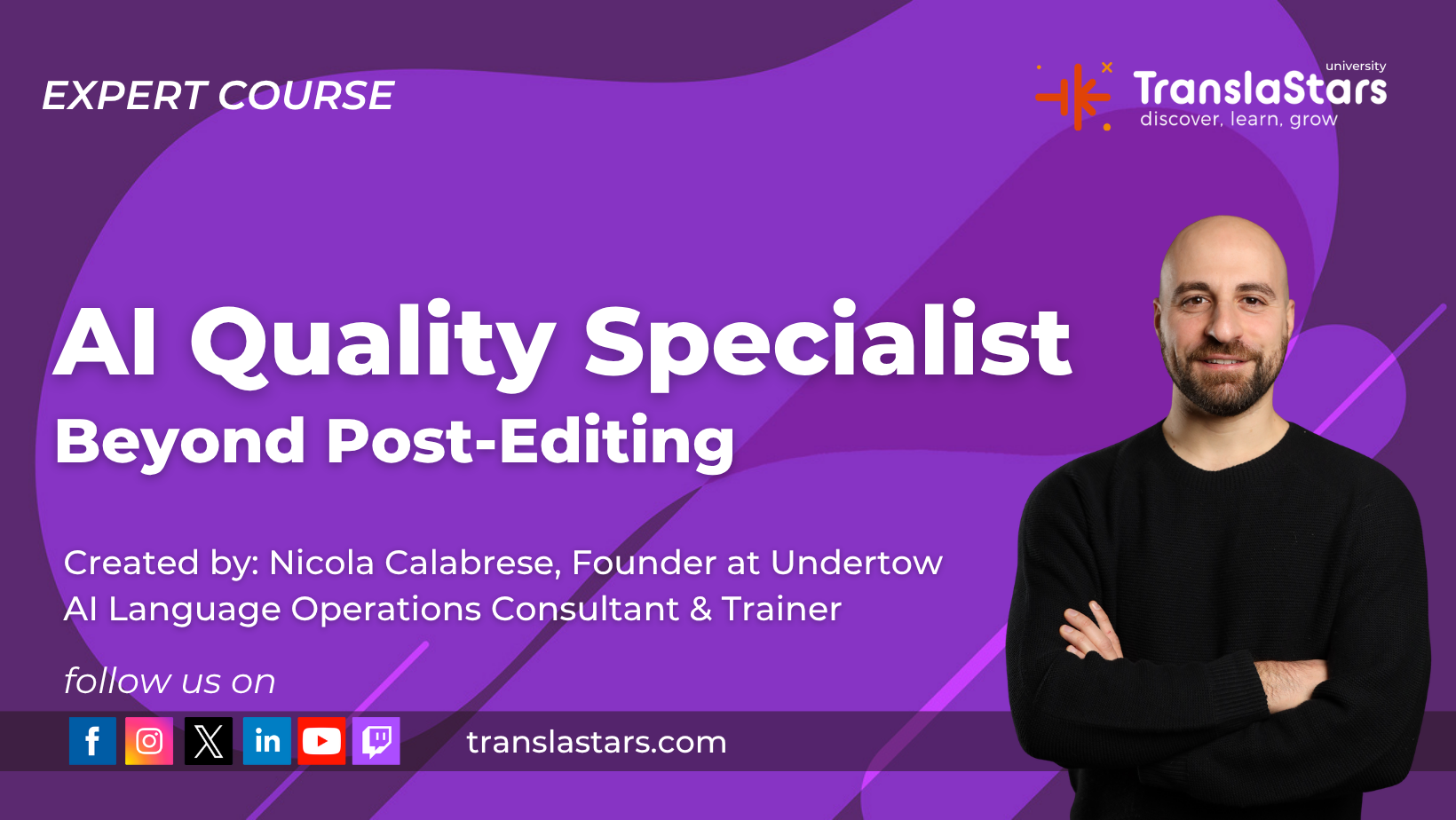
From Post-Editor to AI Quality Specialist
Learn the Four Pillars, the Four-Asset Toolkit and the AI error taxonomy that define this emerging role, and position yourself ahead of the curve.
If you work in Italian, the full post-editing and AI workflow is also available natively in that language.
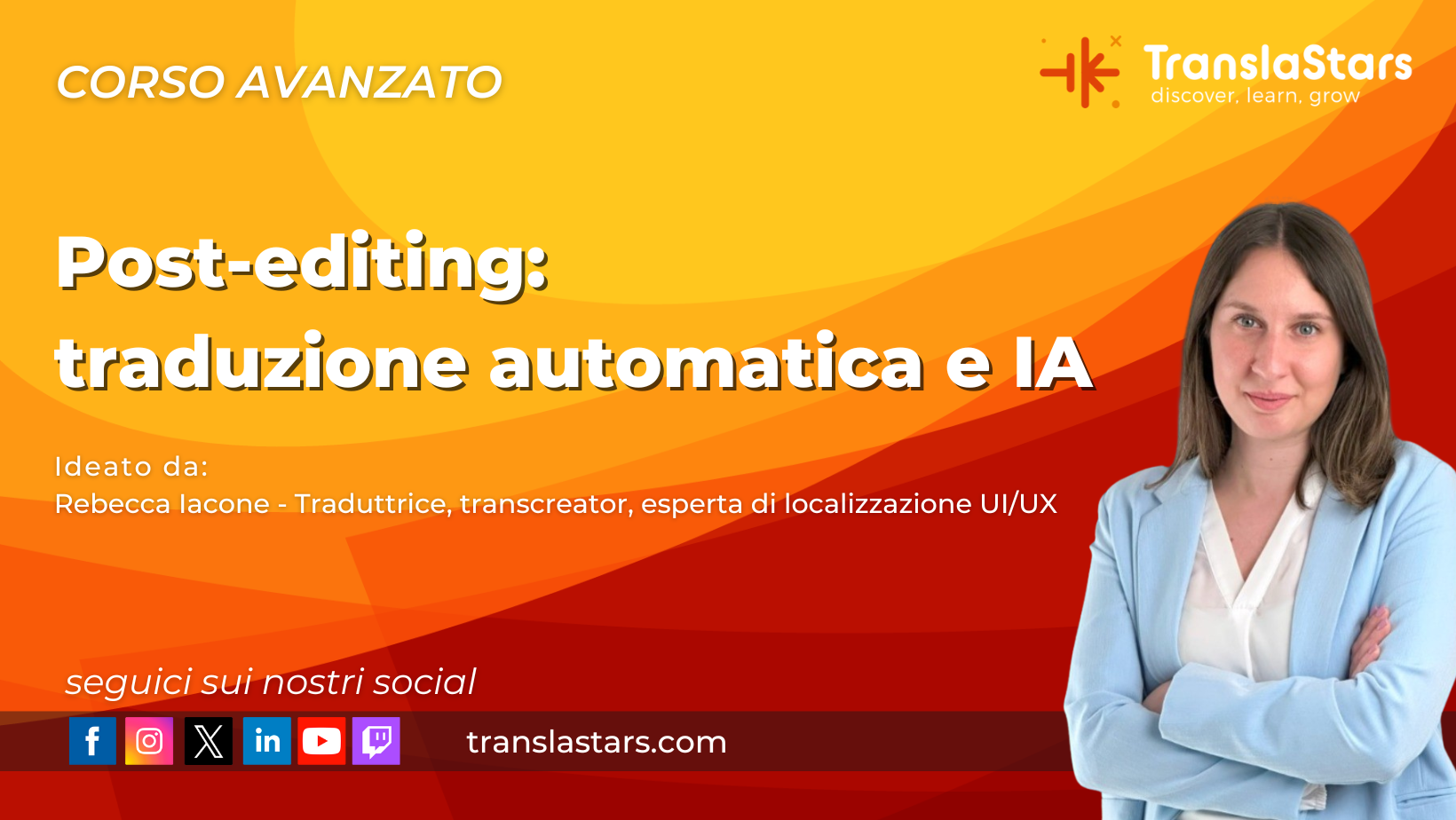
Post-editing: traduzione automatica e IA
Post-editing en italiano: traduzione automatica e IA para profesionales de la lengua que quieren dominar el flujo completo en su idioma.
Want to master AI workflows for translation? Explore the AI and MT courses at TranslaStars Courses, check current promotions, and keep up with the industry on TranslaStars Audio.