It is the moment to become a localization or program manager. Not in five years. Not “some day.” Right now. If you are a translator, a linguist, a coordinator, or someone who already runs projects informally, the window is open—and the data on the TranslaStars Jobs Board shows exactly why.
In this guide we go far beyond a list of duties. We break down, in depth, the three roles that people most often confuse—Localization Project Manager, Localization Program Manager, and Localization Manager—what each one actually does day to day, what you must know to do them well, and how to get from where you are now to being hired. And we ground it all in the real curriculum of the TranslaStars Localization Management Academy (LMA): 24 live sessions, 61 learning units, and instructors who run localization teams at companies like King and Booking.com.
In This Article
- Why Now Is the Time
- What a Localization Project Manager Does
- What a Localization Program Manager Does
- What a Localization Manager Does
- PM vs. Program vs. Localization Manager
- What You Must Know
- The Real Demand, by the Numbers
- Localization Management Programs (LMA)
- How to Become One
- Where to Learn It
1. Why Now Is the Time
For years, “project management” in localization was treated as a support function: someone to chase deadlines, send files, and keep the spreadsheet alive. That is changing. The language industry has crossed a threshold where machine translation and AI can move millions of words in seconds. What cannot be automated is the judgment, coordination and strategy that turns raw translation capacity into a product that works in every market.
That shift is exactly what pushes the manager role to the center. A translator who only translates is increasingly competing with a model. A manager who decides what gets translated, who does it, how it gets quality-checked, how much it costs, and whether it lands on brand is not competing with a model—they are the one running the machine. The LMA describes this evolution explicitly: managing localization is no longer about coordinating tasks, it is about localization strategy, quality governance and workflow design.
In one sentence: the LPM role is moving from coordination to strategy, and the people who understand both humans and AI will be the ones running localization for the next decade.
And for anyone coming from a language background, there is another reason it is the right moment: these are salaried, stable, career-progressive roles, not freelance gigs. You build a ladder, you build a team around you, and your value compounds as your industry gets more complex.

Master AI & Innovation for Localization
The AI layer of the role: how machine translation, LLMs and automation change the way localization is planned, executed, quality-checked and measured.
2. What a Localization Project Manager Does
The Localization Project Manager (LPM) is the single point of responsibility for one project from start to finish. If a product, a campaign, or a document needs to ship in ten languages, the LPM makes sure it happens—on time, on budget, at the right quality, with the right vendors and tools. Think of them as the producer who makes the whole production run, except the production is a localized product.
Concretely, an LPM works across six areas:
- Planning and scoping. Turning a request into a defined scope: how many words, how many languages, what file formats, what turnaround, what budget. Scoping is where projects are won and lost. If the scope is wrong, everything downstream pays for it.
- Vendor management. Selecting, briefing and managing the translators, reviewers, engineers and QA testers who do the work. In a large project this is a small army; the LPM is the one who knows each vendor’s strengths and matches them to the right task. This is so central that the LMA dedicates a full session (Session 14, taught by Nicola Calabrese) to Vendor Management alone.
- Tooling and workflows. Setting up CAT tools, translation management systems (TMS), glossaries and translation memories, preparing the files, and making sure all the moving technical pieces talk to each other.
- Quality management. Defining what “good” means for this specific project, running review cycles, gathering feedback, and fixing issues before they reach the customer. The LMA covers this in depth with dedicated frameworks and QA checklists.
- Stakeholder communication. The LPM is the bridge between the client or internal teams (product, engineering, marketing) and the linguists. They translate business priorities into project instructions, and project instructions into delivered work.
- Budget, cost and delivery. Tracking budgets, raising purchase orders, managing invoices, and ensuring the right files arrive in the right format at the right time.
The job title varies, but the shape is consistent. Across the live jobs on the TranslaStars board you find it as Localization Project Manager - APAC (2K), Localization Project Manager (On-site) (Translated), Localization Project Manager with German (Toppan Digital Language), SAP Localization Project Manager (Deloitte), Game Localization Project Manager (Japanese Speaking) (Dragonbaby), and Media Localization Project Manager (TransPerfect Connect). Same core role, different industries.
The day-to-day reality: an LPM juggles dozens of moving parts across languages and time zones. Files fail to export, a vendor goes silent, a scope explodes—and the LPM is the person who stays calm, reschedules, re-briefs, and still delivers.
memoQ for Translators & Project Managers
The CAT/TMS combination an LPM lives in every day: project setup, file preparation, translation memories and term bases, and the workflows that keep multi-language projects moving.
What an LPM is NOT
It is worth clearing up a common confusion. An LPM is not a production-line administrator, and it is not simply a “translated project manager.” The role requires a genuine understanding of the language industry—workflows, CAT/TMS tools, machine translation, pricing models, quality standards—that a general project manager would not have. That is why the LMA exists and why it is so specific: the best LPMs are language people who learned to manage, or managers who learned languages and localization.
3. What a Localization Program Manager Does
If a Project Manager runs a project, a Program Manager runs a portfolio of related projects that together deliver a bigger business outcome. The distinction matters and is one of the most misunderstood parts of this career.
A Program Manager does not care whether a specific file ships on Tuesday. They care about whether the entire multi-market program is coherent: are all the projects aligned to the same strategy, sharing the same terminology, using the same vendors sensibly, hitting the same quality bar, and not duplicating effort? Where an LPM asks “how do I deliver this project,” a Program Manager asks “how do I make sure all these projects together deliver the business goal, efficiently and without chaos?”
Concretely, a Program Manager owns:
- Program structure. Breaking a large initiative—say, launching a product in 20 markets—into projects, sequencing them, and making sure they reinforce each other.
- Strategy. Setting the localization strategy that all the projects follow. The LMA devotes three full sessions (Sessions 6, 7 and 8) to Localization Strategy, taught by Miguel Sepúlveda, Globalization Director at King. This is the heart of the program-level role.
- Terminology and consistency. Ensuring a single terminology program runs across every market. Session 9, Terminology Management, is taught by Celeste Martins, who has run a real terminology program at Booking.com.
- Cross-project governance. Standards, metrics, shared processes, and the routing of lessons from one project to the next.
- Stakeholder management at scale. Aligning product, marketing, engineering, legal and executive stakeholders. Session 4, Stakeholder Management, is taught by V. Carioni, and covers exactly this.
- People. Program Managers increasingly carry people leadership: leading LPMs, coordinators, and cross-functional teams. The LMA dedicates three sessions (13, 15 and 17) to People Management in Localization, taught by Stephen Nock.
On the live board, program-level roles appear as AI Localisation Program Manager - 12 Month Contract (Canva), AI Program Manager (Localisation) (Canva), Senior Localisation Program Manager, Product (Klaviyo), Localization Program Manager (MaintainX), and Localization Program Manager, CreatorGlobal (MrBeast).
Program Managers tend to earn more and operate at a higher level of abstraction. They are often the bridge between the localization team and the C-suite, because they are the ones who can articulate the business value of localization—not just the cost.
Communicating the Value of Localization
How to make the business case for localization and win buy-in from executives who only see the cost line.
4. What a Localization Manager Does
The term “Localization Manager” is the trickiest of the three, because companies use it in two different ways. Understanding which one you are looking at tells you a lot about the role.
Sense 1 — the in-house owner of everything localization. Here the Localization Manager owns the whole function for a company or a product line: the strategy, the team, the vendors, the budget, the tools, the quality bar, and the metrics. This is effectively a department head. They decide what to localize, in which languages, with what priority, and at what cost. It is the role that the LMA’s Setting up a Localization Department session (Session 12, J. Leal) prepares you for, alongside the ROI, Quality and Metrics session (Session 20).
Sense 2 — a senior project/program lead who owns the day-to-day. In this reading, the Localization Manager is a hands-on lead who runs the operation and the team, and may still roll up their sleeves on specific projects. It sits above an LPM but is more operational than a pure program strategist.
On the board, the title appears in both flavors. Classic department-owner roles include Localization Manager, Italian (Airbnb), Localization Manager | Mid-Senior (Nord Security), Translation & Localization Manager, Regulatory Delivery and Transparency (TikTok), and German Localization Manager (JD.COM).
Whichever sense the company means, a Localization Manager’s core accountabilities are the same: they own the team, the process, the quality and the outcome. They set the standard, they protect it, and they are accountable when it is not met. They also own the relationship with the wider business, which is why the LMA pairs technical localization skills with People Management (Sessions 13, 15, 17) and Stakeholder Management (Session 4).
The leadership layer: a Localization Manager must move from “doing the work” to “making the work happen through others.” The LMA is explicit that this is a distinct skill set, not just a promotion—which is exactly why so many managers describe themselves as “accidental managers.”
People Management in Localization (Ed. IV)
The human layer of the job: managing yourself, managing others and managing teams, with the emotional intelligence, feedback and cross-cultural skills that turn a coordinator into a leader.
5. PM vs. Program vs. Localization Manager
These three titles overlap, but they sit at different altitudes. Here is the clean way to separate them:
- Project Manager = responsible for one project’s on-time, on-budget, on-quality delivery. The unit of work is a project.
- Program Manager = responsible for a portfolio of projects that together deliver a bigger outcome. The unit of work is a program.
- Localization Manager = responsible for the whole function—the team, the strategy, the budget, the metrics—for a company or product line. The unit of work is the department.
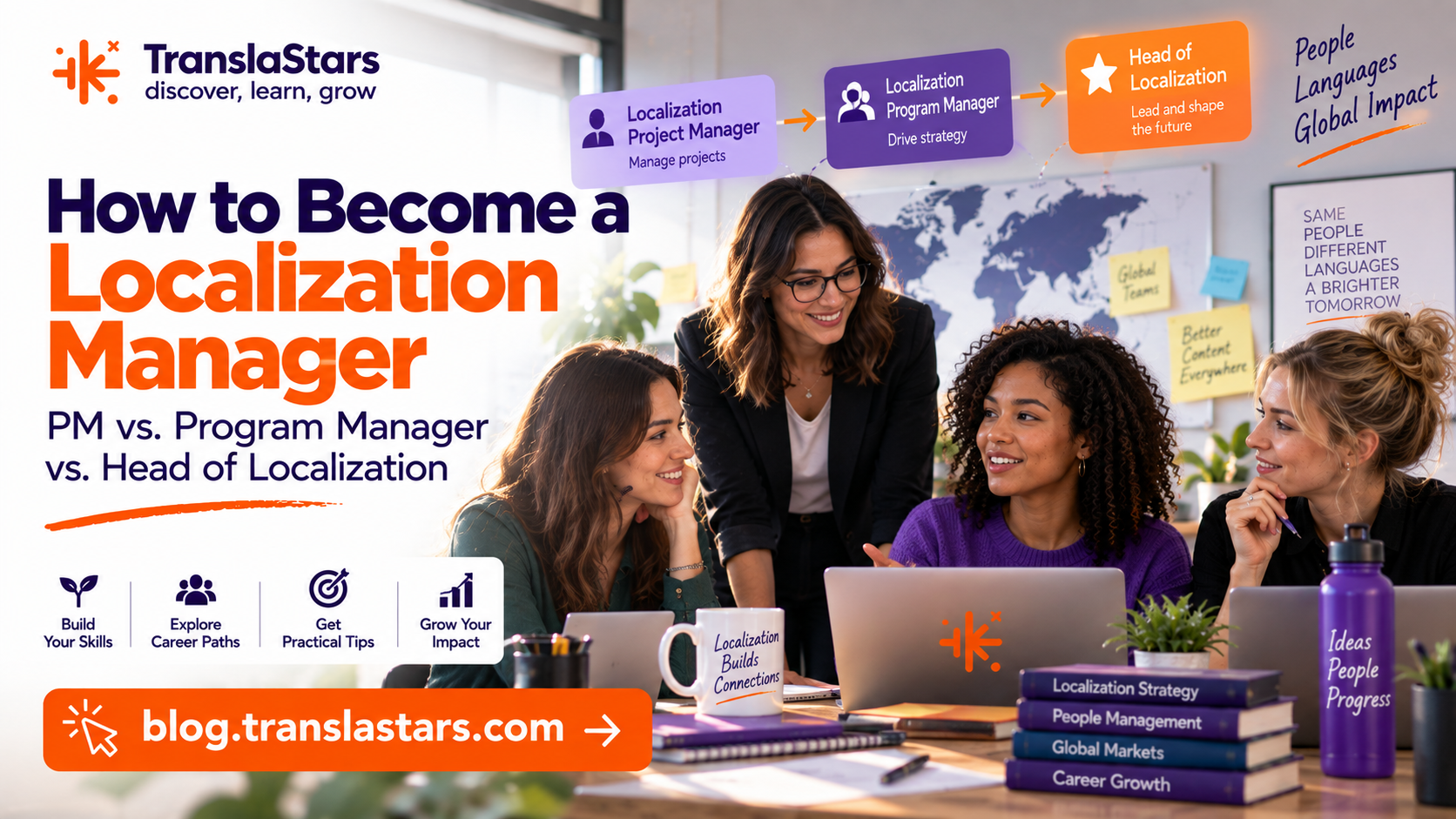
A common career trajectory is the natural progression: Project Manager → Program Manager → Localization Manager (Head of Localization). Or, for those with strong people skills, Project Manager → Team Lead/Localization Manager. The skills stack—project execution, then portfolio strategy, then team leadership—is exactly the stack the LMA is built around.
In practice, small companies use these titles interchangeably; large ones distinguish them carefully. Read the job description, not the title. That is why we break down the tasks here rather than relying on labels.
6. What You Must Know
Across all three roles, there is a core body of knowledge. The LMA maps it cleanly, and it is the best checklist of what an aspiring manager should learn.
1. Localization Strategy
Why localize, what to localize, which markets, in what order, and how it ties to business goals. This is the strategic layer, and it is taught across Sessions 6-8 by Miguel Sepúlveda (Globalization Director at King), who brings the storytelling and the business value of localization that separates a manager from a coordinator.
2. Project and Vendor Management
Running a project end to end, and managing the vendors who deliver it. Session 2 (Project Management, A. Ekhilevskiy) and Session 14 (Vendor Management, Nicola Calabrese) are the core. Vendor management, in particular, is the session people underestimate most—yet the quality you ship is literally the quality your vendors deliver.
Vendor Management for Localization (Ed. II)
Your vendors are your product. The full lifecycle: selection, evaluation, onboarding, assignment, monitoring and retention, including how to evaluate tests in languages you do not speak and how to spot vendor fraud.
3. Language Technology and Automation
CAT tools, TMS, machine translation, file formats, and how automation fits in. Session 3 (Language Technology and Automation, A. Ekhilevskiy) and Session 19 (Managing Multimedia Localization Projects) cover the technical side, and Session 18 (AI in Localization, M. Pantcheva) brings the AI dimension that now sits at the center of the role.
4. Content Strategy and SEO
Localization is not just translation—it is content that has to rank, convert and read naturally in each market. Sessions 10-11 and 22 (Content Strategy and SEO, B. Redondo) cover content marketing, SEO, tracking and measurement. This is where a manager moves from “executing requests” to “driving growth.”

SEO & SEA Localization and Content Creation (III Edition)
Localization that has to rank, convert and read naturally in each market: content strategy, SEO and SEA, tracking and measurement.
5. Terminology and Consistency
Session 9 (Terminology Management, Celeste Martins) teaches how to build and run a terminology program across markets—essential for any brand that cares about consistency, and a prerequisite for effective machine translation.
Strategic Terminology Management for Global Success
How to build and run a terminology program across every market: the prerequisite for brand consistency and for machine translation that actually works.
6. Stakeholder and People Management
Session 4 (Stakeholder Management, V. Carioni) and Sessions 13, 15, 17 (People Management in Localization, Stephen Nock). Stephen Nock is explicit about a key statistic: a huge share of managers are “accidental managers,” promoted on technical skill without formal people training. The LMA exists to fix that gap.
7. ROI, Quality and Metrics
Session 20 (ROI, Quality and Metrics, J. Leal) teaches how to measure localization’s impact, define quality, and report to leadership in the terms executives care about—KPIs, OKRs and the CEO dashboard. This is what gets Localization Managers a seat at the table.
8. Transcreation and Creative Adaptation
Session 16 (Transcreation Management, Nicola Calabrese) is one of the most valuable for managers because transcreation is the hardest project type to scope, brief, price and quality-check. As the LMA puts it: “Translation moves the words. Transcreation moves people.” Knowing when a project needs transcreation rather than translation, and how to brief it, is a genuinely senior skill.

Transcreation Masterclass
Translation moves the words; transcreation moves people. How to brief, run, price and quality-check the hardest project type in localization.
The truth about the industry: according to Nimdzi Insights, the language services market exceeds $68 billion — and the marketing and creative segment is one of the areas least exposed to full automation. That is exactly where a skilled manager’s judgment pays off.
7. The Real Demand, by the Numbers
This is the part that convinces people to make the move. We analyzed the live TranslaStars Jobs Board (curated localization and translation jobs, updated continuously) and the numbers are striking. Across a sample of 2,500 raw job postings, we identified 145 roles that fall in the project/program/localization management family. Breaking them down by title:
- 75 roles explicitly titled Project Manager (Localization, Translation, or Localization Project Manager).
- 32 roles titled Localization Manager.
- 28 roles titled Program Manager (Localization Program Manager).
That is not the whole story. The TranslaStars Jobs Board currently lists close to 1,450 jobs live across the localization and translation industry at any time. When you filter specifically for “Project Manager” in the title, you get 39 matching jobs — all of them real, actively posted roles. That is a strong signal that the market is hiring managers, not just translators.
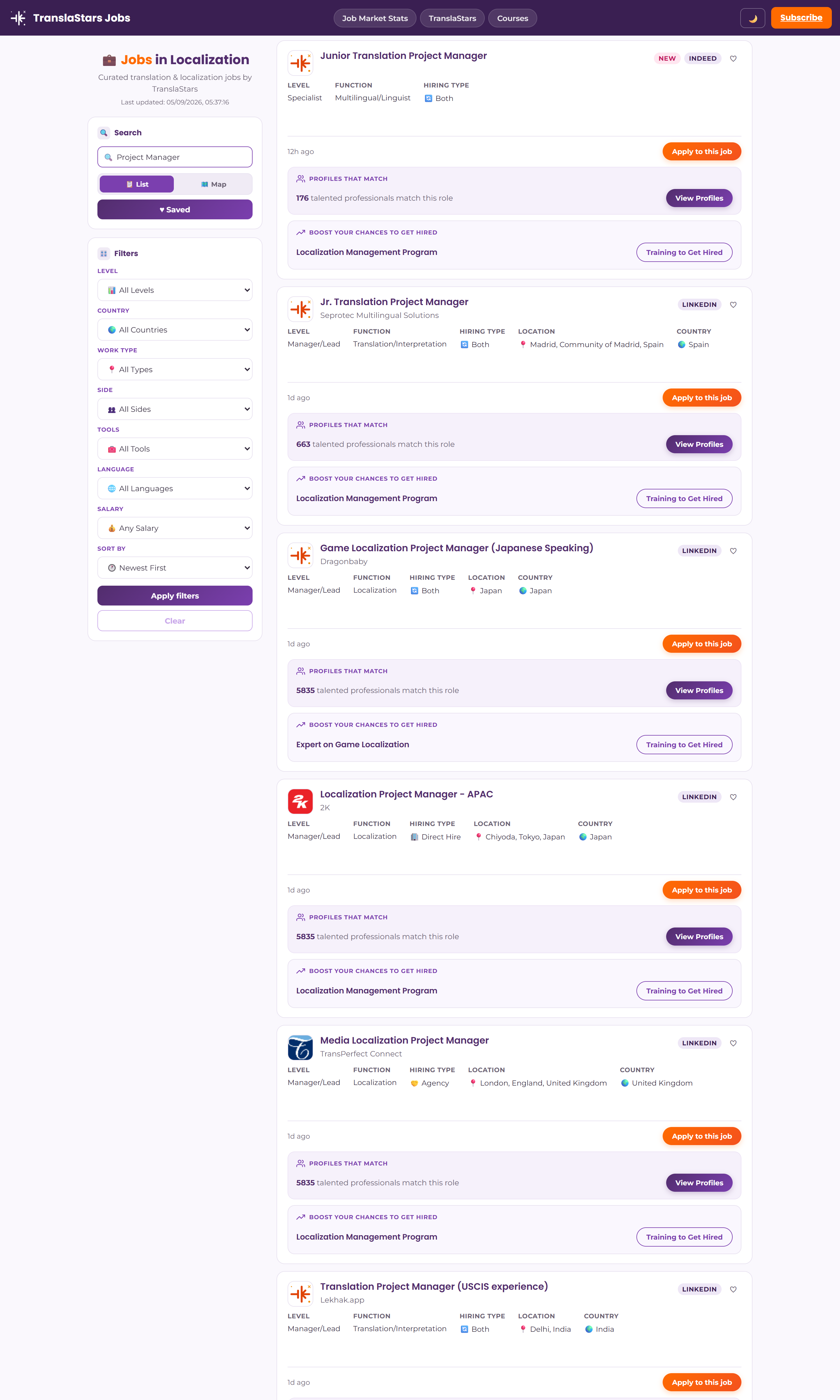
Looking at the companies that hire these roles, the demand is broad and high-profile: LocalizationJobs.com (20 postings), Canva (4), TikTok (4), Airbnb (4), The Pokémon Company International (4), Toppan Digital Language (4), Seprotec Multilingual Solutions (4), Pixelogic Media (4), Thermo Fisher Scientific (4), plus Deloitte, TransPerfect Connect, Klaviyo, SEGA Europe, Apple, MrBeast, 2K, Nord Security, Booking Owners and many more.
And the seniority distribution shows a real career ladder, not a single rung:
- 109 roles at the Manager level.
- 19 roles at the Senior / Lead level.
- 17 roles at the Entry / Junior level.
That means there is a clear on-ramp for juniors, a healthy middle, and a path upward to senior and leadership. It is a market that is actively growing, actively hiring, and rewarding people who can think at the program and strategy level, not just execute tasks.
Read the board yourself: book-mark the TranslaStars Jobs Board and search “Project Manager”, “Localization Manager” or “Program Manager”—you will see live roles from all these companies, in every region.
KPI Measurement for Localization
The data side of the role: word counts, budgets, quality metrics and the KPIs that get localization a seat at the table.
8. Localization Management Programs (LMA)
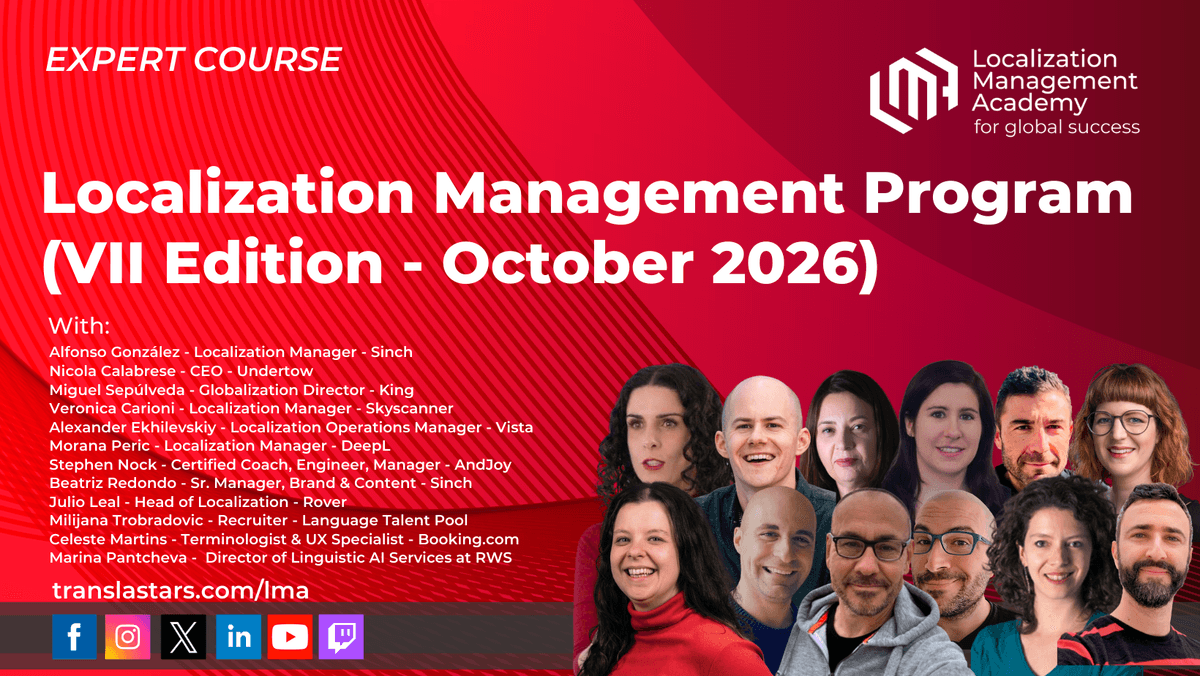
This is the part we are most excited about, because it is the real, hands-on curriculum that teaches exactly the skills above — taught by people who run these roles at global companies. The TranslaStars Localization Management Academy (LMA) is the program we reference throughout, and the program is a complete, 24-session arc across 61 learning units.
Here is the curriculum as it actually runs (with the real instructors):
- Session 1 — Intro, Language Service Buyer & Intro to the Language Services Industry. A. González & N. Calabrese.
- Session 2 — Project Management. A. Ekhilevskiy.
- Session 3 — Language Technology and Automation. A. Ekhilevskiy.
- Session 4 — Stakeholder Management. V. Carioni.
- Session 5 — UX and Product. M. Peric.
- Sessions 6-8 — Localization Strategy I, II & III. Miguel Sepúlveda (Globalization Director at King).
- Session 9 — Terminology Management. Celeste Martins (who has run a terminology program at Booking.com).
- Sessions 10-11 — Content Strategy and SEO I & II. B. Redondo.
- Session 12 — Setting up a Localization Department. J. Leal.
- Session 13 — People Management in Localization I. Stephen Nock.
- Session 14 — Vendor Management. Nicola Calabrese.
- Session 15 — People Management in Localization II. Stephen Nock.
- Session 16 — Transcreation Management. Nicola Calabrese.
- Session 17 — People Management in Localization III. Stephen Nock.
- Session 18 — AI in Localization. M. Pantcheva.
- Session 19 — Managing Multimedia Localization Projects. A. Ekhilevskiy.
- Session 20 — ROI, Quality and Metrics. J. Leal.
- Session 21 — TMS Selection. V. Carioni.
- Session 22 — Content Strategy and SEO Part III. B. Redondo.
- Session 23 — Careers in Localization Management. M. Trobradovic.
- Session 24 — Closing. A. González & N. Calabrese.
There is also a bonus track on Master in AI and Innovation for Localization and, at the end, a Certificate of Completion. The program’s own tagline captures the outcome: “Acquire the skills from the best localization managers to establish a localization strategy and know how to implement it anywhere.”
Localization Management Program (LMA)
The end-to-end management program this article is built on: strategy, project and vendor management, people, stakeholders, AI, transcreation, ROI and metrics, taught by managers from King, Booking.com and leading LSPs.
Live editions: the LMA runs live online in cohorts (4 weeks, 2 hours a day, 46 hours in total). The full calendar is announced on the program page.
Notice what the curriculum is not. It is not a list of translation tips. It is a management education: strategy, vendors, people, stakeholders, AI, metrics, transcreation, content and user experience. Those are exactly the skills a PM, Program Manager or Localization Manager needs to do the job—and exactly what you cannot learn by translating more words.
What the Program Teaches From Inside the Sessions
Let us look at two sessions in detail, because the content is genuinely industry-grade.
Vendor Management (Session 14, Nicola Calabrese). The session’s core thesis is “Your vendors are your product. Manage them like it.” The instructor builds a repeatable system for the whole vendor lifecycle—selection, evaluation, onboarding, assignment, monitoring and retention. It covers how to evaluate translation tests even in languages you do not speak, how to spot vendor fraud and scams (from fake identities to raw machine translation passed off as human work), and how to match the right vendor to the right project by expertise, availability and rate. For anyone who has ever shipped bad quality because a vendor went silent, this is the session that fixes it. And because Vendor Management is a core LSP function, it is delivered against a real project-assignment exercise, not theory.
Transcreation Management (Session 16, Nicola Calabrese). The tagline is “Translation moves the words. Transcreation moves people.” This session is built around real brand work and walks you through the full creative adaptation process—from brief to on-brand, on-time, on-budget copy. The instructor explains when a project needs transcreation rather than translation or multilingual copywriting, how to profile content to pick the right approach per asset, and how to build a copydeck: structured recommended versions, back-translations, alternatives and rationales. Crucially, it gives a reusable QA checklist to judge whether transcreated copy is on-brand or off-brand. Since transcreation has no single correct answer, it is one of the hardest project types to scope and price—and knowing how to run it is a genuine point of seniority.
People Management: the Accidental Manager Problem
Sessions 13, 15 and 17 (Stephen Nock) tackle the human layer. Nock is explicit about a striking statistic: as many as 82% of people stepping into management are promoted on technical skill or high performance without formal management or leadership training. They become “accidental managers.” Project managers suddenly find themselves responsible for people development, vendor relationships and conflict resolution with no training for it.
The sessions are built in three blocks: Managing Yourself (emotional intelligence, self-awareness, the cultural context of leadership, navigating a VUCA and BANI business world), Managing Others (psychological safety and inclusion, active listening, giving feedback that improves quality and trust), and Managing Teams (the shift from contributor to manager, remote and cross-cultural team dynamics, leadership styles and trust). This is the part that turns a coordinator into a leader.
The takeaway: the LMA does not just teach you “how to run a translation project.” It teaches you to think like a manager—strategy, people, metrics, AI, creative and technical—and to build localization programs that deliver real business value.
9. How to Become One
There is no single path, but the routes are well worn. Here is how people actually get into these roles.
Route 1: From Freelance Translator
The most common path. Translators who understand the business side—budgets, workflows, client expectations—move into PM roles at agencies or platforms. You already speak the language of the work; you just add the management layer. This is the natural fit for someone who has ever complained that “the PM doesn’t understand what this takes.”
Route 2: From QA or Vendor Management
QA leads and vendor coordinators grow into LPM roles naturally. You already judge quality and manage suppliers; learning to manage a full project is a short step.
Route 3: From General Project Management
PMs from other industries who learn localization specifics. You already know Gantt charts, risk registers and stakeholder maps; you add CAT/TMS, MT and quality standards. The LMA’s technical sessions (Language Technology, TMS Selection) fill the gap fast.
Route 4: From In-House Language Roles
Terminologists, localizers and content specialists transitioning to coordination and then management. You understand the craft deeply; you learn to run the machine.
Route 5: From Internships and Junior Coordinator Roles
Many agencies and companies hire junior localization coordinators and train them up. This is the entry door, and it is real—the seniority data above showed 17 entry-level roles in just a 145-role sample. Junior PM roles appear on the board as Junior Translation Project Manager, Jr. Translation Project Manager and Associate Project Manager.
The fastest, most reliable route
Get certified in a TMS, learn the end-to-end workflow, and apply for junior coordinator roles. From there you climb. But the accelerant is specific management training—the kind that teaches you strategy, vendor management, people and metrics rather than just task execution. That is exactly what a Localization Management Program fills.
10. Where to Learn It
If you are serious about this move, here is where TranslaStars can help, and these are real courses, not generic links.
- Localization Management Program (LMA) — the end-to-end management standard referenced throughout this article: strategy (3 sessions), vendor management, people management (3 sessions), stakeholders, AI, transcreation, ROI/metrics, content & SEO, TMS selection and careers. Taught by managers from King, Booking.com and leading LSPs.
- memoQ for Translators & Project Managers — the CAT/TMS combination an LPM lives in day to day.
- KPI Measurement for Localization — the data side of the role: word counts, budgets and quality metrics, the language of the CEO dashboard.
- Training to Get Hired — the TranslaStars LMA landing page, where you can explore the program and its sessions.
And once you have the skills, go find the role. Book-mark the TranslaStars Jobs Board and set a recurring search for Project Manager, Localization Manager and Program Manager.
It is the moment to become a PM. Build the skills with a Localization Management Program, find your first role on the TranslaStars Jobs Board, and see how the work is done on TranslaStars Audio.