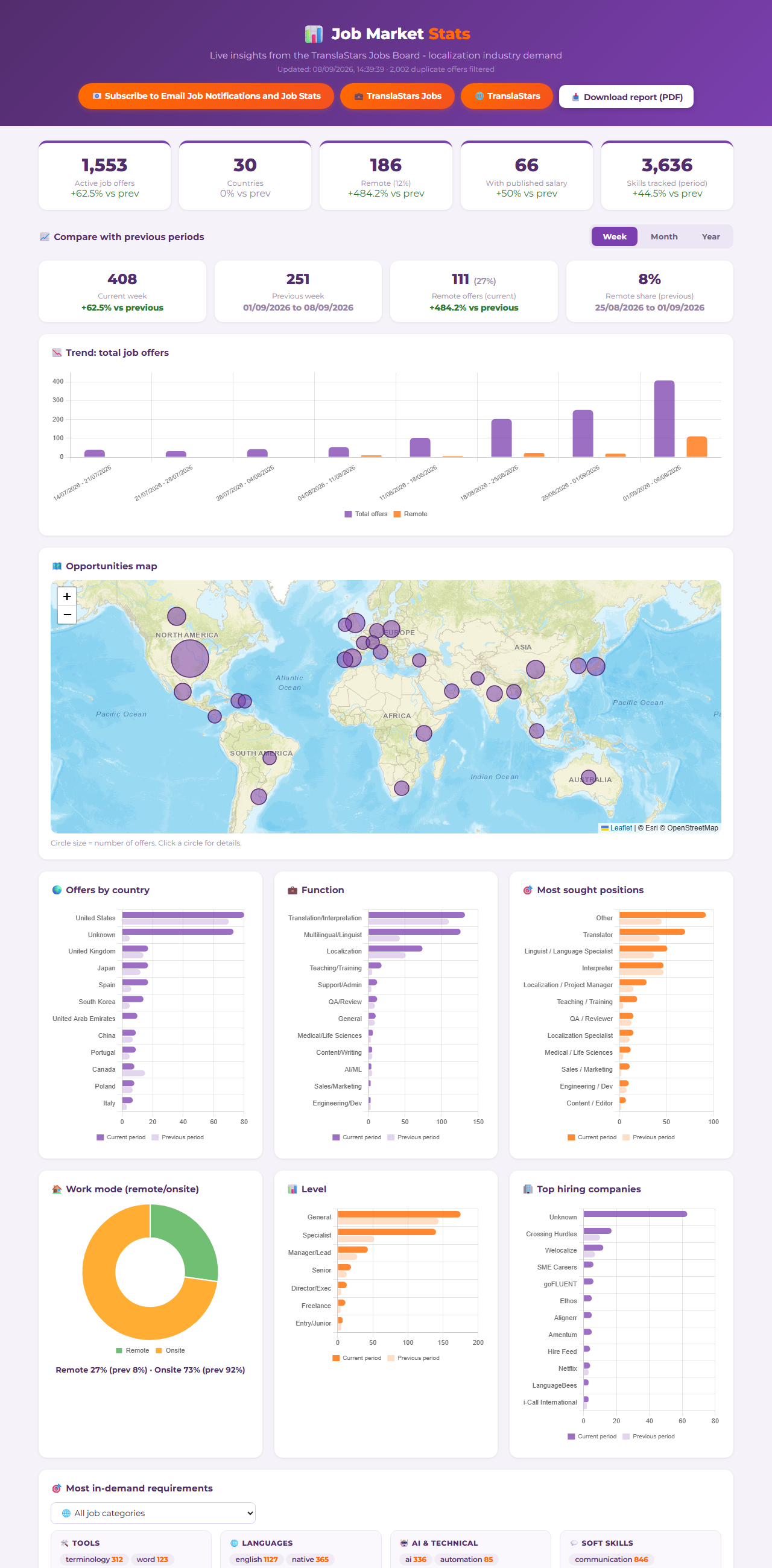

Which translation and localization jobs pay the most in 2026? Not the one you might guess. We went straight to the source: the TranslaStars Jobs Board, which aggregates live translation and localization openings across the industry. This article is built on a snapshot of roughly 2,500 active job postings, of which around 262 listed a salary - a striking reminder that pay transparency is still rare in our field. But those postings revealed a clear pattern: the best-paying roles are not generalist translation. They cluster in specialized domains (medical, legal, technical), project & people management, and AI / machine-learning localization.
Here is the honest summary up front: the market is bifurcating. Plain "translate anything" work is being commoditized by machine translation and global rate competition. Meanwhile, employers are competing hard for people who combine a genuine specialization, real tool mastery, and the management skills to run projects, vendors and teams. The ten roles below are the ones that pay the most in 2026 - and I will show you what each one takes to land.
In This Article
- Where the Jobs Are (By Function)
- 1.Localization Project Manager
- 2.Localization QA / Review Specialist
- 3.Audiovisual & Dubbing Lead
- 4.Medical & Life Sciences Translator
- 5.Legal Translator
- 6.Game Localization Producer
- 7.AI / ML Data Annotator (Linguist)
- 8.Subtitling & Captioning Specialist (SDH)
- 9.Localization Engineer
- 10.Transcreation / Marketing Localization Lead
- How to Get Hired: The Real Strategy
Where the Jobs Are (By Function)
Before you chase a role, understand the shape of the market. From the live board, here is how the 2,500 postings break down by function:
Why "localization" posts pay more but are fewer. In the live board, the roles tagged localization overwhelmingly turn out to be project, program and localization management positions. That is exactly why they pay above the generalist average and appear in smaller numbers: the supply of strong managers is far tighter than the supply of translators. Specialists who can run a whole language pipeline are scarce, so the market prices them at a premium.
Job postings by function
Source: TranslaStars Jobs Board · ~2,500 live listings, 2026
Two takeaways stand out. First, Translation/Interpretation dominates by volume, which is exactly why it is the most crowded and the most rate-competitive lane. Second, the smaller bars are where the money is: QA/Review, Engineering, AI/ML and Medical are all niche, high-skill and far less saturated. The healthier pay follows the scarcity.
1. Localization Project Manager
The single most consistently well-paid role in the data. A Localization Project Manager owns the end-to-end delivery: quoting, vendor selection, schedule, budget, and client communication. Employers ask for TMS platforms (Phrase, Smartcat, XTM), Jira, and real budgeting ability. It is a management role, not a linguist role - and that is why it pays well.
Why it pays: it sits at the business layer, where decisions directly affect revenue and client retention. It is a role you grow into from senior linguist or coordinator, not a first job.

2. Localization QA / Review Specialist
With 68 live QA/Review openings on the board, this is a high-demand, high-skill niche. A Localization QA / Review Specialist is the safety net that catches errors before they reach customers: terminology consistency, error taxonomy, style-guide adherence, and post-editing of machine output. As MT use grows, the need for human QA grows with it.
Why it pays: QA is the quality gate. Clients pay a premium for the confidence that a release is error-free. This is a role where understanding MT output and CAT-tool QA features makes you genuinely valuable.

3. Audiovisual & Dubbing Lead
Audio and video localization is booming, and the postings pay accordingly - we saw expert Audiovisual roles listing $95/hr and above. A dubbing lead directs the whole chain: script adaptation, timing, voice casting, recording sessions and QC. The AI-vs-human dubbing debate is reshaping this lane, so the most valuable leads are the ones who can run a hybrid human + AI workflow.
Why it pays: dubbing is a coordinated production, not a solo translation task. Running the coordinating layer is a specialist, high-trust job.
4. Medical & Life Sciences Translator
Life sciences consistently carries some of the highest rates in the industry. A Medical & Life Sciences Translator handles clinical trials, pharmacovigilance, regulatory submissions and patient-facing documents. The entry requirements are serious: pharmacology, anatomy, FDA/EMEA terminology, and a zero-tolerance-for-error mindset. That barrier to entry is exactly what keeps rates high.
Why it pays: the risk is high, so the pay is high. An error in a dosing label or a clinical report can have real-world consequences, and clients pay for that precision.

5. Legal Translator
Legal translation rewards specialization and formal qualification. Contract law, court documents, intellectual property and corporate filings demand precise, jurisdiction-aware work. Many roles require a legal background or certification, which creates a strong moat against casual competition. As companies expand cross-border, demand for reliable legal linguists stays steady.
Why it pays: the combination of niche knowledge and accountability. You are translating documents with legal weight, so clients select for trust and precision over price.
6. Game Localization Producer
The videogame industry is a heavyweight buyer of localization services. A Game Localization Producer manages localization for a title across many languages at once: string management, character limits, LQA in-engine, and liaison with dev teams on platform constraints. It is fast, technical and genuinely demanding.
Why it pays: video games ship huge volumes of text on tight timelines, and the coordination complexity is high. Producers who understand both CAT pipelines and game tooling are scarce.

7. AI / ML Data Annotator (Linguist)
As AI models learn languages, they need people to teach them. An AI/ML Data Annotator (Linguist) evaluates, labels and corrects linguistic data for training and evaluation. The board shows 30 AI/ML openings and growing, and the best-paying ones want more than grammar: they want Python, SQL, and prompt engineering. This is the emerging lane where linguistics meets data science.
Why it pays: it is a new, technical skill set in short supply. The overlap of language expertise and data skills is rare and commands a premium.

8. Subtitling & Captioning Specialist (SDH)
Subtitling is a volume business, and the SDH (Subtitles for the Deaf and Hard of Hearing) niche is highly specialized. A Subtitling & Captioning Specialist handles timing, reading speed, line-length constraints, and audio description for accessibility. The board shows recurring Subtitling Project Coordinator openings, confirming a steady, professionalized lane.
Why it pays: broadcast and streaming platforms need compliant, precisely-timed subtitles at scale. Specialist subtitlers with tool fluency and accessibility knowledge are in demand.

9. Localization Engineer
At the technical end you find the Localization Engineer. They build and maintain the pipelines that let content flow into many languages: XML/HTML parsing, CAT tool integrations, CI/CD for strings, and pseudo-localization checks. The board shows Engineering/Dev roles and tool demands for Python (67 mentions), C++, Java and HTML.
Why it pays: this is software engineering applied to language. It is the highest median-pay function in our data, because it is hard to find and hard to do.
10. Transcreation / Marketing Localization Lead
The creative end of localization is where brand value lives. A Transcreation / Marketing Localization Lead adapts campaigns so they land emotionally, not just linguistically: brand voice, tone, cultural relevance and SEARCH optimization. It is consultancy as much as translation, and it pays like it.
Why it pays: brands measure this work in revenue impact, not word count. A campaign that resonates in a new market is worth far more than a literal rendering.

How to Get Hired: The Real Strategy
Looking at the level data, the picture is clear. Of the 2,500 postings, the seniority breakdown is: Specialist (459), Manager/Lead (265), Senior (147), and Director/Exec (64). Combined, Manager/Lead, Senior and Director account for about 476 postings - roughly 19% of the total. They are the best-paid and the least crowded.
Put simply: the generalist lane is saturated, the specialist + management lane is not. The strategy that works in 2026 is:
- Pick one specialization (medical, legal, game, audiovisual, or technical) and go deep. Depth beats breadth for pay.
- Master the tools that appear in postings: memoQ, Trados, Phrase, Jira, Excel. Tool fluency is the first filter recruiters apply.
- Get management or AI skills. PM roles and AI-literacy roles are where the money is moving, and they are far less crowded.
- Build the proof. A specialized portfolio with real, measured results beats a long list of general jobs every time.
The roles above are the ones worth targeting. Pick the lane that fits your language pair and interests, invest in the specialization, and you are choosing the less-crowded, better-paid side of a market that is moving fast.
To see this market live, explore the boards. The Jobs Board shows the current openings and their requirements:
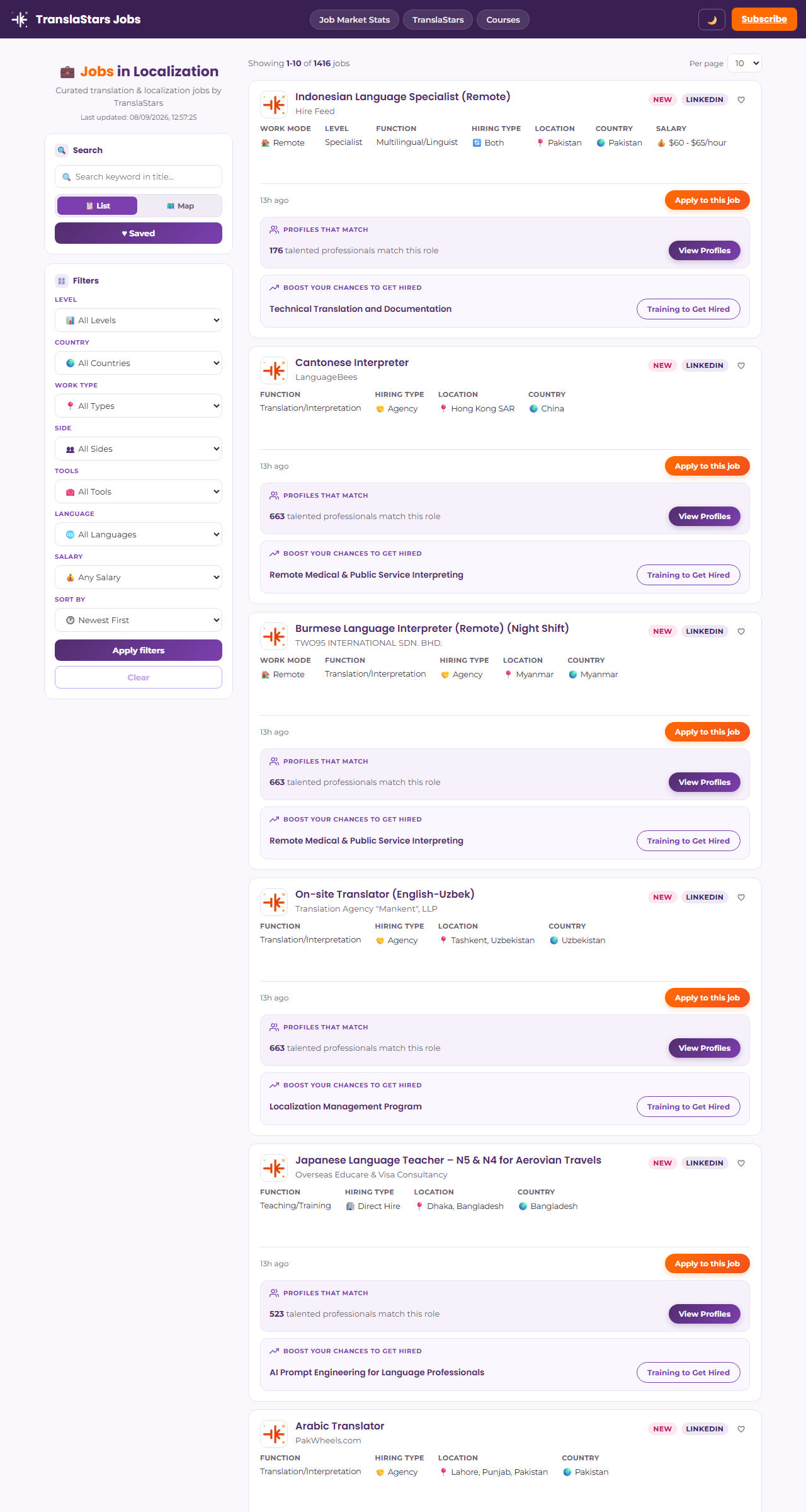
And the Stats Board shows the very same data as live market insights: active postings, growth, work-mode split, and the most in-demand requirements.