Video games are the biggest entertainment industry in the world, and every successful game is localized into multiple languages. From AAA titles with hundreds of thousands of words to indie games reaching global audiences, the demand for game localization professionals has never been higher.
But game localization is not regular translation. It is a blend of translation, creativity, technical constraints and cultural adaptation - and it is one of the most fun and best-paid specializations in the industry. Here is how to break in in 2026.
1. The Industry at a Glance
Game localization is a growing industry built on an enormous global market. These are the numbers behind it:
- Global gaming revenue: Newzoo put the global games market at $182.7 billion in 2024, up 3.2% year on year.
- Players worldwide: Newzoo counted 3.42 billion players around the world in 2024, up 4.5% year on year.
- The localization market: game localization services were worth around $3.9 billion in 2025 and are expected to grow at roughly 8.9% a year, with translation and editing the largest segment.
- Reach by language: a game localized into 8 to 10 languages can access markets that make up more than 80% of global gaming revenue.
- Localization pays off: a 2025 study of more than 10,000 games across 70+ countries found that translating a game into local languages boosted sales revenue in those markets by as much as 12.1%.
Takeaway: localization is not a nice-to-have. It is how games reach the majority of the world's paying players, and the market is growing.
2. What Game Localizers Do
A game localizer adapts every piece of text in a video game for a new market. That includes:
- Dialogue and narrative: character conversations, quest text, cinematics.
- UI strings: menus, buttons, settings, error messages - often with tiny character limits.
- Items and descriptions: weapons, skills, lore entries, item names that must fit the game world.
- Marketing and store text: game descriptions on Steam, PlayStation and app stores.
- Cultural adaptation: jokes, references and content that must work in the target culture.
- LQA (Linguistic Quality Assurance): testing the game with the localization applied to catch bugs, truncation and context errors.
Key difference from other translation: you often translate without seeing the full context. Strings appear one by one in a spreadsheet, and you must imagine the game around them.
3. Types of Game Localization
| Type | What It Involves | Who Does It |
|---|---|---|
| Translation | Translating game text with glossaries and style guides | Game translators |
| LQA (Linguistic QA) | Playing the game to check text in context, report bugs | LQA testers and leads |
| Voice-over (dubbing) | Adapting dialogue for lip-sync and voice recording | Voice directors, adapters, actors |
| Culturalization | Adapting content for cultural sensitivity and legal compliance | Senior specialists |
| Project management | Coordinating teams, tools and schedules | Localization PMs |
4. Skills You Need
Game writing needs a natural, creative voice, so the right training matters. These two courses are taught by translators who work on real titles:
Gaming Localization
Deep dive into the unique challenges and workflows of the gaming industry and become an expert on game localization with Raquel Espada
Expert on Game Localization
Become an expert on game localization with Diego Perez and acquire the skills to succeed in this thriving industry
- Native-level target language: game writing needs a natural, creative voice.
- Strong English (usually): most games are authored in English; some in Japanese or Chinese.
- Gaming literacy: you should actually play games and understand genres, UI conventions and player expectations.
- Creativity and cultural awareness: the ability to adapt jokes, idioms and references so they land in your culture.
- Technical adaptability: working with spreadsheets, CAT tools and game localization platforms.
- Research skills: game universes have their own terminology; consistency is everything.
Specializing in a genre helps: RPGs, shooters, mobile games, or niche genres like visual novels all have different demands.
5. The Unique Challenges
Real game projects come with real scenarios - this course walks you through live cases:
The Videogame Localization Course
Become an expert on videogame localization with real life case scenarios with the wizard of Oz
- Character limits: a button that fits 'Save' in English may not fit the equivalent in German. You must convey meaning in the same pixel budget.
- Variables and placeholders: strings contain {name}, %s and other placeholders that you must not break.
- No context: you often see only a bare string with no surrounding text.
- Pluralization and gender: languages handle these differently; game engines expect specific patterns.
- Consistency at scale: thousands of strings, multiple translators, one coherent game world.
- Truncation and overlap: in LQA, text that is too long breaks the UI - a classic bug.
6. Tools of the Trade
- Game localization platforms: Lokalise, Phrase, Crowdin (widely used by game studios), XTM, memoQ.
- CAT tools: Trados and memoQ for traditional game text.
- Translation memories and glossaries: the backbone of consistency in game projects.
- Spreadsheets: still surprisingly common for indie projects.
- LQA tools: bug tracking systems and in-game screenshot tools for reporting issues.
Pro tip: learn Crowdin or Lokalise - many game studios use them, and free community projects on both platforms are a great way to get real experience.
7. How to Get In (No Experience)
If you work in other languages or markets, there is a course tailored to your target audience:
Game Loc in the Arabic Speaking World
Acquire the basic skills to become a successful game localizer for the Arabic speaking world
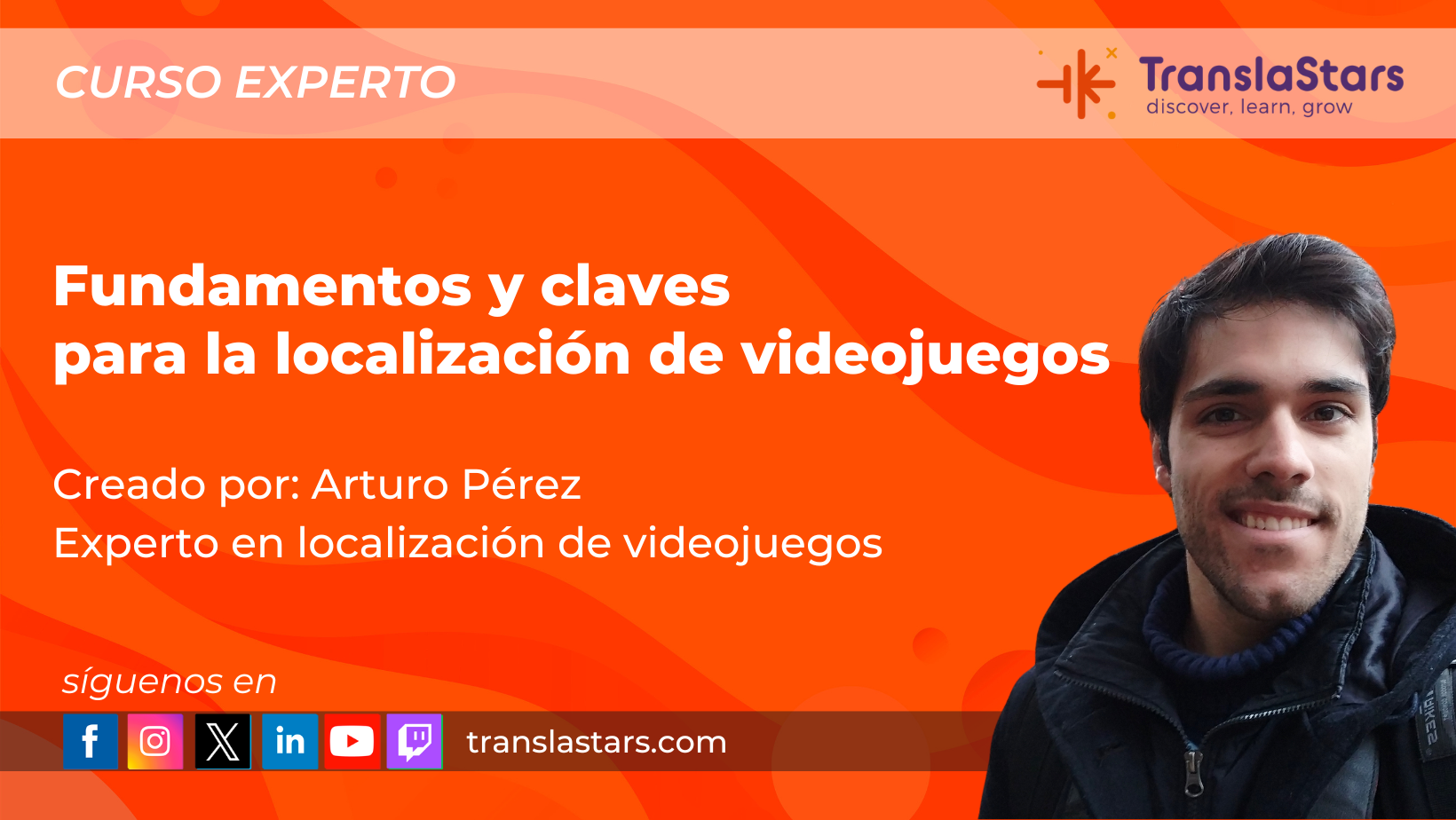
Fundamentos y claves para la localización de videojuegos
Adquiere las habilidades y herramientas necesarias para triunfar en el sector de la localización de videojuegos
- Localize an indie game for free (with permission): many indie developers welcome community translations. Ask politely, deliver quality, and you have a portfolio piece.
- Contribute to game localization projects on Crowdin: real strings, real studios, real feedback.
- Build a gaming-focused portfolio: translate game UI, reviews, or game websites - anything that shows you understand gaming language.
- Take training: TranslaStars offers game localization courses covering fundamentals and LQA, taught by working professionals.
- Apply for LQA positions: entry LQA testing roles are the classic door into the industry - they require gaming knowledge and attention to detail.
- Network on the TranslaStars Jobs Board and LinkedIn: game localization PMs post openings regularly.
8. Rates and Career Path
Game localization rates are generally competitive with other specializations, and the career path is clear:
- Freelance translator: per-word rates for game text, often with LQA sessions billed per hour.
- LQA tester: entry-level, hourly, a foot in the door.
- LQA lead / reviewer: manages other testers, reviews translations, higher rates.
- Senior game localizer / culturalization expert: top of the freelance market.
- In-house localization PM: salaried roles at studios and publishers.
- Localization director: the executive level for large studios.
Advice: start with translation plus occasional LQA. The combination makes you dramatically more hireable than someone who only does one.
9. AI and the Future of Game Loc
AI is already used for game text generation and MT-assisted workflows, especially for UI and bulk content. But creative, narrative and culturalized content still needs human professionals - and LQA is growing because MT output needs checking.
The game localizers who win in 2026 are those who treat AI as a tool: using MT for drafts, then applying their creative and cultural judgment. The demand for human quality in games is not going anywhere.
10. Organizations and Events to Know
Getting in is also about being part of the community. These are the organizations, associations and industry events where game translators and localizers connect, learn and find work:
IGDA - International Game Developers Association
The main global association for game developers. Its Localization special interest group is the natural home for game loc professionals and a great place to network and share resources.
igda.orgGALA - Globalization and Localization Association
The leading nonprofit trade association for the language industry, with news, training and networking for localization professionals across the globe.
gala-global.orgWomen in Localization
A global organization supporting women in the localization industry, with chapters, mentorship, events and a strong community for translators and PMs.
womeninlocalization.comLocalization World
The premier industry conference series connecting localization buyers, providers and professionals through conferences and summits worldwide.
localizationworld.comGamescom
The world's largest gaming trade fair, held every year in Cologne, Germany. A massive hub for game studios, publishers and localization teams - and a great place to understand the market.
gamescom.globalGame Developers Conference (GDC)
The biggest annual gathering for game developers in San Francisco, with dedicated talks on localization, global audiences and accessibility for game content.
gdconf.comdevcom
Europe's leading developer conference, held alongside Gamescom, with a strong focus on the business and production side of games, including localization and global publishing.
devcom.globalSlator
The language industry's leading news and research platform, covering localization, AI and the translation market - essential reading to stay on top of the industry.
slator.comTip: follow these organizations and events online. Many host community translation programs, job boards and networking sessions that are the fastest way to build contacts in the industry.
11. Companies Working in Game Localization
If you want to break into game localization, it helps to know the companies that actually do the work. These are some of the most recognised studios and language service providers in the game localization industry - and many of them hire freelance game translators and LQA testers:
Lionbridge Games
The dedicated game division of Lionbridge, one of the largest language services providers in the world. It handles full-game localization, audio and testing for major studios and publishers across the globe.
games.lionbridge.comKeywords Studios
The global leader in creative and technical services for video games, with localization as a core service. Through its network of studios it delivers translation, audio and QA for many of the biggest AAA titles.
keywordsstudios.comWabbit Translations
A boutique game translation studio, known for its high-quality work in video games, board games and comics. A great example of a specialist agency that puts native expertise first.
wabbit-translations.comTerra Translations
A language partner with a dedicated video games division, praised by studios for culturally accurate, secure and scalable localization. Strong in native quality across the major game languages.
terrateamup.com/video-gamesPTW (Pole To Win)
A global gaming services company providing QA, localization, player support and engineering across dozens of studios worldwide. A major employer of freelance and in-house game loc professionals.
ptw-i.comXLOC
A web-based localization platform for the video games industry, part of the Keywords Studios group. Many studios use it to manage game translation and keep consistency across projects.
xloc.comTip: nearly all of these companies keep rosters of freelance game translators and LQA testers. Building a gaming-focused portfolio and reaching out to their localization teams is a proven route into the industry.
12. Study With TranslaStars: Game Localization Courses
TranslaStars University has a dedicated Game & Software Localization track, taught by working professionals from the industry. Here are the flagship programs our students recommend most:
Expert on Game Localization
Become an expert on game localization with Diego Perez and acquire the skills to succeed in this thriving industry
The Videogame Localization Course
Become an expert on videogame localization with real life case scenarios with the wizard of Oz
Gaming Localization
Deep dive into the unique challenges and workflows of the gaming industry and become an expert on game localization with Raquel Espada
Want to go deeper or work across screens too? Explore our full game & software and audiovisual translation catalogs, including the Master in AI & AVT:
Master in AI, PM & Translation for AVT
Join the first master designed to combine AI and AVT for language professionals and acquire the skills to succeed in today's AVT industry
Ready to turn your gaming passion into a career? Explore the TranslaStars game localization courses and check current promotions for a discount on your training.