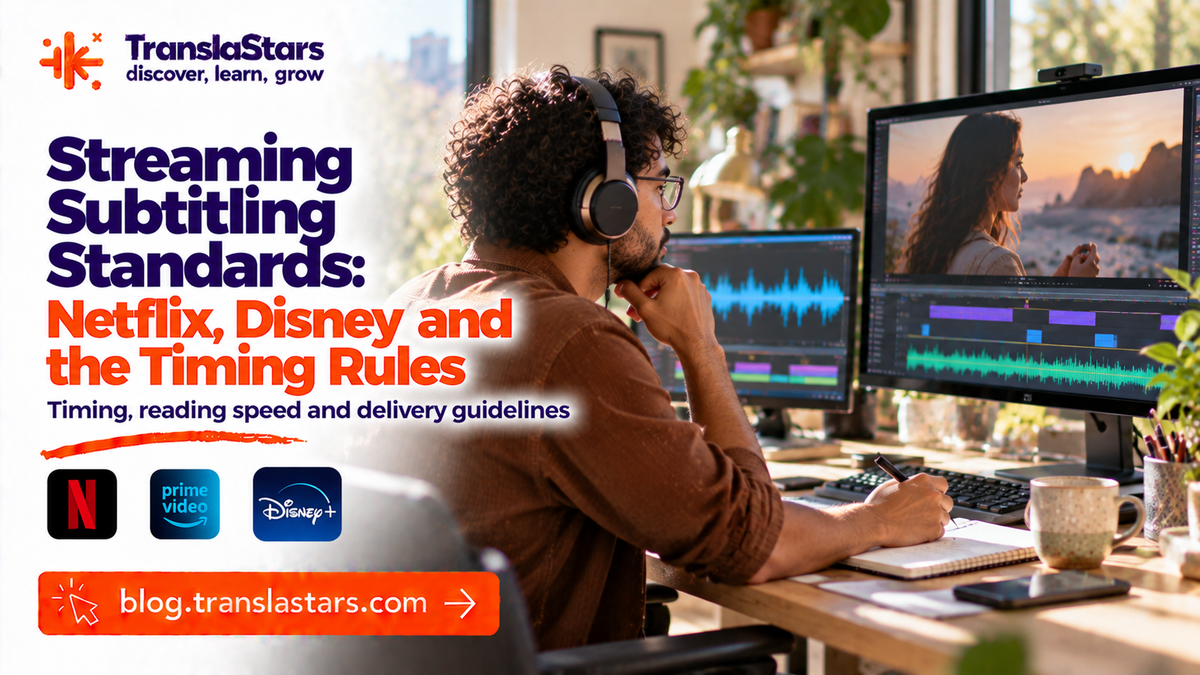
Streaming subtitling is one of the few areas of audiovisual translation where the client hands you a specification document and expects the file to match it, cue by cue. Netflix, Amazon and Disney each maintain their own timed text requirements, and while they share a common ancestry in broadcast subtitling, they diverge on the numbers: how fast a line may be read, how long a subtitle may stay on screen, how many characters fit on a line, and how the file has to be built. Learn those numbers and you can be dropped into a platform account and be productive; ignore them and your delivery comes back with a QC report.
This guide collects the rules that are publicly documented, names the source for each figure, explains how reading speed in characters per second is actually calculated, describes the file formats and templates involved, and ends with how to prepare if you want to work with these platforms.
In This Article
- Why These Standards Exist
- Netflix: the Timed Text Style Guide
- Amazon Prime Video: Reading Speed in Numbers
- Disney: IMSC and Delivery Specs
- The Rules Side by Side
- How CPS Is Actually Calculated
- Formats and Templates
- How to Prepare to Work With These Platforms
- Do Netflix, Amazon and Disney Hire Freelance Subtitlers?
- Where to Train
- Sources and Public Style Guides
- Frequently Asked Questions
1. Why These Standards Exist
A subtitle file is a quality artifact, and a global platform has the same problem a broadcaster always had: thousands of hours of content, delivered by hundreds of vendors, in dozens of languages, that all have to look and behave the same way on the same player. The style guide is how the platform enforces consistency without reviewing every cue by hand.
That is why the guides are so specific. They are not creative advice; they are delivery requirements. A file that reads beautifully but breaks the duration rule is a file that comes back. Once you understand that the rules are a shared contract between the platform and every vendor it works with, the format of the documents makes sense: general requirements that apply everywhere, plus a language-specific guide that adds the character limits, punctuation and conventions for each market.
2. Netflix: the Timed Text Style Guide
Netflix publishes its timed text requirements in the public Partner Help Center, under a general guide plus a guide for each language. The Timed Text Style Guide: General Requirements states the rules that apply to every delivery, and it is explicit that the language-specific, timing and file-type guidelines have to be followed as well.
2.1. General requirements
| Requirement | Netflix general Timed Text Style Guide |
|---|---|
| Minimum duration | Five-sixths of a second per subtitle event (20 frames at 24 fps) |
| Maximum duration | 7 seconds per subtitle event |
| Lines | 2 lines maximum; text should usually be kept to one line unless it exceeds the character limitation |
| Line breaks | Break after punctuation marks and before conjunctions or prepositions; do not separate a noun from its article or adjective, a first name from a last name, or a verb from its subject pronoun |
| Positioning | Centre justified, at the top or bottom of the screen, positioned to avoid overlap with on-screen text |
| Glyph list | Only characters in the Netflix Glyph List may be used |
| Technical (TTML) | Percentage values only, no pixel values; positioning via tts:textAlign and tts:displayAlign with static tts:extent and tts:origin; tts:fontSize defined as 100% |
Two of those rows carry more weight than they look. The duration window, five-sixths of a second as the floor and 7 seconds as the ceiling, is the rule a novice breaks first, because a natural reading of a dense line often wants to sit longer than seven seconds. The TTML row is where technical subtitlers and purely linguistic subtitlers separate: the file has to be built to spec, not just written.
2.2. Language guides and SDH
The language-specific guides add the working numbers. The English (USA) guide sets a limit of 42 characters per line and specifies the handling of SDH: transcribe as much of the original content as possible, do not simplify or water down the dialogue, limit truncation to cases where reading speed and synchronicity require it, and favour text reduction and condensation when editing for speed. The same guide fixes the italics rules (narration, inner monologue, sung lyrics, unfamiliar foreign words, and dialogue heard through electronic media when the speaker is not physically present) and the dual-speaker convention, where a hyphen without a space marks two speakers with one speaker per line.
The pattern to notice: the general guide sets duration, lines and format; the language guide sets character limits, italics, punctuation and the finer conventions. Read both, and read the version dated for your delivery.
The SDH conventions that sit alongside these timing rules are the subject of the Closed Captions & SDH course.
3. Amazon Prime Video: Reading Speed in Numbers
Where Netflix documents its requirements rule by rule, Amazon's Prime Video subtitling guidelines are written as a framework, and they are unusually clear about reading speed, which is the single figure most quoted and most misunderstood in the industry. The guidelines organise quality into two dimensions: translation and adaptation, and technical requirements, which cover synchronisation and timing, reading speed, duration, line treatment and positioning.
3.1. Reading speed
The document recounts the history of the number. Broadcast television traditionally used the six-second rule, described as two full lines of about 35 characters each, so roughly 70 characters that should be readable in six seconds. That works out to 12 characters per second, or about 130 words per minute. Streaming platforms moved to faster speeds on the argument that modern viewers read on-screen text more easily, and 15 characters per second, about 160 words per minute, is described as fairly standard, with some platforms allowing 17 or higher.
Prime Video then states its own values explicitly:
- Adult programmes: aim for a maximum of 17 characters per second.
- Children's programmes: aim for a maximum of 13 characters per second.
- Last resort: if the text cannot be condensed or given more time, reading speed may be increased up to 22 characters per second.
The document is also candid that the numbers vary by language, because script density varies: it gives Japanese as 4 characters per second for both adult and children's content, and Indian languages as 22 characters per second for adults and 18 for children. The repeated instruction is to consult the language-specific style guide for the reading speed that applies.
3.2. Timing, duration and line treatment
| Requirement | Prime Video subtitling guidelines |
|---|---|
| Sync to audio | Time to within 3 frames |
| Shot changes | If dialogue starts within 3 frames of a shot change, move the in-time to the shot change; if it ends within 3 frames, pull the out-time to 2 frames before the change |
| Minimum duration | About five-sixths of a second per event (20 frames at 24 fps, 21 at 25 fps, 25 at 30 fps) |
| Maximum duration | 7 seconds per event; longer periods are split |
| Gap between cues | A minimum of 2 frames |
| Lines and characters | Maximum 2 lines per event, and no more than 42 characters per line |
| Language variation | Japanese uses 13 characters per line horizontally and 11 vertically; Thai uses 37 characters per line |
The document also makes a point that is easy to forget when you are working from a script: creation and quality checking of subtitled content must always be done while watching the video, so that timing, context and visual information, and the performance, can be assessed. Spotted from a transcript alone, none of the numbers above can be checked properly.
Alongside the subtitling guidelines, Prime Video documents the timed text formats it accepts, and the manifest fields that go with them, on the same public Video Central timed text page.
4. Disney: IMSC and Delivery Specs
Disney's approach is the most closed of the three. Its full Subtitle and Closed Captioning Style Guide is distributed to approved vendors rather than published openly, so there is no public link to give for it, and the practical way in is through the delivery format and the documentation that vendor tools describe. Disney+ delivers timed text in IMSC 1.1, the W3C profile for Internet Media Subtitles and Captions built on TTML, and its specifications are strict on a small set of points.
From the vendor-side documentation of the Disney+ export specification, the constraints that are publicly described are: a maximum of 2 text lines per subtitle, text alignment rules, safe-area requirements that depend on the video's aspect ratio, and font defaults of a generic proportional sans-serif, with Disney recommending the Noto Sans family and Noto Sans CJK JP specifically for Japanese, and a default text colour of #DCDCDC. Ruby characters and their positioning are handled when the output language is Japanese.
Read that section as a vendor briefing rather than a public guide. What you can rely on without a Disney account is the shape of the requirement: IMSC 1.1, a two-line maximum, strict safe areas, and language-specific font and ruby handling. The exact line-length and reading-speed values live in the vendor document you receive with the project.
5. The Rules Side by Side
| Rule | Netflix (general) | Amazon Prime Video | Disney |
|---|---|---|---|
| Minimum duration | Five-sixths of a second | About five-sixths of a second | Vendor document |
| Maximum duration | 7 seconds | 7 seconds | Vendor document |
| Reading speed | Language guide | 17 cps adult, 13 cps children, up to 22 as last resort | Vendor document |
| Lines per event | 2 maximum | 2 maximum | 2 maximum |
| Characters per line | 42 (U.S. English guide) | 42 | Vendor document |
| Gap between cues | Per language guide | 2 frames minimum | Vendor document |
| Delivery format | TTML | Timed text, language guides | IMSC 1.1 |
The headline is that the two platforms with public figures agree on the shape of the problem, which is reassuring for a subtitler and useful for a vendor working across accounts. Where they differ is in reading speed, where Amazon publishes explicit ceilings and Netflix pushes the value into each language guide, and in format, where Netflix and Disney both sit on TTML-family specifications.
6. How CPS Is Actually Calculated
CPS stands for characters per second, and it is the reading-speed measure the guides use. The calculation is simple enough to do by hand, and doing it by hand once is the best way to understand why the rules are set where they are.
CPS = total characters in the cue divided by total duration of the cue in seconds. Count every character that appears in the cue, including spaces, and divide by the time the cue is on screen.
Two consequences follow from that formula, and they explain most QC failures. First, shortening the text and lengthening the cue both reduce CPS, but they are not equivalent: a cue extended past the platform maximum breaks a different rule. Second, the formula counts the whole cue, so a two-line cue at the limit is judged as one unit; splitting it into two cues can raise CPS, not lower it, if the same words are spread over less readable chunks.
Working with the Amazon figures as a concrete example: an adult programme aims for a maximum of 17 characters per second. A cue of 51 characters should therefore be readable in around 3 seconds. If the timing only allows 2 seconds, the CPS is about 25.5 and the cue is over the limit; the fix is to condense the text, extend the out-time, or re-segment, in that order, and only as a last resort to accept the higher speed.
The reading-speed conventions behind these numbers, and the WPM settings that go with them, are covered in the Master the Art of Subtitling course.
7. Formats and Templates
The numbers decide whether the text is readable; the format decides whether the platform can ingest it. These are the families a streaming subtitler meets.
7.1. TTML and IMSC
TTML is the Timed Text Markup Language, an XML format maintained by the W3C, and IMSC is the W3C profile of TTML for Internet Media Subtitles and Captions. Netflix deliveries and Disney+ deliveries both sit in this family, which is why the technical rows in the style guides talk about XML attributes rather than about text files. In the Netflix general guide, that means percentage values instead of pixels, positioning attributes, and a font size defined as 100 percent.
7.2. SRT, VTT and broadcast formats
Outside the XML family, the working formats are the familiar ones: SRT and WebVTT for web and social delivery, and broadcast formats such as SCC for U.S. television and EBU-STL for European broadcast. A subtitler who can move between these and the TTML family is employable across the whole market, because the timing grid transfers and only the container changes.
7.3. Templates and parsers
The practical tool for compliance is the parser that ships with a professional subtitling application. EZTitles and Avellan both check a file against a platform's delivery rules and flag the cues that break them, which turns a style guide into an automatic QC pass. The workflow that works is to set the client's rules in the tool, let it flag, fix, and only then deliver. Learning to configure a template once saves a QC round on every episode afterwards.
AI-Powered Subtitling with EZTitles
The broadcast standard, with the parser and AI features in the places that speed up delivery.
Free
AI-Powered Subtitling with Avellan
A browser-first AI subtitling workflow, from the first transcription to the QC pass.
Free8. How to Prepare to Work With These Platforms
Platform vendors hire on evidence that you can deliver to spec, and the specification is public, so the preparation is concrete rather than mysterious.
- Read the general guide, not the summary. The Netflix general Timed Text Style Guide and the Amazon Prime Video subtitling guidelines are both public. Read them once end to end before you apply for anything.
- Learn the six numbers by heart. Minimum duration, maximum duration, maximum lines, characters per line, reading speed and minimum gap. Everything else is consistency.
- Practise spotting to a shot change. The 3-frame sync and the shot-change rules are where a test file shows whether you have actually spotted to picture or only to a transcript.
- Build a checklist per platform. Turn each guide into a short list you run before delivery, and keep it for the next project.
- Configure your tool. Set the client rules in EZTitles, Avellan or Subtitle Edit and let the parser flag the breaks, rather than finding them by eye.
- Work from the video, always. Amazon states it plainly: creation and QC must be done while watching the video. A transcript is not the source of truth for timing.
- Keep a clean sample. A short file delivered to a platform's rules, with a noted QC pass, is the portfolio piece that gets you the next account.
9. Do Netflix, Amazon and Disney Hire Freelance Subtitlers?
The short answer, based on what the three companies publish, is that they contract the work to localization vendors rather than hiring individual subtitlers directly. A freelance subtitler reaches platform work through an approved vendor, not through a platform application form.
Each company's own documentation points the same way. Netflix keeps its timed text guides, the General Requirements and the language guides, in a Partner Help Center written for the vendors and partners who deliver to it. Amazon's Prime Video subtitling guidelines address their readers directly as "partners, including subtitling vendors, translators, and quality control specialists", and they sit in Video Central, the portal for the content partners who supply the service. Disney's Subtitle and Closed Captioning Style Guide, as noted above, is distributed to approved vendors and is not published openly.
What that means in practice for a freelancer:
- There is no public freelance application. At the time of writing we found no page on which Netflix, Amazon Prime Video or Disney accepts freelance subtitler applications directly. Treat any site that promises to sign you up as a "Netflix subtitler" for a fee with suspicion.
- The route is through a vendor. Localization companies and subtitling houses hold the platform accounts. They advertise on their own careers pages and on language-industry job boards, and they test candidates with a sample file judged against the platform's public specification.
- The public specification is your portfolio. Because Netflix's and Amazon's rules are public, a vendor test is predictable: a short file that respects the six numbers and the file format is the strongest evidence you can send.
- Watch the job boards. Subtitling and accessibility roles, including vendor-side ones, are posted on the TranslaStars jobs board.
None of this is secret, but none of the three publishes a step by step "become a freelance subtitler" process either. Where a platform does publish something, it is the specification, and that is what a vendor will test you on.
10. Where to Train
The rules above are the shelf. The craft that makes them automatic is what turns a vendor test into an account.
The Master the Art of Subtitling course covers timing, reading speed, condensation and professional delivery, which is exactly the ground the platform guides assume. The two free courses, AI-Powered Subtitling with EZTitles and AI-Powered Subtitling with Avellan, put you inside the tools that check platform compliance. The audiovisual programmes are collected on the Audiovisual Translation courses page, and the Master in AI, Translation and New Tech for Audiovisual Translation adds AI and project management. The catalogue is on the TranslaStars courses page, and subtitling roles are posted on the TranslaStars jobs board.
Related reading on this blog: Best AI Tools for Subtitling and Dubbing in 2026 for the tools that fit this workflow, and Main Subtitling Challenges and Solutions for the everyday problems behind the numbers.
11. Sources and Public Style Guides
Every figure in this article comes from a document you can open yourself. These are the public sources, checked on 5 October 2026.
11.1. Platform style guides (public)
- Netflix, Timed Text Style Guide: General Requirements (Partner Help Center).
- Netflix, English (USA) Timed Text Style Guide, and the other language guides in the same Help Center.
- Amazon Prime Video, Subtitling Guidelines (Video Central).
- Amazon Prime Video, timed text delivery documentation (Video Central).
Disney's Subtitle and Closed Captioning Style Guide is not public. It is supplied to approved vendors, so it is deliberately not linked here, and the Disney points in this article are limited to what the public delivery specification describes.
11.2. Courses used as a source
The teaching material behind the practical advice in this article comes from TranslaStars programmes whose module outlines informed the sections above:
- Master the Art of Subtitling: the Ultimate Training Course (Maria Virgínia Barros) covers text reduction, segmentation, CPS and WPM settings, characters per line, spotting and timecode, and the working relationship with direct clients and agencies.
- AI-Powered Subtitling with EZTitles and AI-Powered Subtitling with Avellan cover the professional tools whose parsers check a file against a platform's delivery rules.
- Closed Captions & SDH (Jessica Hinds-Mingo) covers the SDH conventions that sit alongside the platform timing rules.
The full audiovisual catalogue is collected on the Audiovisual Translation courses page.
Frequently Asked Questions
11.1. What is a good CPS for subtitles?
There is no single universal value, which is why the guides state their own. Amazon's Prime Video guidelines give the clearest public range, describing the older broadcast six-second rule as 12 characters per second, calling 15 characters per second fairly standard for streaming, and then setting 17 characters per second as the ceiling for adult content and 13 for children's content, with 22 as a last resort. Language matters as much as platform, because script density changes the number.
11.2. Why is the maximum duration the same across platforms?
Because 7 seconds is where a subtitle stops being a reading aid and starts inviting the viewer to re-read. Both the Netflix general guide and the Amazon guidelines set 7 seconds as the maximum per event, and both treat longer spans as something to split. The minimum of five-sixths of a second exists for the opposite reason: to stop a cue flashing on screen.
11.3. Do I need to know TTML to work for Netflix?
You need to be comfortable enough with it to build or verify a spec-compliant file, because the Netflix general guide sets TTML technical requirements such as percentage values only and a font size defined as 100 percent. Most working subtitlers do this inside a professional application rather than by hand-editing XML, but you have to understand what the tool is producing.
11.4. Is Disney's subtitle guide public?
Not in full. Disney's Subtitle and Closed Captioning Style Guide is provided to vendors, so the publicly observable requirements are the delivery format, IMSC 1.1, and the points vendor documentation describes: a two-line maximum, safe-area rules, a proportional sans-serif default with Noto Sans recommended, and ruby handling for Japanese. The precise values arrive with the project.
11.5. Which is faster to learn, the format or the timing rules?
The format, by a wide margin. Exporting a compliant container is a tool setting. The timing rules are where experience shows, because spotting to a shot change, respecting a minimum gap and keeping a two-line cue under the reading limit are judgement calls you make cue by cue, and no template makes them for you.