

Moravec's paradox is the reason a model can write fluent Spanish about a pharmaceutical leaflet and then fail to count the letters in a word. Marina Pantcheva demonstrates both in the same hour, and the point is not that AI is overhyped. It is that its failures are not random. They cluster, with remarkable consistency, exactly where human expertise lives.
Pantcheva is VP Research and Linguistic AI, and she teaches the AI foundations track of the Master in AI and Innovation for Localization across four sessions: word embeddings and the anatomy of LLMs, how models learn, prompt design, and operationalizing AI. What follows comes from those four decks, in the order she builds the argument.
In This Article
1. Two Paradoxes in the Same Hour
The first is Moravec's paradox, which she states plainly: things that come easily to humans are hard for AI, and things that are hard for humans are easy for AI. A child learns to recognise a face in one glance. The same child cannot multiply four-digit numbers, which a calculator does without effort. Language models inherit that shape, because they are built on the same trade.
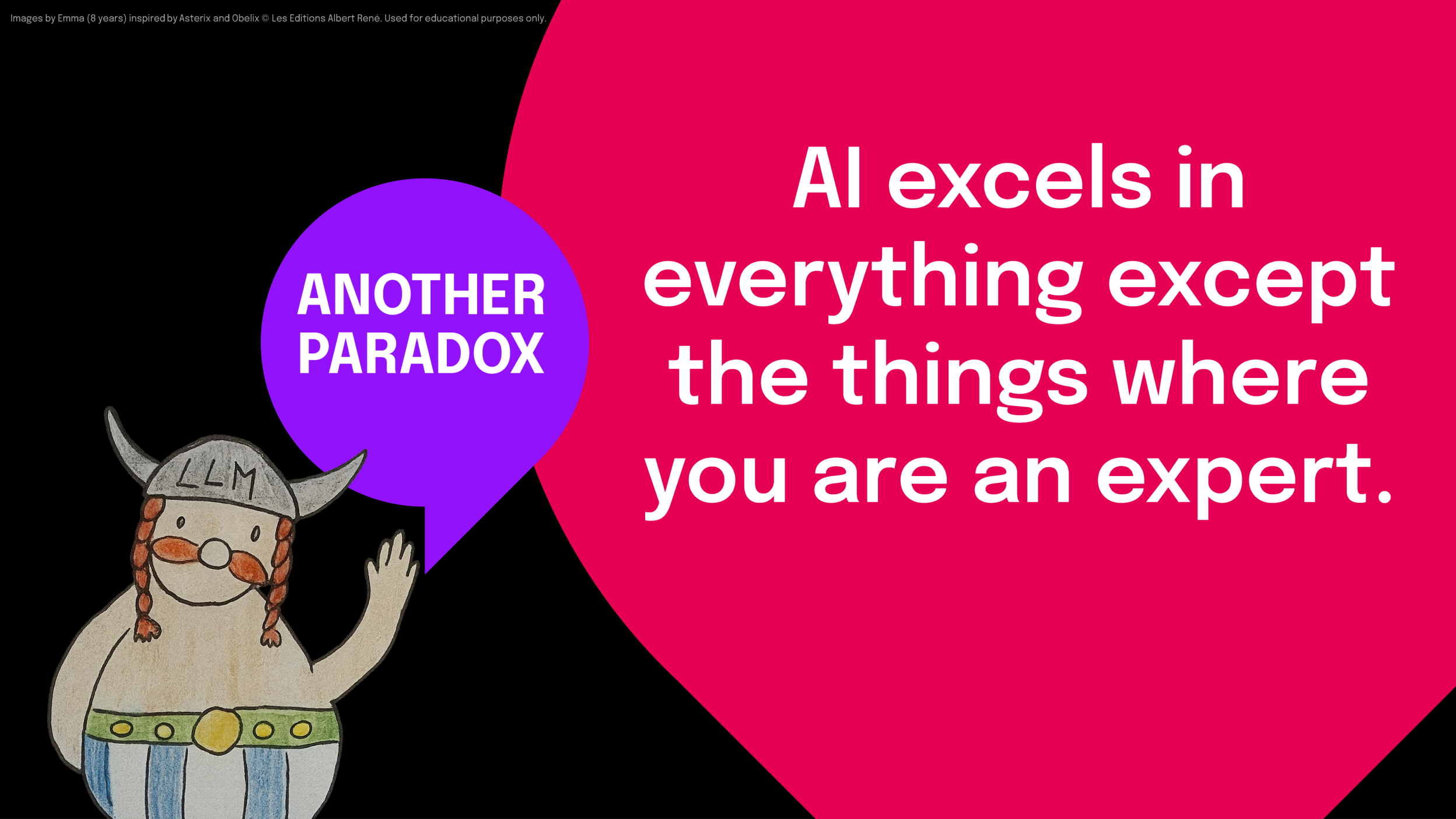
The second is her own formulation, and it is the one worth pinning above a desk: AI excels in everything except the things where you are an expert.
She proves it with two exercises that look like party tricks and are not. First: replace the x in a sequence of thirteen letters with the right symbols. Second: write the word "bag" eleven times. A regular GPT-4 returned aacdefgfeda with eleven items instead of thirteen, along with a confident explanation of what it had done. Asked to write "bag" eleven times, it produced the word fifteen times. Neither failure is about knowledge. Both are about what the model is doing when it appears to reason.
2. What the Model Is Actually Doing
2.1. Tokens, vectors and 12,288 dimensions
The explanation starts with tokens. Language gets chopped into pieces, the pieces become numbers, and the numbers become vectors: a position in a space with 12,288 dimensions in GPT-3.5, built on a vocabulary of roughly 50,000 tokens. Meaning is direction in that space, which is why vector arithmetic appears to work. The famous example from the session is jump plus ed giving jumped, and the more interesting one: Tokyo minus Japan plus Germany lands near Berlin.
2.2. The next-word loop
Then comes the part that decides everything downstream. The model predicts the next word, converts its scores into probabilities with a softmax, and samples from them. That sampling is deliberate: it is where variability and creativity come from, and it is also where inconsistency comes from. The same prompt can produce a different answer because the model is not retrieving a stored fact, it is drawing from a distribution.
Two consequences matter for translation. The first is that numbers are tokens like any other, so the model has no numerical understanding and cannot count reliably without a tool. The second is that translation itself is an emergent capability, not an engineered one: it appears because parallel text in the training data made the mapping useful, not because anyone built a translation module.

Understanding and Using LLMs in Localization
Marina Pantcheva on tokens, embeddings and the limits that no prompt can remove.
3. Why Hallucination Is Structural
This is the strongest part of the argument, and it is geometric. In a low-dimensional space, points are dense and neighbours are genuinely near. In a 12,288-dimensional space, the volume grows so fast that the concepts available cannot fill it. Pantcheva's line is memorable: the density of concepts in the semantic universe of LLMs is lower than the density of matter in the physical universe.
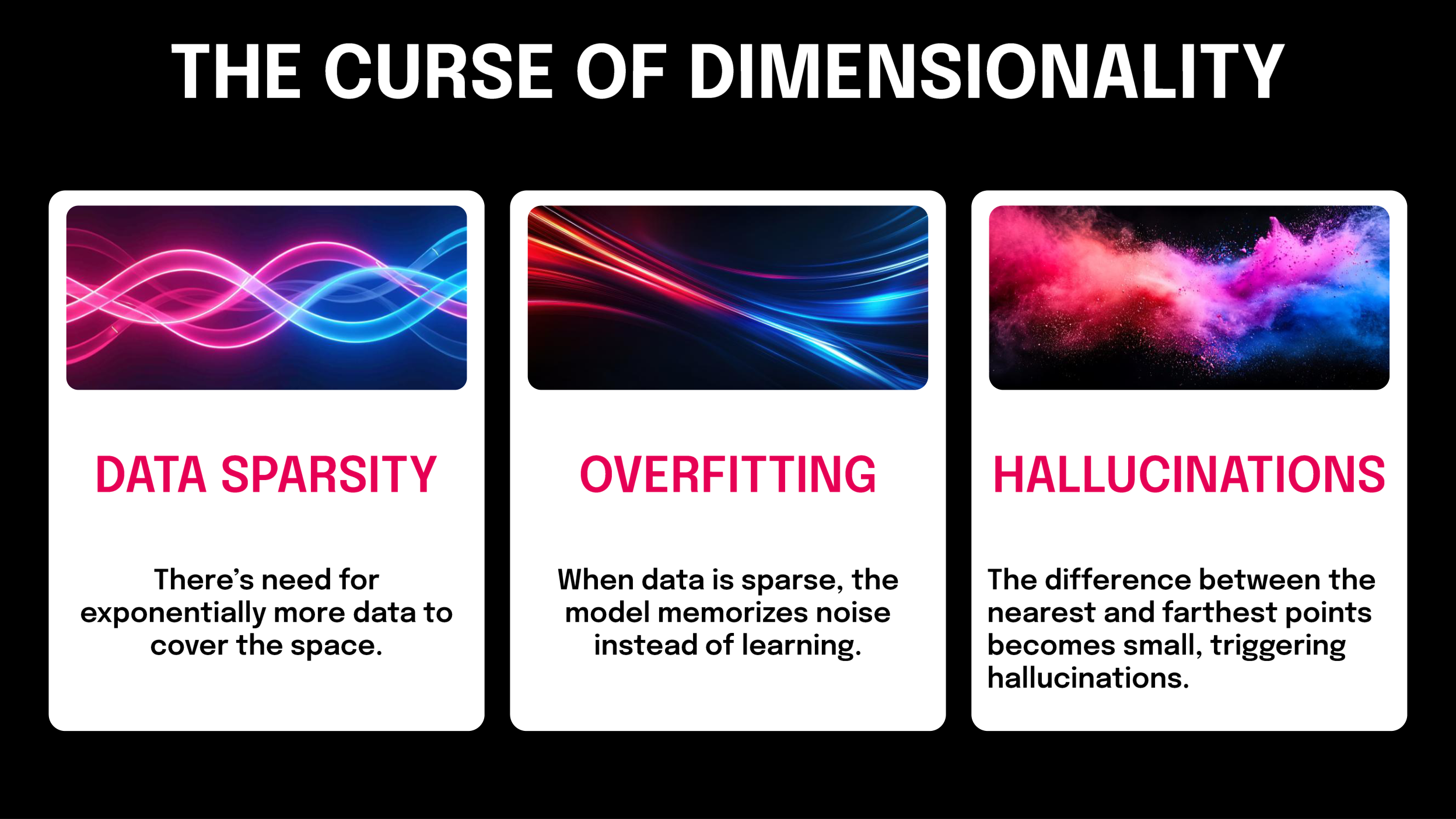
When the space is that sparse, the distance between the nearest and the farthest point becomes small. Nearest neighbours stop being meaningful, and the model produces something that sits close enough to be plausible and far enough to be wrong. That is a hallucination, and it is not a bug waiting for the next release.
Hallucination is what a sparse semantic space does when you ask it for a point that is not there. No release note fixes geometry.
4. Five Things That Do Not Come Easily
The session lists the consequences in a way that is easy to act on, because each one has a countermeasure attached:
| Limit | What it means in practice | What to do |
|---|---|---|
| Numeracy | Numbers are processed as ordinary tokens, with no abstract arithmetic | Send calculation to a tool, never to the prompt |
| Multitasking | The model handles one well-defined mono-task per pass | Atomic prompting: split the job and process each part separately |
| Common sense | Relations that are not encoded in language stay unresolved | Spell the relation out; test with Winograd-style sentences |
| Form vs meaning | Sensitive to meaning, unreliable on exact lexical form | Verify strings, counts and formats with deterministic checks |
| Training data | It cannot produce what it has not seen often enough | Supply the data in the prompt, or retrieve it |
The form versus meaning row is the one localization teams should read twice. Asked to identify the language of a sentence, the model answers by topic rather than by lexicon: The sushi bar is around the corner comes back as Japanese, I need to buy a red sari as Hindi. It is not detecting the language, it is recognising the subject. Any task that depends on the exact string, from placeholders to tag syntax, needs a different instrument.
5. The Three Curses
5.1. Knowledge, dimensionality, multilinguality
Pantcheva groups the difficulty under three names, and the first one is about the person, not the machine. The curse of knowledge is what happens when an expert cannot imagine not knowing what they know. It produces prompts that assume context the model never received, and it is the most common cause of an answer that is technically correct and completely useless.
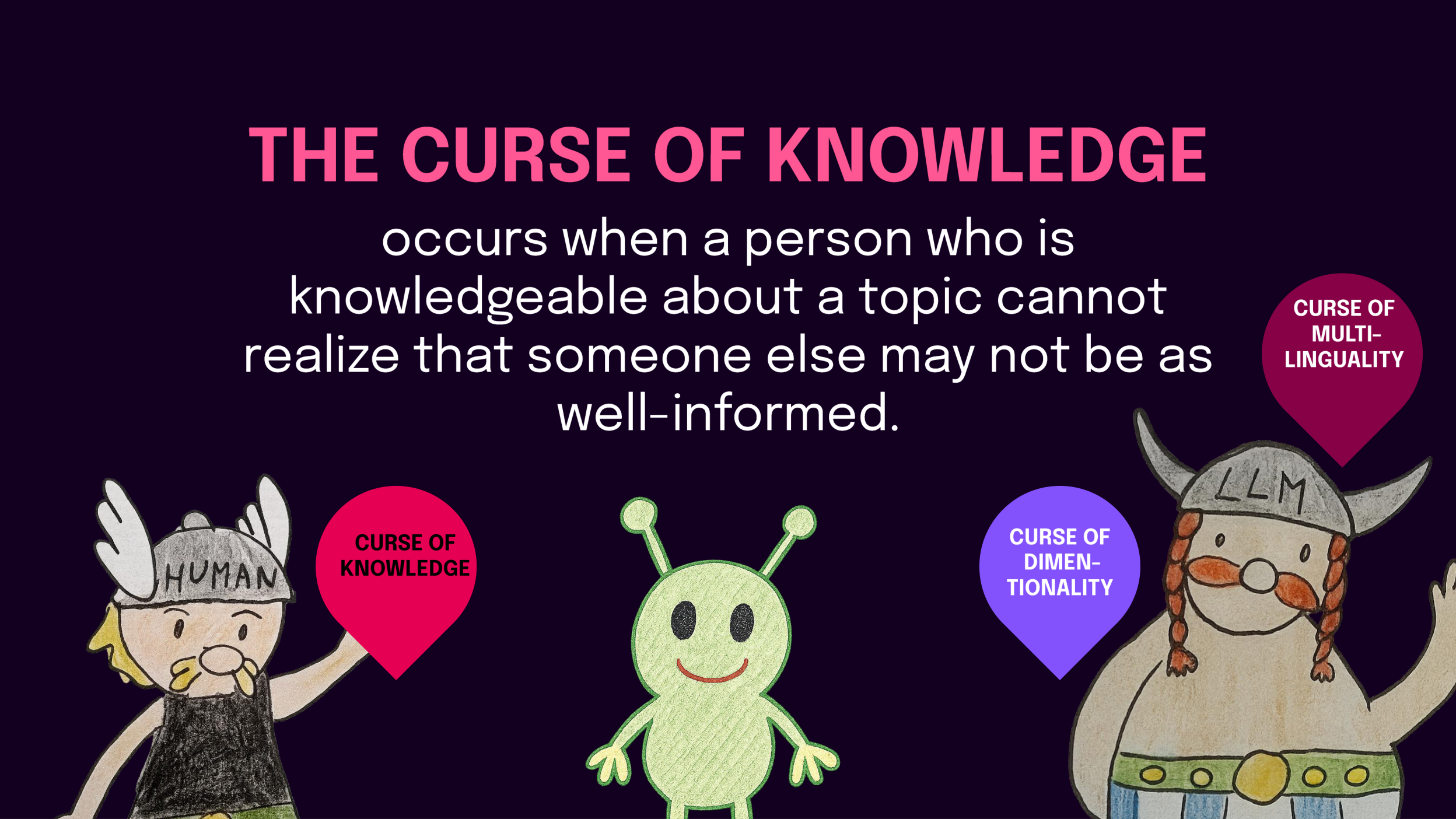
The curse of dimensionality is the one above, and you cannot fix it. The curse of multilinguality is the one localization feels daily: performance is not equal across languages, because the training mix is not equal. A benchmark in the session shows accuracy moving by more than twenty percentage points between a high-resource language and a low-resource one on the same task. The practical reading is that a demo in English proves nothing about your target market.
The curse of knowledge is yours to fix. You cannot fix the curse of dimensionality, but you can stop aiming at the empty part of the space.
6. One Task per Prompt
The prompt design session turns all of this into procedure. Its first principle is the one that answers the curse of knowledge: always take the perspective of the LLM and ask whether the prompt contains everything needed to perform the task. Its second is atomic prompting, from the limits table: break the complex request into components and prompt for each one.
6.1. The three layers of a prompt
Her example of a prompt that carries its own context is built from three layers. The system prompt sets role and rules: you are an English to German professional translator working on a technical manual, maintain consistency when the same source expression appears more than once, use the same German translations and grammatical structure throughout. The user prompt carries the actual content after a marked source. The expected pair of question and answer completes the picture of what a good output looks like.
6.2. Prompt errors worth a checklist
She also names the errors that show up most often in real prompts: repeating instructions at the start and the end, repeating the system prompt inside the user prompt, giving two different instructions across the two layers, and contradicting yourself between them. None of these are exotic. All of them are cheap to catch with a checklist.
A single pass of a single prompt is the cheapest thing to build and the most expensive thing to trust. The 5% of GenAI pilots that produce value are not the ones with the longest prompts.
7. What This Means in Localization Work
7.1. The five levels of automation
The last session, on operationalizing AI, is where the abstractions turn into decisions. It sets out a ladder of five levels: rule-based automation at zero, a single LLM pass at one, an augmented model with retrieval and APIs at two, orchestrated agentic workflows at three, and a system that plans and chooses its own tools at four. Most localization teams sit between one and two and describe themselves as being at three.
| Level | What it is | What it buys you |
|---|---|---|
| 0. Automation | Scripts and workflow rules, deterministic | Scale without judgement |
| 1. Single pass | One prompt in, one output out, no iteration | Speed on bounded tasks |
| 2. Augmented | Model plus retrieval, APIs and memory | Answers grounded in your data |
| 3. Agentic workflow | Several models and tools in a fixed orchestration | Multi-step tasks with checkpoints |
| 4. Agentic system | The system plans and selects its own tools | Autonomy, and the oversight problem that comes with it |
7.2. What a business case has to include
Two findings from the session are worth carrying into any business case. The first is the MIT figure she quotes: only 5% of enterprise GenAI pilots produce value. The second is that the hidden costs are rarely the model. They are data preparation, inference, drift monitoring, infrastructure, human ghost work and the brand damage of a hallucination that ships.
7.3. Evaluation and the human problem
Her treatment of evaluation is the most useful part for anyone doing LQA. A true or false question about whether a translation contains an error is cheap and scales, but it only works where a yes or no answer maps cleanly onto the judgement. Different error types need different information: fluency can be assessed from the target segment alone, accuracy needs source and target together. And then there is the problem with humans, which she states without flinching: the alignment between models and reviewers, the alignment among reviewers, and the agreement of reviewers with each other. A gold standard that disagrees with itself cannot adjudicate a model.
The closing image is Zeno's paradox: chasing AI developments only halves the distance to the latest advance, so the gap never closes. The alternative she implies is not to run faster. It is to stop racing and start choosing where the verification actually pays.
8. Where to Go Next
These four sessions are the foundations track of the Master in AI, Innovation and Localization Operations, and the fifth edition is here, with the full calendar at master-ai-localization-5.translastars.com.

If you want the technical foundations as a standalone course, without the full programme, this is the one to take: Understanding and Using LLMs in Localization.
All our sites, in one place:
- TranslaStars University: master's programmes and recognised courses
- TranslaStars: the main site, with every programme
- Blog: guides and market data
- Jobs Board: curated openings, deduplicated and filterable
- Talent Pool: your profile working for recruiters
This article follows sessions 3, 5, 6 and 7 of the Master in AI and Innovation for Localization, taught by Marina Pantcheva, VP Research and Linguistic AI. Examples, figures and benchmarks are as presented in the sessions.
9. Sources and Public Style Guides
These are the sources behind this article, checked on 30 October 2026.
9.1. Course sessions used as a source
- Understanding and Using LLMs in Localization (TranslaStars), sessions 3, 5, 6 and 7 given by Marina Pantcheva: tokens and embeddings, the limits of LLMs, prompt design, and operationalisation.
9.2. Programme and catalogue
- Master in AI, Innovation and Localization Operations, fifth edition, the programme site with the full calendar.
- Master in AI, Innovation and Localization Operations, the course page for the programme.
Frequently Asked Questions
9.1. Why does AI hallucinate?
Because of geometry, not of missing facts. Language models place meaning in a space with 12,288 dimensions, and in a space that large the concepts available cannot fill the volume. The distance between the nearest and the farthest point becomes small, nearest neighbours stop being meaningful, and the model returns something close enough to look plausible and far enough to be wrong.
9.2. Would a bigger model or a new update fix hallucination?
No. Pantcheva's argument is that hallucination is what a sparse semantic space does when you ask it for a point that is not there. A release note does not change the geometry of the space the model works in, so the failure is structural rather than a bug waiting for the next version.
9.3. What is Moravec's paradox?
It is the observation that things which come easily to humans are hard for AI, and things which are hard for humans are easy for AI. A child recognises a face in one glance but cannot multiply four-digit numbers, while a calculator does the multiplication without effort. Language models inherit that shape, and the practical version of it is that AI excels in everything except the things where you are an expert.
9.4. Why can an LLM not count the letters in a word reliably?
Because numbers are tokens like any other, so the model has no numerical understanding and cannot count reliably without a tool. In the session, a regular GPT-4 asked for thirteen letters returned eleven, and asked to write "bag" eleven times it produced the word fifteen times. The countermeasure is to send calculation to a tool rather than to the prompt, and to verify strings, counts and formats with deterministic checks.
9.5. What is the curse of multilinguality?
It is the fact that model performance is not equal across languages, because the training mix is not equal. A benchmark in the session shows accuracy moving by more than twenty percentage points between a high-resource language and a low-resource one on the same task. For localization teams the practical reading is that a demo in English proves nothing about the target market.