

How much can you actually earn as a translator in 2026?
It is the first question every aspiring translator asks – and the hardest to answer, because rates vary wildly by language pair, specialization, market, employment model and experience. Ask five working translators and you will get five different answers, from "barely survivable" to "genuinely comfortable". Both are true, and the gap between them is not luck.
This guide gives you realistic 2026 figures for freelance and in-house roles, explains why the range is so wide, and shows you the fastest way to move from the bottom of the range to the top. Crucially, it is not built on folklore. The market data below comes from the live TranslaStars Jobs Board: roughly 1,450 active job listings at the time of this analysis, drawn from a raw dataset of about 2,500 offers. When a statistic about "what the market pays" appears here, it is a number counted from that dataset – not a guess.
Before we get to the tables, one warning: salary data in this industry is unusually opaque. Of the ~2,500 offers in the dataset, only 244 include any salary field, and only 167 publish usable salary numbers (roughly 7% of all offers). That scarcity of information is itself a market signal: translators who benchmark against real posted pay instead of anecdote are already ahead of most of their competition.
In This Article
1. The Honest Starting Point
Two translators can work in the same city, with the same language pair, and earn 10x different incomes. The difference is almost never talent – it is specialization, positioning and client type. Talent determines the ceiling of your quality; positioning determines the price that quality commands. A brilliant generalist who sells to the cheapest agencies will earn less than an average specialist who sells directly to law firms, simply because of how the market values the two offers.
That asymmetry shows up in the job data too. Look at what employers actually ask for. Of the ~2,500 offers in the dataset, the overwhelming majority are labelled generalist translation and interpretation work (1,129 posts), with multilingual and linguist roles (592) and localization (402) behind them. The long tail – QA and review (50), teaching and training (38), support and admin (63) – is small but revealing: those niches are where employers look for people who understand quality control and process, not just raw language ability.
| Job Function | Postings in Dataset | What It Tells You |
|---|---|---|
| Translation / Interpretation | 1,129 | The core demand – but priced as a commodity unless you specialize |
| Multilingual / Linguist | 592 | Broad language roles, often with extra skills attached |
| Localization | 402 | Higher rates; software, games and product work |
| General | 90 | Uncategorized generalist posts |
| Support / Admin | 63 | Language-adjacent roles; steady income, lower ceiling |
| QA / Review | 50 | Paid by the hour more often; rewards precision |
| Teaching / Training | 38 | Rare but recurring; great for diversifying income |
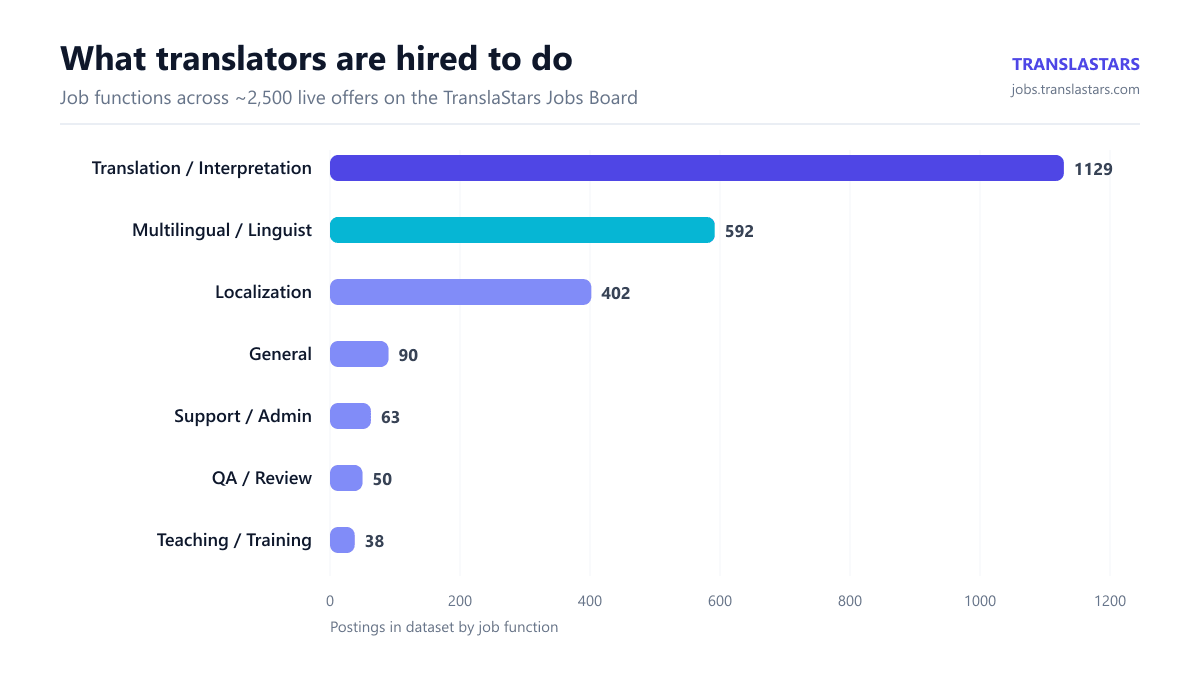
Read that table as a map of where the money flows. Translation and interpretation generate the most volume, which is why beginners find work there easily – but volume with no specialization is exactly the trap described at the top of this section. The categories where employers are more selective (localization, QA, review) are also the categories where rates are set by skill rather than by auction. Your goal in year one is not to translate more; it is to move your profile into a column of this table where the employer is choosing quality over price.
Reality check: most translators start at the bottom and some stay there. The ones who raise their rates consistently do three things: specialize, keep samples, and fire low-paying clients.
2. Freelance Rates by Specialization
Freelance translation is still overwhelmingly priced per word, so the first number you need is your per-word rate by domain. The ranges below reflect typical European agency practice in 2026 and are deliberately conservative: they are the rates agencies pay freelancers, not the rates agencies charge their clients (usually 2-4x higher). Direct clients sit between the two, which is why "cut out the middleman" is such a powerful lever.
| Specialization | Typical Agency Rate (per word) | Typical Direct Rate (per word) |
|---|---|---|
| General / marketing | 0.03 - 0.06 EUR | 0.06 - 0.12 EUR |
| Technical / IT | 0.05 - 0.09 EUR | 0.10 - 0.18 EUR |
| Legal | 0.06 - 0.10 EUR | 0.12 - 0.22 EUR |
| Medical / pharma | 0.07 - 0.12 EUR | 0.14 - 0.25+ EUR |
| Financial | 0.06 - 0.10 EUR | 0.12 - 0.20 EUR |
| Creative / transcreation | 0.08 - 0.15 EUR | 0.15 - 0.30+ EUR |
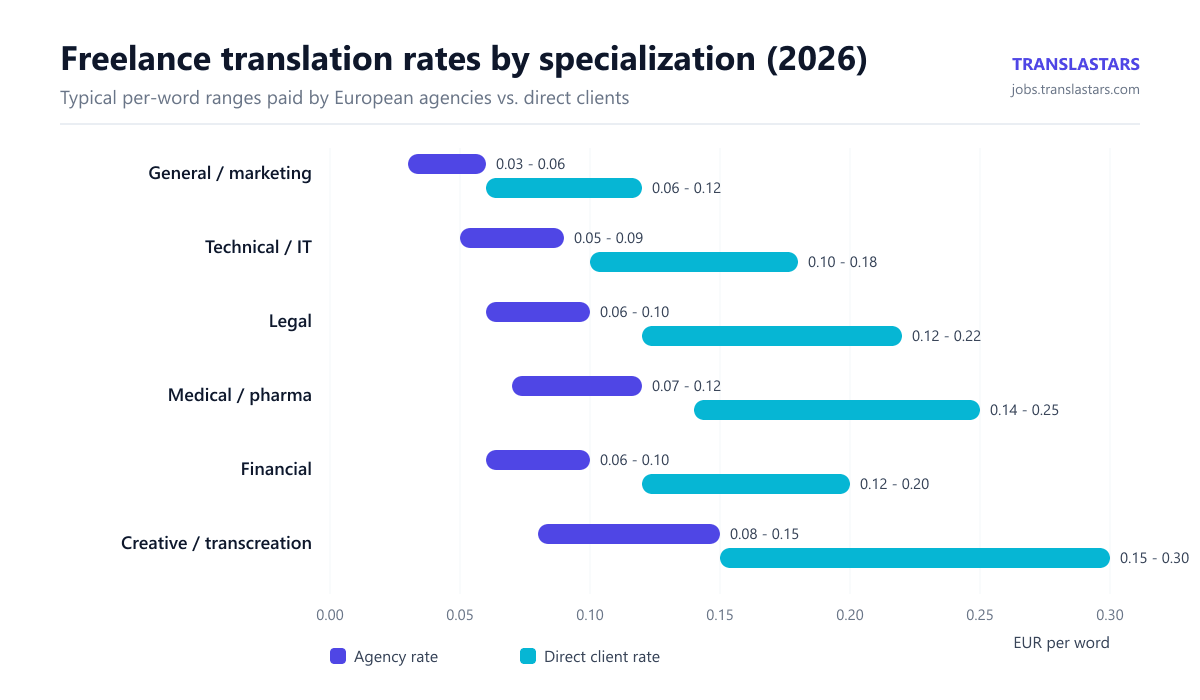
Notice what the table does not say: the gap between the top and bottom rows is 2.5-5x. A medical translator at 0.10 EUR/word is earning more than a generalist at 0.04 EUR/word while producing the same number of words. And the advantage compounds: because medical and legal texts carry liability, agencies will not hand them to the cheapest bidder, so specialized work is more stable. The market data agrees – employers listing translation roles rarely stop at "translator"; they specify the domain, and the domain is what justifies the budget.
One currency note before you compare tables: the per-word rates above are in EUR (common agency practice in Europe), while most salary data on the job board is in USD per hour. Do not compare a 0.05 EUR/word quote to a $29/hour posting without converting both into the same unit and checking what the hourly figure assumes about speed. A clean way to sanity-check: if you comfortably produce around 300 billable words per hour, an effective rate at the market median of $29/hour corresponds to roughly $0.10 per word. If your per-word rate implies an hourly figure far below that, you are working too slowly for the price or charging too little for the speed – both are fixable, and both are diagnosed by the same calculation.
Specialized work also gives you more consistent volume: agencies that pay more per word also tend to send more of that work, because they cannot easily replace a good medical translator. In our dataset, QA/review posts (50) outnumber teaching posts (38), but both are recurring niches where a freelancer with a reputation receives invitations rather than having to pitch. Volume stability is a hidden component of income: two freelancers at the same rate can earn very different annual sums if one has 40 booked weeks and the other has 25.

Reinventing Your Localization Career
Reposition yourself as the industry shifts: resilience, adaptation and growth outside your comfort zone, with certified coach Stephen Nock.
3. How Language Pairs Change Rates
Language pair is the second big variable. Supply and demand are brutally simple here: pairs with huge pools of qualified translators have depressed rates; pairs where qualified people are scarce command premiums. The scarce-pair premium is not a myth – it is the same logic as any labor market, applied to a skill that takes years to build.
- Common pairs (EN-ES, EN-FR, EN-DE, EN-PT): high supply, competitive rates, but huge volume. You can always find work; the fight is over price.
- Scarce pairs (Nordic, Eastern European, Asian, Arabic): less competition, often higher rates and fewer clients. You must market yourself harder to be found, but once found you are sticky.
- Into English: one of the most competitive directions globally; specialization is essential, because the world's source content increasingly arrives in English and the number of native-English translators is not growing with demand.
- Out of English: better rates in most markets, since most source content is English and the client's need is to reach local audiences properly.
- Rare combinations: e.g., EN into a regional language or niche languages – can be a golden niche if demand exists. The premium exists precisely because the supply is thin.
The job board geography confirms where the demand concentrates. The United States dominates postings by a wide margin, followed at a distance by the UK, Canada, Japan, India and China:
| Country | Postings in Dataset | Reading |
|---|---|---|
| United States | 659 | The largest market; highest absolute pay, strongest currency |
| United Kingdom | 96 | Mature market with strong agency infrastructure |
| Canada | 89 | Bilingual hiring culture (EN-FR) creates steady demand |
| Japan | 83 | High willingness to pay for quality into Japanese |
| India | 79 | Huge volume, often price-sensitive, strong IT localization |
| China | 73 | Massive volume; games and tech localization demand |
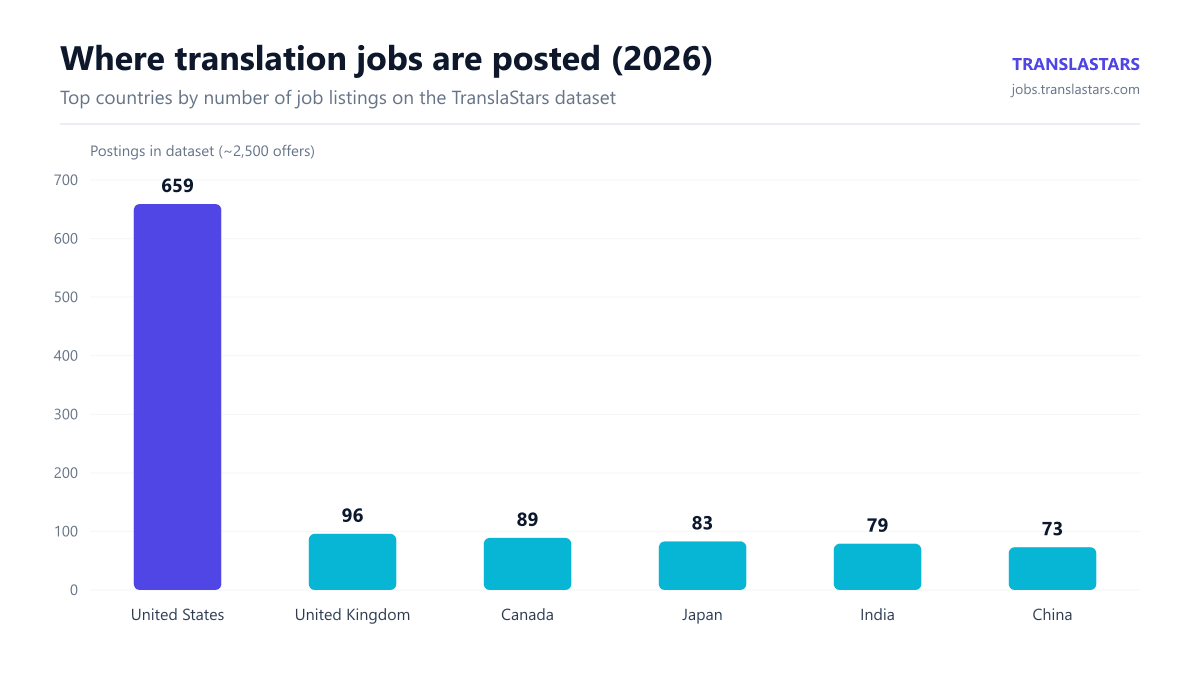
What this geography means for your rate depends on where you sit. If your pair is US-centric (any language into or out of English for American clients), you are competing in the deepest pool in the world – 659 US postings dwarf every other market. If your pair involves Japanese, Nordic or other scarce combinations, the smaller counts (83 for Japan) work in your favor: fewer postings, but also far fewer qualified bidders per posting.
Remote changes the math completely. The dataset contains 212 explicitly remote postings, and freelance roles are almost entirely remote in practice – which means global competition. A freelance post advertised by a US company can receive bids from translators on four continents, and it often does. That is the reason freelance rates compress toward a global median while in-house salaries track local cost of living. The counter-strategy is not to be cheaper than the global pool (you will lose that race to someone with a lower cost base); it is to be different from the global pool – domain expertise, direct client relationships, and proof of quality that a rate comparison cannot capture.
The lesson: if your pair is crowded, your specialization is what differentiates you. If your pair is scarce, market it loudly – you are rarer than you think. And if you work remotely, assume global competition and compete on positioning, never on price alone.
4. In-House Salaries
Salaried roles offer stability and benefits in exchange for lower per-word income. For many translators, in-house employment is the bridge that builds the specialization they later sell as freelancers: you learn a domain on someone else's payroll, with feedback, glossaries and a team around you, then take that credential to the market. 2026 reference ranges:
- In-house translator (regional agency): roughly 22-35K EUR/year depending on country.
- In-house translator (tech company): 35-60K EUR/year, higher in the US.
- Localization PM: 35-55K EUR/year.
- Localization engineer: 40-65K EUR/year.
- Senior roles and management: 60-100K+ EUR/year at scale-ups and big tech.
Those ranges describe pay per role, but the job market also tells you how many such roles exist at each seniority level. The dataset classifies postings by level, and the shape of that distribution is a career map:
| Level | Postings in Dataset | Share of the Pyramid |
|---|---|---|
| General | 1,470 | The broad base – most openings, most competition |
| Specialist | 451 | The first upgrade: domain skills pay more |
| Manager / Lead | 270 | Process and people responsibility |
| Senior | 147 | Scarce; deep experience required |
| Freelance | 58 | Contract postings, almost all remote |
| Director / Executive | 55 | Strategy-level; rare and well paid |
| Entry / Junior | 49 | Small funnel: employers want experience even for "entry" |
Three readings of that pyramid matter for your income. First, the base is enormous (1,470 generalist postings) but the paid-salary data concentrates higher up – generalist and junior posts rarely advertise numbers, while specialist, senior and managerial posts do, because those budgets are bigger and more deliberate. Second, the "entry" tier is tiny (49), which reflects a hard truth: the industry has quietly moved entry-level hiring into internships, QA roles and low-paid generalist agency work rather than titled junior positions. Third, every step up the pyramid reduces the number of competitors faster than it reduces the number of postings – climbing from General to Specialist more than triples your relative scarcity.
In-house also offers non-monetary value: benefits, training, career progression and a team. Many freelancers move in-house for a few years to build specialization, then return to freelancing with higher rates. The numbers justify the detour: if an in-house localization role teaches you a domain and a toolchain, the rate you can command on return often exceeds what five more years of generalist freelancing would have produced.

Master in AI and Innovation for Localization (Ed. IV)
The AI layer of the role: how machine translation, LLMs and automation change the way localization is planned, executed, quality-checked and measured.
5. Realistic Annual Income
Let us do the math with realistic productivity. A full-time freelancer has roughly 1,600-1,800 billable hours per year after admin, marketing, training and holidays. That assumption – not your per-word rate – is the first thing to fix, because income is rate multiplied by hours, and most freelancers overestimate available hours and underestimate unpaid work:
- General translator at 0.04 EUR/word, ~300 words/hour effective: 12 EUR/hour, roughly 20-25K EUR/year – the survival tier.
- Specialized at 0.09 EUR/word: 27 EUR/hour, roughly 45-55K EUR/year – a solid freelance income.
- Top specialist at 0.15+ EUR/word with direct clients: 45+ EUR/hour, 70-90K+ EUR/year.
- With MTPE volume and retainer clients: income becomes more predictable month to month, which matters more than the headline rate for most people's wellbeing.
Now compare those tiers against the actual paid-post median. Of the 167 offers in the dataset with published salary data, the median hourly rate is about $29/hour, and the median annualized pay is roughly $61,000/year (the hourly median annualized at 2,080 full-time hours gives $61,360). That median sits exactly where you would expect: comfortably above the commodity bottom (high-volume generalist work at agency rates) and clearly below the specialist and senior tier. Treat it as the market's honest midpoint for paid language work today.
Key number: every 0.01 EUR/word you add to your rate is roughly 5-7K EUR/year of extra income at full capacity. Rate raises are worth more than working more hours – they are the only lever that improves income and quality of life at the same time.
A warning about comparing the two income concepts. The $61K median describes posted jobs – mostly hourly roles where the employer names a figure. Freelance reality is different: your realized annual income is what survives after unpaid pitching, admin, software costs, taxes and empty weeks. A freelancer who bills $40/hour but only books 1,000 billable hours a year earns $40K, less than an in-house translator at a modest salary – and with none of the benefits. That is why the annual-income math above uses billable hours, not rates, as the anchor. When you hear "translators earn $61K", ask: in-house or freelance? Gross or net? 2,080 hours or 1,400? The same profession contains all of those answers.
What the live market shows: of the job offers active on the TranslaStars Jobs Board right now, 167 include published salary data. The median hourly rate is about $29/hour, and the median annualised pay is roughly $61,000/year. That is the real midpoint of paid language work today – above the commodity bottom (high-volume general work) and below the top (specialised or senior in-house roles). Use it to sanity-check your own rates: if your effective hourly rate is far below $29, the fix is usually positioning, not speed.
6. How to Raise Your Rates
Raising your rate is rarely one conversation; it is a sequence of positioning changes that make the new number credible. The market data points to where the leverage is: only ~7% of job offers publish a salary, which means the other 93% are negotiated in the dark – and the side with better benchmarks wins those negotiations. The six steps below are ordered roughly by leverage, from the biggest structural change to the smallest tactical one.
- 1. Pick one specialization and go deep: medical, legal, financial, subtitling, games – employers pay for the niche. In the dataset, postings that name a domain are the ones that carry salary figures and tool requirements; pure "translator wanted" posts are the ones that compete on price.
- 2. Build visible proof: a portfolio with before/after samples, client testimonials, and certifications. A rate is a claim; proof is what makes the claim believable. Translators who raise rates successfully almost always do it after assembling evidence, not before.
- 3. Move from agencies to direct clients: one direct client at translation rates equals several agency accounts. Direct clients also pay faster, complain less about style, and become repeat buyers once trust is established.
- 4. Raise rates for new clients first: then, once a year, raise rates for existing clients with a professional note. New-client prices are pure upside; existing-client increases are where most translators hesitate, which is exactly why the ones who do it annually pull ahead.
- 5. Fire the bottom 20%: the clients that pay least and demand most are holding your income down – and, less obviously, holding your reputation down, because their feedback and usage patterns train you toward their low standards.
- 6. Keep training: AI skills, subtitling, MTPE – the market pays for skills it does not have yet. Every new capability you can name on a call is a reason the client cannot simply replace you with the next bidder.
6.1. The tools that pay: what employers actually ask for
One of the most practical signals in the dataset is the frequency of tool mentions. Employers do not list tools for decoration – each mention is a skill they intend to use and, implicitly, a premium they will pay to avoid training someone. Here is what the job postings actually demand:
| Tool / Skill | Postings Mentioning It | Why It Appears |
|---|---|---|
| Excel | 114 | Quoting, terminology management, data-heavy workflows |
| TMS (generic) | 69 | Platforms like Phrase, Smartcat, Crowdin – project pipelines |
| PowerPoint | 51 | Presentation localization and transcreation |
| memoQ | 51 | CAT tool; the memoQ/Trados duopoly in agency work |
| Jira | 49 | Localization inside software development teams |
| Translation Memory | 47 | The core workflow concept behind every CAT tool |
| Trados | 45 | CAT tool; still the default in many agencies |
| Python | 41 | Automation, file handling, MT post-editing pipelines |
| Phrase | 33 | Modern cloud TMS with strong API ecosystem |
Read the table twice, because the headline is counter-intuitive: Excel is demanded more than any CAT tool. The reason is that translation work at scale is a data operation – quotes, glossaries, termbases, delivery sheets and client reports all live in spreadsheets, and a translator who can structure data (or even write a basic formula) removes work from the client's plate. memoQ and Trados (51 and 45 mentions) confirm that agency work still runs on classic CAT tools, while the TMS and Phrase mentions (69 and 33) show the cloud platform shift. Python (41) is the quiet outlier: automation skills are crossing over from localization engineering into translator roles, and a freelancer who can script repetitive tasks converts tool time into billable time – the same 0.01 EUR/word logic applied to hours.

Navigate AI to Reclaim Your Localization Career
Turn AI disruption into a rate-raising skill set: how to acknowledge the change, adapt your offer and stay valuable.
6.2. From per-word to per-hour and per-day
Every successful freelancer eventually hits the same ceiling: per-word pricing rewards speed, but your typing speed has a limit, and post-editing and review work do not fit the per-word model at all. The escape hatch is migrating your pricing structure upward, in three stages. First, quote per hour for work that resists word counts – QA, review, terminology projects, consulting – and anchor the hourly rate to your effective per-word hourly equivalent so the migration is not a pay cut. Second, move retained clients to half-day and full-day rates for batches, which smooths cash flow and stops the client from auditing every word count. Third, graduate to value-based or project pricing for direct clients: a legal translation that prevents a contract dispute is worth more than its word count, and the client knows it. None of these steps requires a dramatic confrontation; each one starts with the phrase "for this type of project, I price differently".
Courses that directly move your rate:
- Reinventing Your Localization Career – repositioning yourself as the industry shifts.
- Navigate AI to Reclaim Your Localization Career – turning AI disruption into a rate-raising skill set.
7. Rate Calculators and Resources
A few practical resources to benchmark your rates – because in a market where 93% of offers hide their numbers, the cheapest advantage is refusing to negotiate blind:
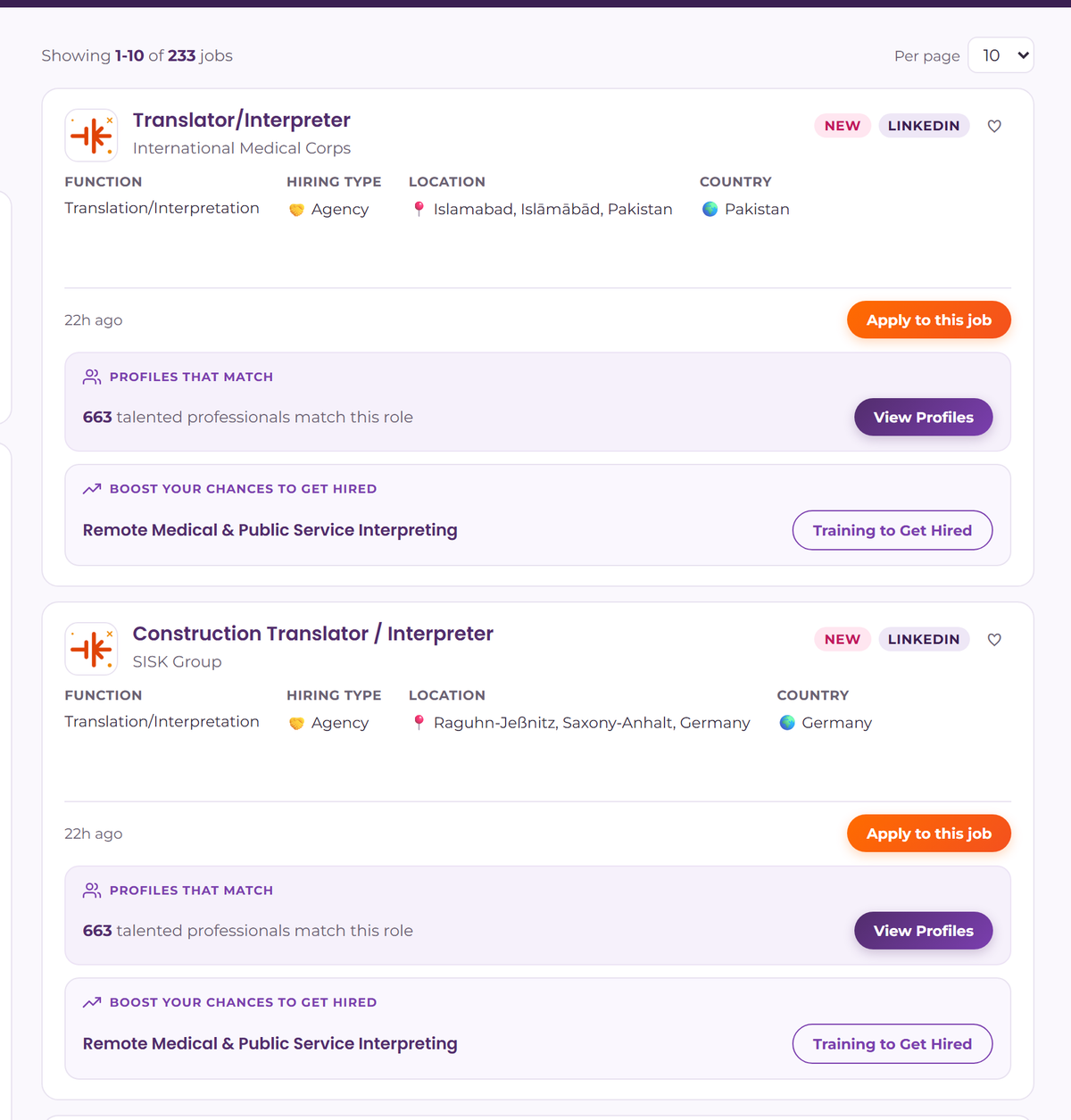
- The TranslaStars Jobs Board: real job posts show what clients pay today – filter for the offers that publish salary data and compare by country, level and function.
- Your own tracking: record your effective hourly rate (income divided by total hours worked, including admin and pitching). That single number – not your per-word rate – is the one that determines whether you are moving toward or away from the $29/hour market median.
- Professional associations: rate surveys from ATA, ITI, SFT and similar bodies give annual benchmarks by pair and specialty. They are slower-moving than a live job board but excellent for long-term trend lines.
- Course library: TranslaStars' career-focused courses cover pricing, time management, AI and career reinvention for exactly these decisions.
- Listen while you work: TranslaStars Audio interviews working professionals about rates, clients and career moves – free context for your next negotiation.

Localization Management Program (VII Edition, October 2026)
The end-to-end management program for people who want to move into leadership: strategy, project and vendor management, people, stakeholders, AI, transcreation, ROI and metrics.
Finally, build your own benchmark ritual. Once a quarter, spend twenty minutes on the job board: count the postings in your function, note the published salaries in your pair and level, and compare them with your last three months of realized income. That ritual replaces anxiety with data. The market median of roughly $29/hour and $61K/year is a snapshot, not a destiny – it is the midpoint of a distribution whose top end is built by specialization, direct clients and pricing structure. Every step in this guide moves you along that distribution. The only real mistake is not knowing where you currently sit.
Want to earn at the top of your range? Find well-paid, specialized work on the TranslaStars Jobs Board, build the skills employers pay for with TranslaStars Courses, and hear how peers negotiate on TranslaStars Audio.
Translator Rates Translation Income Freelance Translation Translation Salary Translation Career How Much Do Translators Earn TranslaStars