
Ask a localization team which AI model they use and you get a product name. Ask how they use it and the answer usually gets vague. That gap is what Miguel Sepúlveda spends two sessions on in the Master in AI and Innovation for Localization, and the choice he puts in front of a translator is not a model but a mode: co-pilot or co-thinker.
Sepúlveda is Globalization Director at King, part of Team Xbox at Microsoft, a Nimdzi researcher and the writer behind yolocalizo.com. He started in 1995 as a linguistic QA tester for Microsoft in Dublin, spent twelve years as global localization manager at Lionbridge, directed a localization studio at Enzyme and managed solutions at Electronic Arts. That sequence matters: he has watched several tool generations arrive and seen what each changed, and what it did not.
In This Article
- The Mode Comes Before the Model
- Co-Pilot: When You Can Define the Output
- Co-Thinker: When the Answer Is a Judgement
- The Same Situation Usually Needs Both
- Five Traps That Make Either Mode Useless
- CREATE: The Structure That Holds in Both Modes
- What This Changes for a Localization Professional
- Where to Go Next
- Sources and Public Style Guides
- Frequently Asked Questions
1. The mode comes before the model
The framing he uses is a change in the relationship, not in the software: tools, then assistants, then collaborators. A tool is something you operate, such as editing a document. An assistant is something you delegate to, such as requesting a draft update. A collaborator is something you develop ideas with in dialogue, such as discussing a difficult decision.
1.1. Three stages, one relationship
Most teams claim the third stage and work in the first. They open a chat window, paste a string, take the answer, and call it collaboration. The distinction matters because dialogue asks for a decision the tool metaphor never demanded: before you type, you have to know which conversation you are having.
2. Co-Pilot: when you can define the output
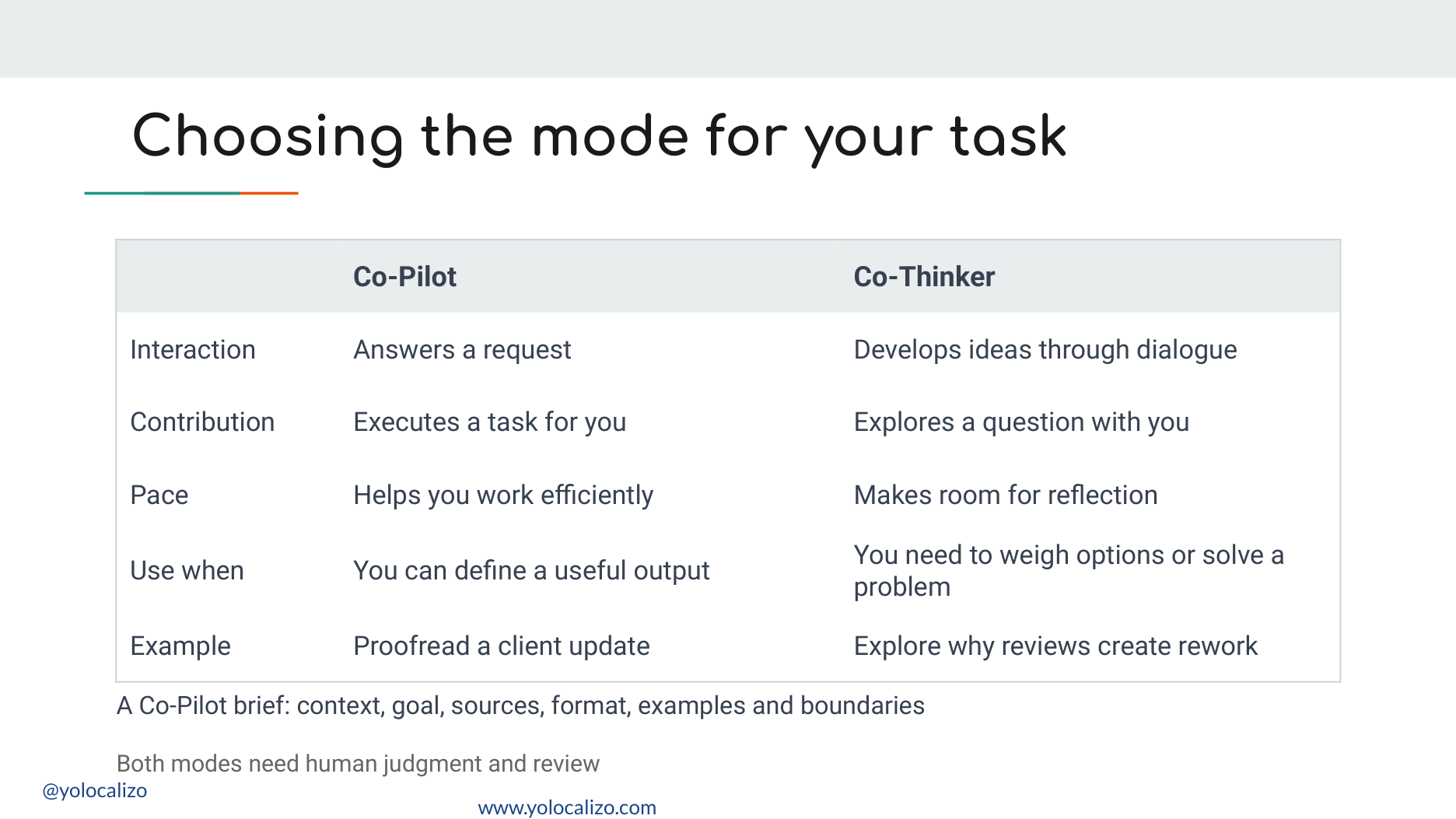
Co-Pilot is the mode for work where a useful output can be described before you start. It answers a request, executes a task, and is judged by efficiency: a usable result in less time than doing it yourself.
The example from the session is proofreading a client update. You know what a good client update looks like, and you have the source notes and the house style. The work is to specify those things so the model can execute against them instead of against its own idea of a client update.
2.1. What a brief has to carry
A Co-Pilot brief carries six elements: context, goal, sources, format, examples and boundaries. The last two are the ones teams leave out, and they decide whether the output survives contact with a real client. Examples show what good looks like in your language rather than in general. Boundaries say what may not change: no new claims, no reordered commitments, no dates that were not in the notes.
If you cannot describe the output before you start, you are not in Co-Pilot mode. You are hoping.

Master in AI, Innovation and Localization Operations
The 5th edition programme where Miguel Sepulveda sets out the co-pilot and co-thinker modes, the brief and the traps.
3. Co-Thinker: when the answer is a judgement
Co-Thinker is the mode for work where the deliverable is a judgement rather than a document. It develops ideas through dialogue, explores a question with you, and is measured differently: it makes room for reflection instead of saving minutes.
The session's example is precise: exploring why reviews create rework. No single prompt produces that answer: it depends on what you find out while asking. You arrive with a hypothesis, the model offers options and counter-arguments, and you leave with a better question than the one you brought.
3.1. The four preparation steps
The preparation differs. Sepúlveda sets out four steps. First the role: perspective, purpose and desired outcome. Then the setting: who is in the room, just you and the AI or your team as well. Then a dialogue outline: the sequence of contributions and the pauses between them. Finally the prompt, which is that plan written as full instructions.
One instruction in the session looks almost childish and changes the output more than any other: ask one question at a time and wait for my answer.
4. The same situation usually needs both
The useful part of the framework is that these are not two personalities. They are two modes for the same professional, and most real situations contain both. The session maps it onto everyday localization work:
| Situation | Co-Pilot | Co-Thinker |
|---|---|---|
| Stakeholder update | Draft the update from supplied notes | Explore how to explain a difficult decision |
| Quality review | Summarize the reported issues | Investigate why the same issues recur |
| New language | Organize the supplied market evidence | Compare investment options and assumptions |
Read down the columns and the dependency appears. The Co-Pilot task sits downstream of the Co-Thinker question. You cannot draft the explanation of a decision until you know what it costs, and you cannot summarize a pattern of issues until someone has worked out why it repeats.
5. Five traps that make either mode useless
Both modes share the same failure modes, and naming them is most of the defence. The session lists five, with the correction attached to each one: trust, fabrication, conformity, speed and solo.
| Trap | What goes wrong | A useful response |
|---|---|---|
| Trust | Accepting an answer because it sounds good | Ask for weak points and opposing views |
| Fabrication | Invented facts or sources look real | Check reliable sources or consult an expert |
| Conformity | Generic ideas miss your context | Add context and explore other options |
| Speed | Quick answers crowd out reflection | Pause and contribute your own view |
| Solo | AI replaces discussion with colleagues | Involve teammates and share the learning |
5.1. Three words to hold the line with
Three words on the same slide set the standard: conversational, experimental, responsible. Conversational, because the value lives in the exchange and not in the first answer. Experimental, because you should be testing what the system can and cannot do in your language. Responsible, because the final judgement never leaves the person who signs the work.
Trust, fabrication and conformity are not model problems. They are brief problems, and the correction in every case is to give the model something specific to be wrong about.
6. CREATE: the structure that holds in both modes
The prompting framework Sepúlveda teaches for localization work is CREATE, and each part repairs a failure that shows up in real briefs. Context sets the situation. Role gives the model a specific perspective instead of a generic one. Example shows the output you want. Assembly breaks a complex task into ordered steps. Tweaks add the constraints that matter in your market. Evaluation defines how quality gets measured.
6.1. The Role slide
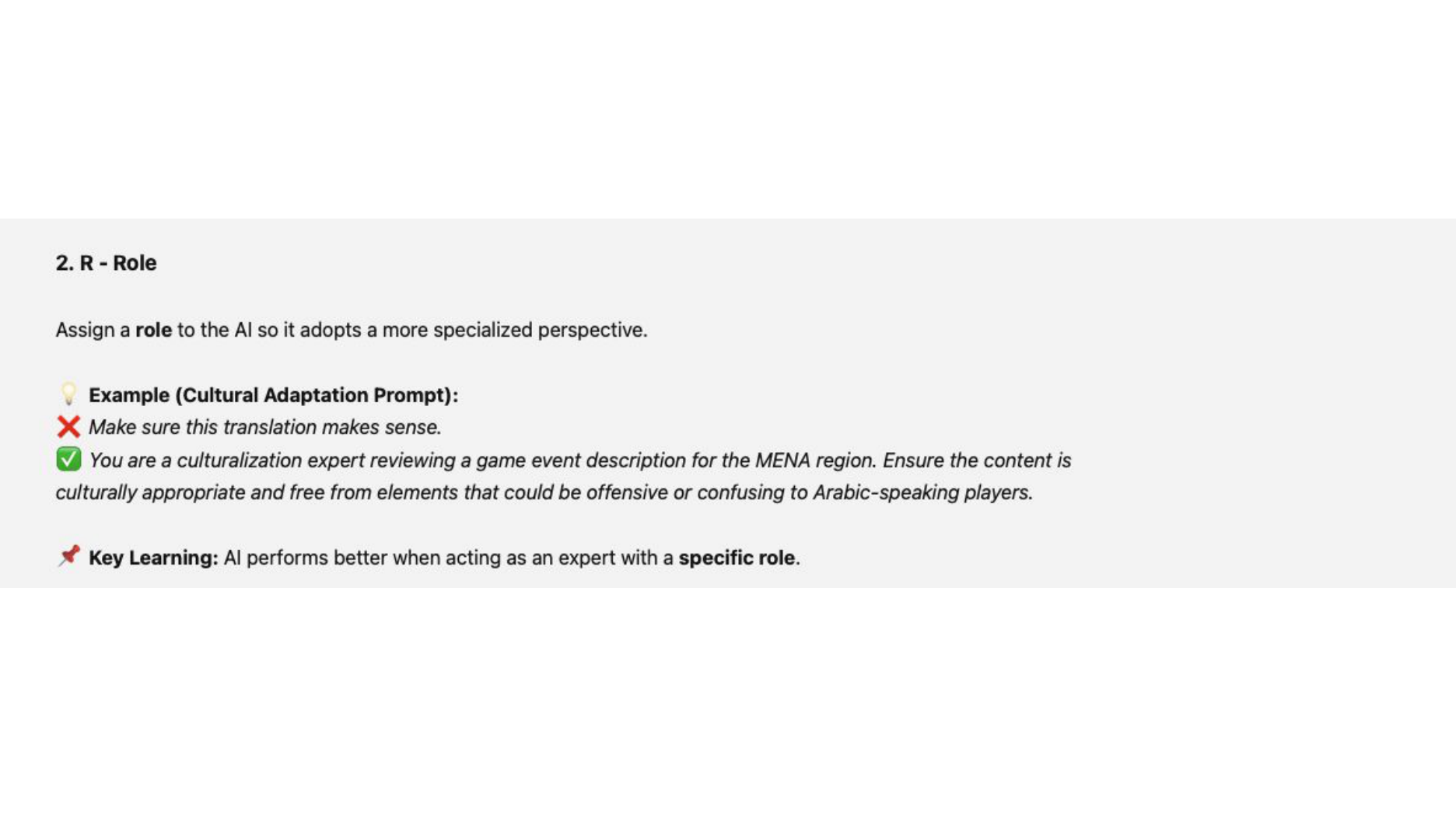
The contrast in that slide is the whole lesson. "Make sure this translation makes sense" gives the model nothing to be right about. "You are a culturalization expert reviewing a game event description for the MENA region, ensure the content is culturally appropriate and free from elements that could be offensive or confusing to Arabic-speaking players" gives it a role, a market, a risk and a criterion. The same model produces a different answer because it was finally asked a different question.
6.2. The other elements
The other elements work the same way. For style guide compliance, the session supplies a localized precedent, ¡Prepárate para una batalla épica!, so the model imitates a pattern instead of inventing a voice. For quality assurance, it becomes a reviewer with four ordered steps, including the technical limit of twenty characters per line, because UI constraints are where confident output fails quietly. For inclusive language, it asks for both a literal and an inclusive alternative rather than a single neutral rewrite that may not exist in the target language. And for evaluation, it scores a legal disclaimer from one to three and explains the score, which turns a vague "check this" into a measurement.
7. What this changes for a localization professional
The skills list in the session does not replace the old ones. Linguistic expertise and cultural competence stay at the centre; what changes is that both now have to be expressed as instructions before anyone can benefit from them.
7.1. What changes in practice
That is the practical shift. A professional who can specify context, define evaluation criteria and reject a plausible but wrong answer becomes more valuable, not less, because those are the three things a model cannot supply for itself. The professional who can only recognise a good sentence after someone else has produced it is the one whose work is now a commodity.
The two sessions also make an argument about pace. A team that only runs Co-Pilot gets faster at work it should have questioned, and a team that only runs Co-Thinker gets thoughtful answers it never ships.
Co-Pilot is where the time savings are. Co-Thinker is where the decisions are. A team that only runs the first gets faster at work it should have questioned.
8. Where to go next
The whole programme these two sessions belong to is here, with the full calendar at master-ai-localization-5.translastars.com.
If prompting is the part you want to fix first, start with the practical course; the catalogue runs from AI translation engines to agents and AI search.
All our sites, in one place:
- TranslaStars University: master's programmes and recognised courses
- TranslaStars: the main site, with every programme
- Blog: guides and market data
- Jobs Board: curated openings, deduplicated and filterable
- Talent Pool: your profile working for recruiters
This article follows sessions 22 and 23 of the Master in AI and Innovation for Localization, taught by Miguel Sepúlveda, Globalization Director at King, part of Team Xbox at Microsoft. Examples and frameworks are as presented in the session.
9. Sources and Public Style Guides
These are the sources behind this article, checked on 30 October 2026.
9.1. Course sessions used as a source
- Master in AI, Innovation and Localization Operations, 5th edition, sessions 22 and 23, given by Miguel Sepúlveda: the co-pilot and co-thinker modes, the brief, the five traps and the CREATE framework.
9.2. Programme and catalogue
- Programme site: master-ai-localization-5.translastars.com.
- Catalogue: Translation, localization and AI courses.
Frequently Asked Questions
9.1. What is the difference between co-pilot and co-thinker?
Co-Pilot executes work whose output you can describe in advance and is judged on efficiency. Co-Thinker develops a judgement through dialogue and is measured by the reflection it allows.
9.2. Can one project use both modes?
Yes. The session maps everyday localization work onto both columns, and the Co-Pilot task usually sits downstream of a Co-Thinker question, such as explaining a decision whose cost is not yet known.
9.3. What should a Co-Pilot brief contain?
Six elements: context, goal, sources, format, examples and boundaries. Examples show what good looks like in your language; boundaries state what may not change, such as claims, commitments or dates.
9.4. What does CREATE stand for?
Context, Role, Example, Assembly, Tweaks and Evaluation. Context sets the situation, Role gives a perspective, Example shows the output, Assembly orders the steps, Tweaks add constraints, Evaluation defines how quality is measured.
9.5. Why is fabrication a brief problem rather than a model problem?
Because the correction is to give the model something specific to check against: a reliable source, an expert, or an instruction to flag what it cannot verify. Trust and conformity fail the same way.