

Why is AI an imperative in localization rather than an opportunity? Because generation has become a commodity, and the business has moved to verification. That is the thesis Jourik Ciesielski builds in the opening session of the Master in AI and Innovation for Localization, and it is a more uncomfortable argument than the usual "adopt AI or fall behind", because it says the industry already had its chance and spent it badly.
The session is called The AI Imperative: Opportunity, Tension, and the Business Case for Change, and it is structured in five movements: everyone can generate, we had a head start, and we wasted it, the second chance, and what it takes. This article follows that structure, with the data and the argument as he presented them.
In This Article
1. Everyone Can Generate
The opening point is not about localization at all. It is about where the money went. In a short span, AI companies raised rounds in the hundreds of millions at valuations in the billions, and the capability behind those valuations is generation: text, image, voice, video, code. Producing a plausible sentence in a language has stopped being a technical achievement and become a button.
That has a direct consequence for anyone who sells language work. When generation costs almost nothing, the value does not disappear. It moves. It moves to knowing what is right, and to being able to prove it at scale.
The line he uses to close the block is the one worth pinning above a desk: generation is a commodity, verification is the business. When generation costs nothing, the value moves to knowing what is right.
Generation is now cheap everywhere. What is still expensive, and what nobody has industrialized, is the confidence that what was generated is right for this content, in this market, at this moment.
2. We Had a Head Start
Here the session turns to history, and it is a history that flatters nobody. Translation was the first thing AI learned to generate well, and not by accident.
- In 2016 Google replaced its phrase-based statistical system with Google Neural Machine Translation.
- In 2017 DeepL raised neural output to a level that turned machine translation into a consumer product, and in the same year the transformer architecture arrived with a paper whose title says it plainly: Attention Is All You Need.
- The transformer, the architecture underneath today's large language models, was built for translation. The task the industry owns was the first one solved.
So translation should have been the sector that understood generative AI before anyone else. Instead, the industry spent the head start arguing about whether the problem was solved. It is not, and the reasons are old:
2.1. Garbage in, garbage out
A language model is only as good as what it is fed. Trained on enormous amounts of human content, it reproduces the prejudices and stereotypes in that content. And when it lacks context, it produces confident mistranslations. The industry calls them hallucinations. In most cases they are simpler than that: the model did not know what a human linguist would have known.
2.2. No context, no verification
The model knows only what it was fed. A human linguist judges against what they know about the audience, the jargon, the purpose, the risk and the style. That difference is the whole game, because context is what you verify against. Verify without it and you are checking the wrong thing.
2.3. Translation memories are not the asset we thought
Only a small portion of everything translated on this planet passes through language professionals or sits in a translation memory. As a training resource for models, TMs are insignificant. The industry's most defended asset turned out to be too small for the fight that arrived.
The session's summary of this period is blunt: we were the first to get cheap generation, and the first to learn it isn't enough.
The AI Imperative
Opportunity, tension and the business case for change: the course this analysis comes from.
3. And We Wasted It
This is the hardest block, and the most useful. The argument is not that the industry failed to adopt technology. It is that it forced new technology into an old model, and made the model pay for it.
3.1. The translation memory is older than the problem
The translation memory architecture is more than thirty years old and essentially unchanged. It reduced translation to units, words, segments and characters, which made it possible to quote work upfront without considering complexity. It also started the gradual devaluation of the linguist's judgement and institutionalised discounts for broken translations, the fuzzy matches. In the session's words, the translation memory may be a bigger threat to the industry's progress than AI itself.
"If you have an 85 percent fuzzy match, you know upfront that you will need to correct 15 percent of that translation, and still we are offering them at discounts, which is something that I fail to understand. My conclusion is that the translation memory is perhaps a bigger threat to our industry's progress than AI. And I am not talking about the translation memory as a technology. I am talking about our way of implementing, leveraging the translation memory as the beating heart of everything."
Jourik Ciesielski, opening session
3.2. The neural MT failure
When neural machine translation arrived, the industry was not ready for a technology that powerful, and it made linguists pay the price, literally. The main weaknesses, context and consistency, were amplified by the single-sentence paradigm that the whole workflow was built around. Shiny MT departments appeared without real transformation. The promise of more, better, faster and cheaper was an illusion, and some very promising companies went down believing it.
3.3. Legacy processes and the connectivity problem
The typical localization process is still linear and static, with manual triggers, emails, documents and the familiar chain of multi-language vendor, single-language vendor and freelancer. It feeds the perception that human translation is clunky and expensive, and it invites buyers to experiment with AI on their own. Meanwhile the TMS market was caught by surprise: many LLM features arrived with low business impact, the connectivity problem was never solved, and support for multimodal sources such as images, speech and video stayed thin.
3.4. Where the money still goes
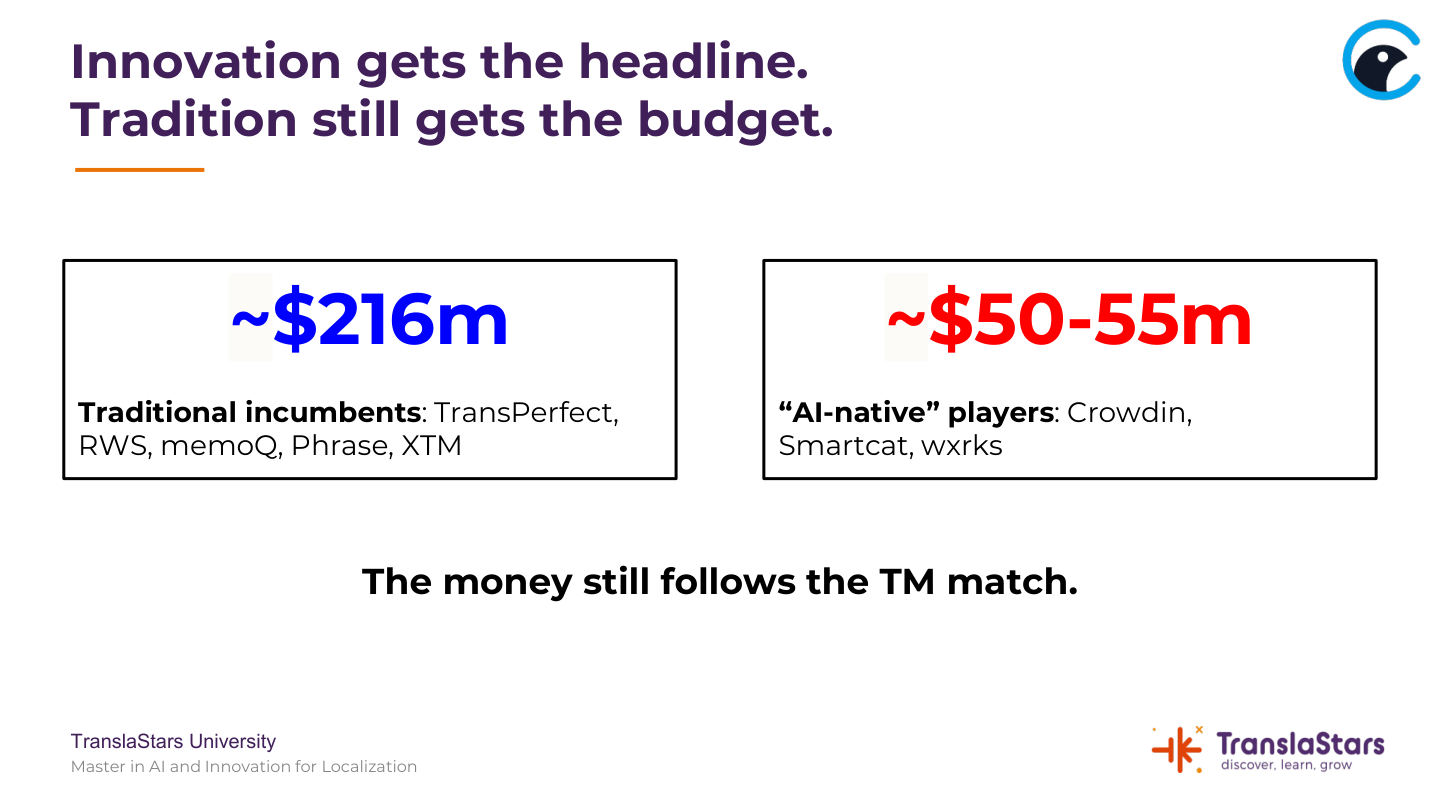
One slide makes the point better than any argument. Traditional incumbents, the names everyone knows, account for roughly 216 million dollars, while the so-called AI-native players account for roughly 50 to 55 million. Innovation gets the headline. Tradition still gets the budget. The money still follows the TM match.
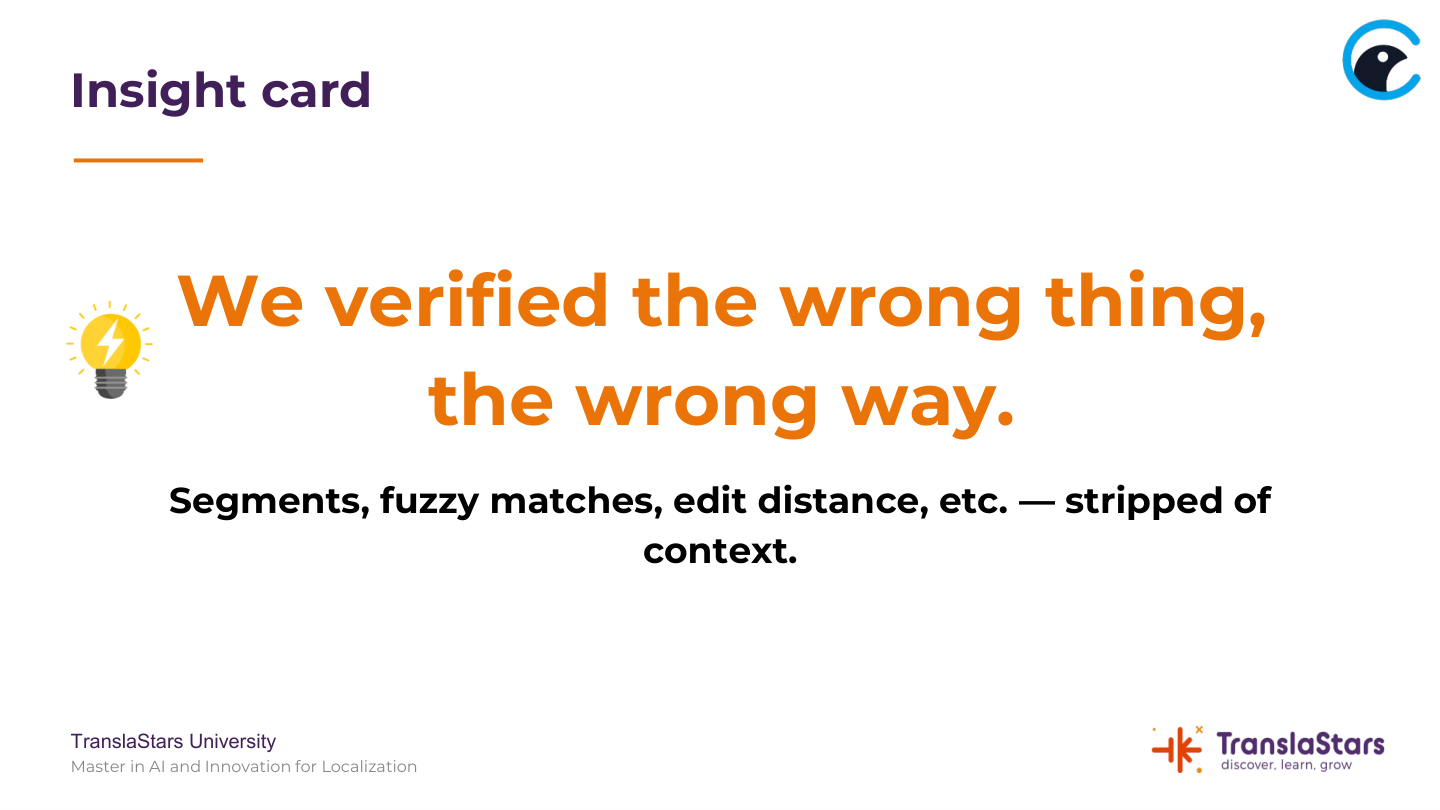
Which leads to the block's closing insight, the seed of everything that follows: we verified the wrong thing, the wrong way. Segments, fuzzy matches and edit distance, all stripped of context.
The translation memory may be a bigger threat to the progress of this industry than AI itself, and the threat is not the technology: it is having made it the heart of everything.
4. The Second Chance
Large language models bring exactly what neural MT lacked: context from legacy translations, legislation and research; instructions about audience, style, terminology and business rules; and modalities across text, speech, image and video, in and out. That is what makes context-aware machine translation possible, and it is genuinely new rather than a better version of what came before.
But the same abundance is a trap. When output is fluent and confident, checking it becomes harder, not easier, because the surface no longer tells you where the problems are. Hence the second insight: LLMs make generation abundant and convincing, and that makes verification harder, and worth more.
5. What It Takes: The New Business Case
The last block is where the session stops diagnosing and starts pricing, and it opens with a question rather than an answer: what does it take, as an industry, to build a business case that creates a good future for everyone involved, and not just a cheaper quarter?
"What does it take for us as an industry to come up with a new business case to really create the foundation for a good future for our industry and for all our stakeholders?"
Jourik Ciesielski, opening session
5.1. The demand nobody serves
Less than one percent of all content is translated, and only into a handful of markets. That is not a ceiling set by interest. It is what companies can afford to translate with today's legacy technology and processes.
All content produced worldwide
99% never translated
Less than 1% translated, into a handful of markets Source: opening session, 5 October 2026
Which produces the counter-intuitive conclusion: making translation more efficient does not reduce demand, it reveals how much demand was never served.
The examples he uses are consumer-facing rather than industrial. A celebrity chef tripled the views on his channel by publishing in other languages. A video creator runs more than thirty language versions of an average video. Another built tens of millions of followers through dubbed channels. Content that speaks the audience's language performs differently, and that is the business case for translating what was never worth translating before.
5.2. Quality is how content performs, not a score
If demand is the opportunity, quality is the constraint, and the session reframes it as a business decision rather than a linguistic one. A high-traffic page that drives sales deserves a skilled linguist. Raw machine output on the low-traffic rest can deliver the same business quality, because the stakes are different. A Black Friday sprint is not a bigger summer release: it is a different quality regime, with more at stake per word and a temporary tolerance. Uber's decision to add translation to its platform so drivers and passengers can talk to each other is the same logic: fit for purpose, not uniform perfection.
5.3. Everyone is doing verification
The market has noticed where the value sits. Vendors are converging on quality evaluation with humans in the loop, under one roof: MQM-based evaluation with a CAT-style editor on one side, acquisitions of AI evaluation assets such as COMET on the other. Different strategies, same scarce asset, which is trust. And trust pays: one vendor is reported at around 130 million dollars in revenue with roughly thirty percent organic growth, and OpenAI centralised its localization programme with another.
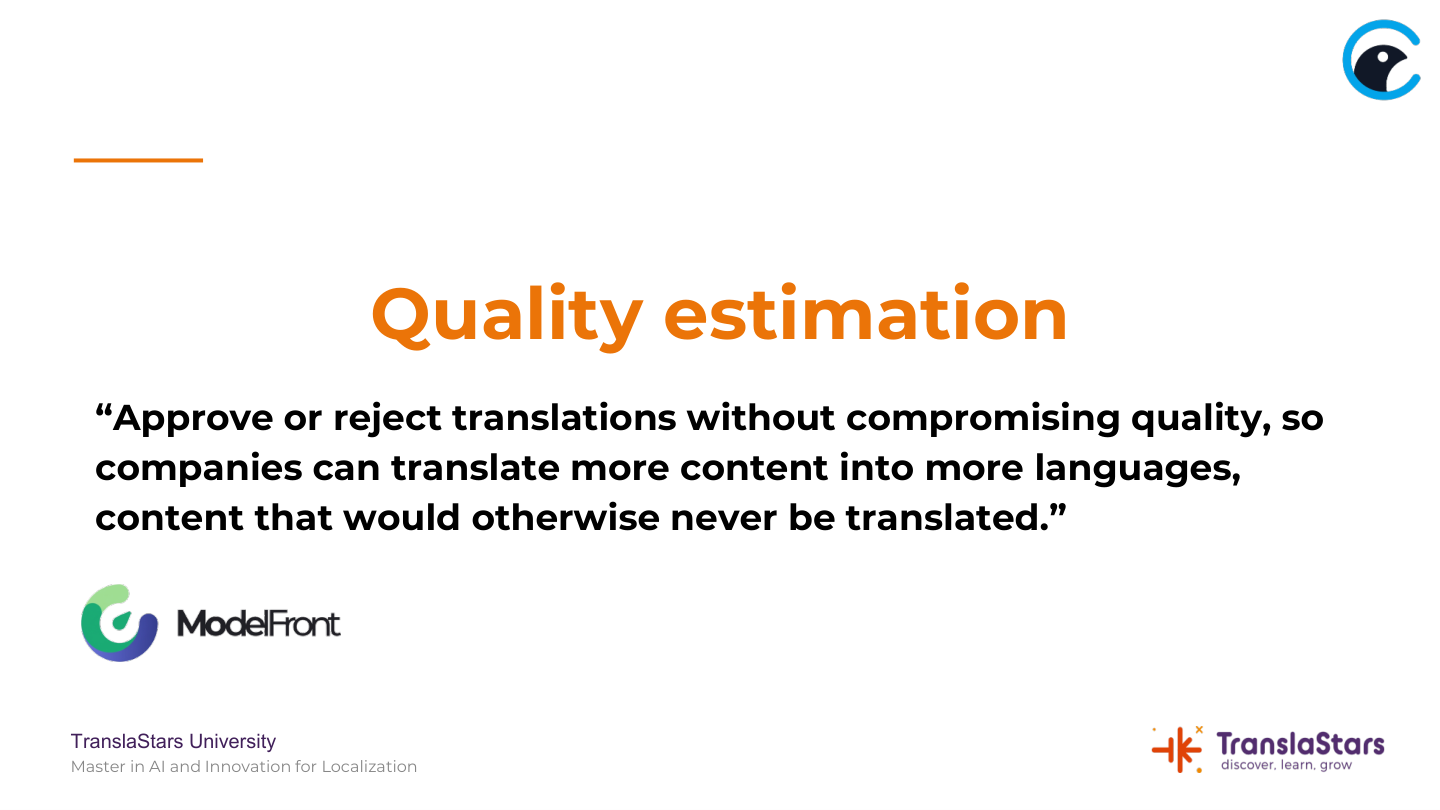
The bottleneck is stated plainly: the bottleneck isn't generation, it's trust at scale.
"Getting people to trust AI blindly and at scale, that is something different. Generation is a commodity. The true business is verification. When generation costs nothing, verification is the true business."
Jourik Ciesielski, opening session
And there is a statistic that should worry anyone selling quality estimation as a solved problem: if you asked a hundred buyer-side localization teams whether they are successfully using quality estimation to skip humans, you would find zero or one.
5.4. The two business cases, side by side
Read together, the session is an argument for replacing one business model with another, not for adding AI to the existing one. This is the difference in a single table:
| Dimension | The old business case | The new business case |
|---|---|---|
| Unit of work | The word, the segment, the character, the line | Context, purpose and consequence of being wrong |
| What is sold | Capacity: more words at a lower unit price | Verification: a defensible judgement on what is good enough |
| Quality proxy | Fuzzy match percentage and edit distance | Fitness for purpose, measured against the content's job |
| Pricing logic | Discounts that grow with the match, including on broken text | Price tiers by risk, traffic and consequence |
| Growth logic | Squeeze cost out of the content already translated | Reach the demand that legacy economics never served |
| Who decides | The pipeline, by default | A linguist or an evaluator, on purpose |
The demand is not the problem. Less than one percent of content is translated. The problem is that legacy economics cannot serve the other ninety-nine at any price that works.
6. What This Means If You Work in Localization
Three practical readings, all of them following from the session rather than replacing it:
- Stop selling generation. It is priced like a commodity because it is one. Sell the verification layer: terminology, context, evaluation criteria and the judgement that says what is good enough for this content, in this market, at this moment.
- Fix the unit of work. The single-sentence paradigm is where context went to die. If your pipeline still treats a segment as the atom of quality, no model will save the output.
- Price quality by consequence. The 30/70 split between high-traffic and long-tail content is not a compromise, it is a portfolio decision. Teams that cannot articulate it end up applying premium review to content nobody reads and raw output to the pages that pay the bills.
7. Conclusion
The argument of the session reduces to one sentence: generation has been solved and verification has not. When a plausible sentence costs almost nothing, the value moves to the judgement that decides whether that sentence should be published, in which market, and with what consequence if it is wrong. That judgement is not a layer added at the end of the pipeline. It is the product.
The uncomfortable half is the second one. Localization had a head start because it already owned the verification step, and it spent the advantage on unit economics instead: segments, fuzzy matches and edit distance. A thirty-year-old translation memory architecture was promoted from tool to strategy, and the numbers describing it were mistaken for quality. The second chance is not a recovery of that position. It is a decision to sell fit for purpose, priced by consequence, with the 30/70 split between high-traffic and long-tail content treated as a portfolio rather than a compromise.
Read that way, the imperative is not a threat to the profession. It is the argument the profession has never made properly: someone has to be accountable for the output, and that accountability is what a client is buying.
8. Where to Go Next
If you want the foundations first, the same session also exists as a free course, with the same framing and no cost: The AI Imperative: Opportunity, Tension, and the Business Case for Change.
If you are the person who has to build the case, run the pilot and defend it in front of a client or a board, that is the work of the Master in AI, Innovation and Localization Operations, and this session opens the programme. The fifth edition is here, with the full programme calendar at master-ai-localization-5.translastars.com.

If you want to see where this fits next to the rest of the catalogue, from AI translation engines to agents, prompting and AI search, the full list of courses is here: translation, localization and AI courses.
All our sites, in one place:
- TranslaStars University: master's programmes and recognised courses
- TranslaStars: the main site, with every programme
- Blog: guides and market data
- Jobs Board: curated openings, deduplicated and filterable
- Talent Pool: your profile working for recruiters
This article follows the opening session of the Master in AI and Innovation for Localization, taught by Jourik Ciesielski, CTO at ELAN Languages and founder of C-Jay International. Figures and examples are as presented in the session.
9. Sources and Public Style Guides
These are the sources behind this article, checked on 30 October 2026.
9.1. Course sessions used as a source
- The AI Imperative: Opportunity, Tension, and the Business Case for Change, the opening session of the programme, taught by Jourik Ciesielski.
9.2. Programme and catalogue
- Master in AI, Innovation and Localization Operations, Edition V, the programme the session opens.
- master-ai-localization-5.translastars.com, the programme site with the full calendar.
- Translation, localization and AI courses, the full catalogue.
Frequently Asked Questions
9.1. Is AI really an imperative in localization, or just an opportunity?
It is an imperative because generation has become a commodity. When anyone can produce fluent text at almost no cost, the value moves to knowing what is right and proving it at scale, which is verification. An opportunity can be declined; an imperative changes what the business is selling.
9.2. Why does the article call the translation memory a bigger threat than AI?
Because the threat is not the technology but the way it is used. The architecture is more than thirty years old and reduces translation to units, words, segments and characters, which institutionalised discounts for fuzzy matches and devalued the linguist's judgement. Making it the heart of everything is what the session criticises.
9.3. What does "we verified the wrong thing, the wrong way" mean?
It means the industry measured what was easy to count, such as segments, fuzzy matches and edit distance, and treated those numbers as quality. All of them are stripped of context, so verification never answered whether the output is right for this content, in this market, at this moment.
9.4. If less than one percent of content is translated, does efficiency not reduce demand?
No. The conclusion is the opposite: making translation more efficient reveals how much demand was never served. The one percent is not a ceiling set by interest, it is what companies can afford with legacy technology and processes, so cheaper production opens markets instead of shrinking the existing one.
9.5. What is quality estimation, and why is trust the bottleneck?
Quality estimation is the promise of approving or rejecting translations without compromising quality, so companies can translate more content into more languages. The bottleneck is not generation, which is cheap, but trust at scale: if you asked a hundred buyer-side localization teams whether they successfully use quality estimation to skip humans, you would find zero or one.